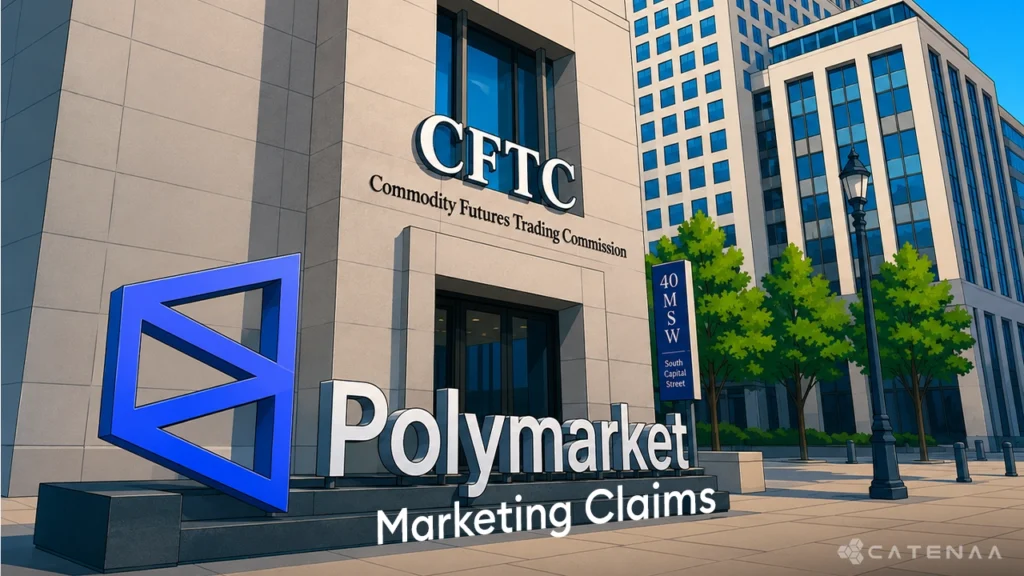


Catenaa, Sunday, July 05, 2026- Bipartisan lawmakers have called on the US Commodity Futures Trading Commission (CFTC) to explain how it is overseeing prediction markets after allegations that cryptocurrency-based platform Polymarket used staged betting activity in marketing campaigns to attract users.
In a letter to CFTC Chairman Michael Selig, Senators Adam Schiff of California and John Curtis of Utah requested detailed information on whether the regulator is investigating recent allegations involving Polymarket and whether it possesses sufficient authority and expertise to protect consumers participating in event-based trading markets.
The inquiry follows media reports alleging that promotional content featured approximately $1.9 million in simulated wagers designed to create the appearance of genuine market activity.
The senators requested responses to six questions covering the CFTC’s enforcement approach, ongoing investigations and consumer protection framework for prediction markets.
The lawmakers argued that the agency has consistently asserted jurisdiction over event contracts and prediction markets through enforcement actions and regulatory oversight.
They expressed concern that aggressive social media promotion portraying prediction markets as an easy way to make money could blur the distinction between regulated financial products and gambling.
The senators asked the CFTC to respond by July 10.
Prediction markets have attracted increasing attention from regulators over the past year as trading volumes and public participation continue to expand.
Several US states have questioned whether certain event contracts resemble unauthorized gambling activities, while federal regulators continue evaluating how existing commodities laws apply to the rapidly growing sector.
The latest allegations add to previous concerns surrounding market integrity, insider trading risks and promotional practices across prediction market platforms.
Polymarket has said it will conduct a comprehensive review of its promotional materials following the allegations.
The Wall Street Journal has separately reported that the CFTC is conducting an extensive investigation involving Polymarket, although the precise scope of that inquiry has not been publicly confirmed.
It remains unclear whether the reported investigation specifically includes the alleged advertising practices highlighted by lawmakers.
The CFTC has not publicly disclosed details regarding any ongoing enforcement activity related to the platform.
As an independent federal regulator, the agency generally does not comment on active investigations.
The senators argued that influencer marketing, social media promotion and claims of easy profits may create unrealistic expectations among retail participants.
They questioned whether current regulatory safeguards adequately protect consumers participating in event contracts that increasingly resemble traditional sports betting or wagering activities.
The inquiry also reflects broader concerns over transparency within rapidly expanding digital trading platforms where financial products intersect with entertainment and online communities.
Analysts say stronger disclosure standards and marketing oversight could become increasingly important as prediction markets continue attracting mainstream users.
The outcome of the congressional inquiry could influence future regulatory policy toward prediction markets and event contracts.
If lawmakers conclude that existing oversight is insufficient, the CFTC could face additional pressure to strengthen enforcement, update marketing guidance or seek expanded authority from Congress.
For the cryptocurrency industry, the debate highlights the continuing evolution of digital asset regulation beyond traditional cryptocurrencies into emerging financial products built on blockchain infrastructure.
As prediction markets gain popularity, regulators are increasingly balancing innovation with consumer protection and market integrity.
Prediction markets allow users to buy and sell contracts based on the outcome of future events, including elections, sports, economic indicators and public policy decisions. Many platforms use blockchain technology to facilitate decentralized trading and transparent settlement. The CFTC has increasingly asserted jurisdiction over event contracts that qualify as derivatives under US commodities law, while state regulators have separately examined whether certain prediction markets resemble gambling operations. The sector has become a growing focus of policymakers as trading volumes and retail participation continue to expand.