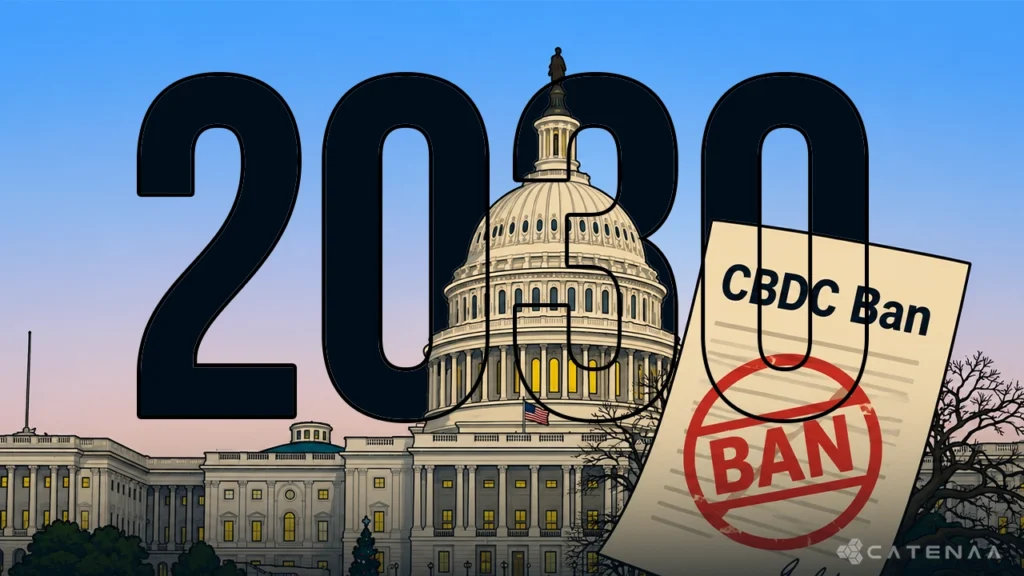


Catenaa, Monday, June 22, 2026- US lawmakers have reached a bipartisan agreement on a sweeping housing reform package that includes a temporary ban on the creation of a US central bank digital currency, marking one of the strongest legislative moves yet against a digital dollar.
The updated “21st Century ROAD to Housing Act” was unveiled jointly by Senate Banking Committee Chairman Tim Scott, Senator Elizabeth Warren, House Financial Services Chairman French Hill and Ranking Member Maxine Waters after months of negotiations between the Senate and House of Representatives.
While primarily focused on housing affordability and increasing housing supply, the legislation contains a provision prohibiting the Federal Reserve from issuing or creating a central bank digital currency, or any substantially similar digital asset, until Dec. 31, 2030.
The inclusion of the anti-CBDC provision highlights growing political resistance in Washington toward a government-issued digital dollar.
Republican lawmakers have repeatedly argued that a CBDC could increase government surveillance over financial transactions and threaten consumer privacy. The provision reflects a broader policy shift under the Trump administration, which has consistently opposed the development of a US central bank digital currency.
Treasury Secretary Scott Bessent recently reiterated that a CBDC remains “off the table,” while emphasizing the administration’s focus on broader digital asset legislation, including the CLARITY Act and stablecoin regulations.
The legislation’s primary objective remains addressing America’s housing affordability crisis.
Lawmakers say the package is designed to increase housing supply, reduce regulatory barriers, support homeownership and limit excessive concentration by large corporate landlords.
A compromise provision introducing a three-year sunset clause for a disaster relief program helped bridge differences between House and Senate negotiators and secure broader bipartisan support.
Although unrelated to housing policy, the CBDC ban carries major implications for the digital asset sector.
The measure effectively removes uncertainty surrounding the potential launch of a US digital dollar for the next four years. Industry participants have largely favored privately issued stablecoins over a government-controlled digital currency.
The move may further strengthen the position of dollar-backed stablecoins operating under the recently enacted GENIUS Act framework, which established federal rules for stablecoin issuers.
The bill is now expected to move through procedural votes in the Senate before advancing to the House for final consideration after lawmakers return from recess later this month.
If approved by both chambers, the legislation would proceed to President Donald Trump for final signature.
The housing bill demonstrates how digital asset policy is increasingly being incorporated into broader legislative negotiations in Washington.
While the CLARITY Act faces delays in the Senate, lawmakers continue advancing crypto-related provisions through alternative legislative vehicles.
The temporary CBDC prohibition also sends a strong signal to global markets that the United States currently favors private-sector digital asset innovation and regulated stablecoins over a central bank-issued digital currency.
Central bank digital currencies have become a major focus for governments worldwide, with China, the European Union and several emerging economies advancing digital currency initiatives. The United States has taken a more cautious approach. Critics argue CBDCs could create privacy concerns and expand government oversight of financial transactions, while supporters say they could modernize payments and strengthen monetary policy transmission. The latest congressional action represents the clearest legislative effort yet to prevent a US digital dollar from emerging during the remainder of the decade.