

Catenaa, Wednesday, May 20, 2026- US President Donald Trump ordered the Federal Reserve to review whether crypto companies and fintech firms should gain direct access to America’s core payment infrastructure, escalating a major policy debate over how digital asset companies connect with the traditional financial system.
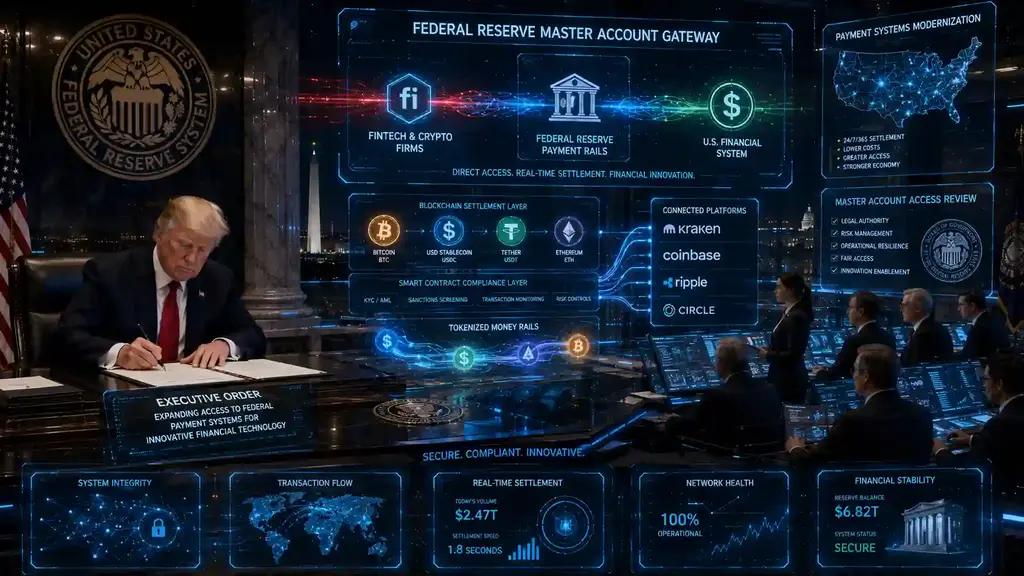
Trump signed an executive order Tuesday directing federal agencies to remove regulations considered overly restrictive toward financial technology innovation and blockchain-based payment services.
The order specifically instructed the Federal Reserve to examine its rules governing access to Reserve Bank payment accounts and settlement services, often referred to as “master accounts.”
Such access would allow crypto firms to connect directly to US payment rails without relying on intermediary commercial banks.
Master Account Debate
Under existing law, Federal Reserve Banks generally grant payment access only to licensed depository institutions.
That restriction has pushed several crypto companies to seek specialized banking charters and alternative regulatory pathways.
The executive order directed the Fed to determine whether regional Federal Reserve banks possess independent authority to approve or deny payment account access.
The administration also requested a full report within 120 days examining whether fintech and blockchain firms should receive expanded access to Fed payment systems.
The move represents one of the clearest signals yet that the Trump administration intends to integrate digital asset infrastructure more directly into the US financial system.
Crypto Access Push
The debate intensified earlier this year after the Federal Reserve Bank of Kansas City approved a limited-purpose master account for Kraken parent company Payward.
The arrangement gave Kraken access to high-value dollar settlement systems used inside core US banking infrastructure.
The approval potentially allows faster deposits, withdrawals and institutional settlement services for crypto clients.
Arjun Sethi, co-CEO of Kraken, described the approval as a convergence between crypto infrastructure and sovereign financial rails.
Still, the arrangement imposed restrictions including no access to interest on reserves held at the Fed.
Traditional banking groups reacted sharply against the decision.
Bank Policy Institute warned the Fed moved too quickly before finalizing broader rules governing limited-purpose or “skinny” master accounts.
Critics argued granting direct Fed access to crypto firms could weaken banking safeguards and introduce systemic risks into payment systems.
The Federal Reserve has already proposed broader frameworks for restricted master accounts that would allow payment system participation while limiting access to central bank borrowing facilities and reserve interest payments.
The proposals remain under review.
The executive order also aligns with growing political efforts in Congress to modernize payment access rules.
Last month, Representatives Sam Liccardo and Young Kim introduced the Payments Access and Consumer Efficiency Act, commonly known as the PACE Act.
The legislation seeks to permit certain fintech and payment firms to access Federal Reserve services directly under regulated conditions.
Crypto industry groups strongly backed the bill, arguing current banking restrictions disadvantage blockchain-based financial firms.
Supporters of broader Fed access say direct connectivity could improve settlement speed, reduce costs and strengthen payment efficiency for digital asset companies.
Crypto firms increasingly argue blockchain infrastructure can operate as regulated financial plumbing rather than merely speculative trading systems.
The issue also reflects broader competition between traditional banks and fintech firms over control of future payment infrastructure.
Stablecoins, tokenized deposits and blockchain settlement systems are increasingly viewed as potential alternatives to legacy banking rails.
At the same time, regulators continue debating how to balance innovation with financial stability and anti-money laundering protections.
Analysts said the Federal Reserve’s response to Trump’s order may shape the future relationship between crypto markets and the US banking system for years.