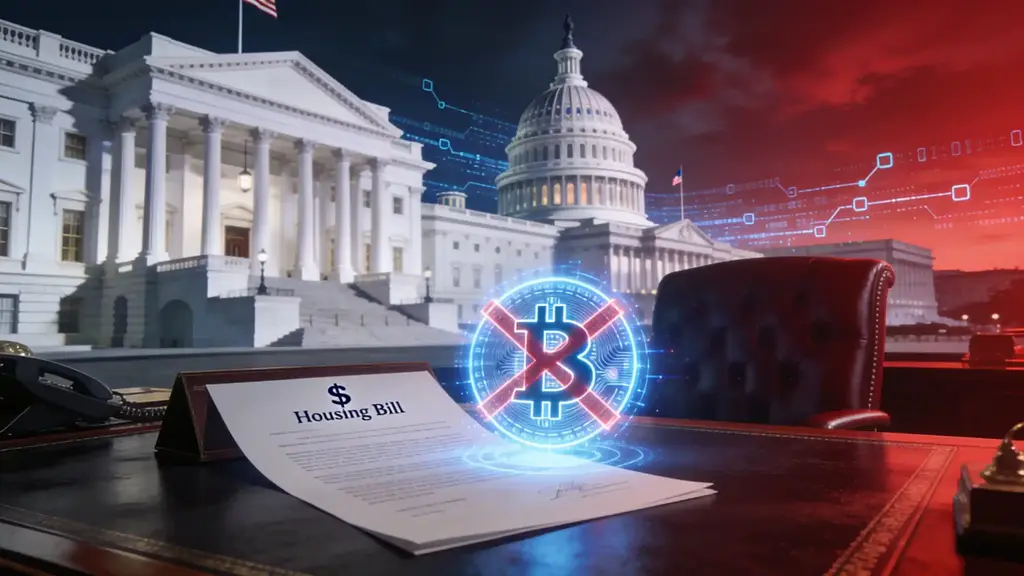


Catenaa, Thursday, July 02, 2026- US President Donald Trump has approximately eight days remaining to decide whether to sign into law the 21st Century ROAD to Housing Act, a bipartisan housing package that includes a temporary prohibition on the Federal Reserve issuing a US central bank digital currency (CBDC).
The legislation, which has already cleared both chambers of Congress, was formally delivered to Trump’s desk after receiving broad bipartisan support. Under the US Constitution, the president has 10 days, excluding Sundays, to sign, veto or allow the bill to become law without his signature.
If enacted, the measure would prohibit the Federal Reserve from issuing or creating a CBDC, or any digital asset deemed substantially similar, until Dec. 31, 2030.
Although primarily focused on housing affordability and increasing housing supply, the legislation also incorporates one of the most significant federal restrictions on a potential US digital dollar.
The CBDC provision reflects growing Republican concerns that a government-issued digital currency could expand financial surveillance and reduce consumer privacy.
The temporary ban aligns with the Trump administration’s broader opposition to a Federal Reserve-issued digital dollar.
Trump postponed a planned signing ceremony after urging congressional Republicans to first pass the SAVE America Act, legislation requiring proof of US citizenship for federal voter registration.
Calling the housing legislation “a yawn,” Trump suggested that election legislation should take priority before other measures receive presidential approval.
Despite the delay, the housing bill retains strong bipartisan backing.
Democratic Sen. Elizabeth Warren, a sponsor of the legislation, urged Trump to sign the measure, arguing that Congress had already reached bipartisan agreement on a package addressing housing affordability.
Supporters say the bill represents one of the most significant bipartisan housing reforms in recent years while also settling the immediate debate over a US CBDC.
The housing legislation arrives as Congress prepares to resume debate on broader digital asset regulation.
When lawmakers return to Washington in mid-July, attention is expected to shift to the Digital Asset Market Clarity (CLARITY) Act, which would establish a comprehensive federal framework governing cryptocurrencies and divide oversight between the Securities and Exchange Commission and the Commodity Futures Trading Commission.
Trump has previously indicated support for advancing crypto market legislation while maintaining opposition to a government-issued digital dollar.
If Trump signs the housing bill, the United States would formally suspend development of a Federal Reserve CBDC until the end of the decade, providing greater regulatory certainty for private stablecoin issuers and the broader digital asset industry.
A veto would reopen congressional debate, though lawmakers could override presidential opposition with a two-thirds majority in both the House and Senate.
Debate over a US CBDC has intensified as many central banks worldwide continue exploring sovereign digital currencies. Critics argue a digital dollar could enable excessive government oversight of financial transactions, while supporters contend it could modernize payments and strengthen the dollar’s global role. The temporary ban would pause any Federal Reserve CBDC initiative until at least 2031, reinforcing the US government’s current preference for privately issued, regulated digital payment solutions.