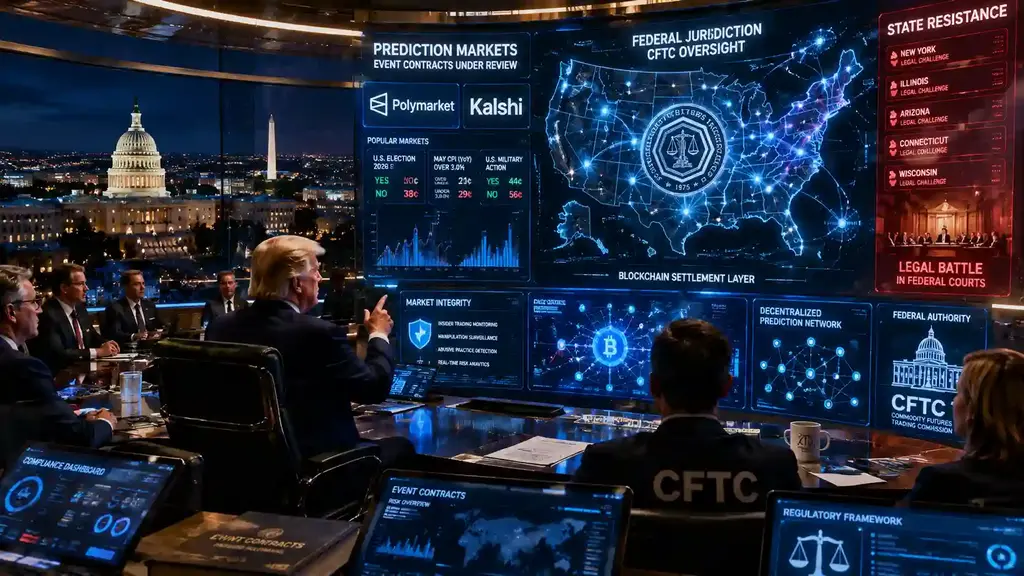


Catenaa, Wednesday, May 27, 2026- The White House has begun reviewing new federal rules for prediction markets as President Donald Trump publicly backed the Commodity Futures Trading Commission’s (CFTC) authority over the rapidly expanding industry, intensifying a growing legal battle between federal regulators and US states.
The White House Office of Information and Regulatory Affairs confirmed Tuesday that it had received the CFTC’s proposed event-contract rulemaking package for formal review under the federal interagency process.
The move comes as prediction market platforms such as Kalshi and Polymarket face mounting scrutiny over sports betting, election wagering and contracts tied to geopolitical events.
Prediction markets allow traders to speculate on the outcomes of future events including elections, inflation data, military actions and sports results.
Over the past year, the CFTC has increasingly argued that such markets fall under federal derivatives law rather than state gambling regulations.
In March, the agency released guidance requiring exchanges listing event contracts to monitor manipulation risks, abusive trading activity and insider information.
The issue has since evolved into a major legal confrontation between federal regulators and state governments.
Several states including Illinois, Arizona, Wisconsin, Connecticut and New York have attempted to restrict or investigate prediction market platforms, arguing that many contracts resemble unauthorized gambling products under local law.
The CFTC, led by Chair Michael Selig, has sued multiple states while asserting what it describes as “exclusive jurisdiction” over prediction markets.
Trump’s direct intervention raises the political stakes surrounding prediction market regulation ahead of the 2026 midterm election cycle.
The president publicly defended the CFTC’s authority Tuesday while attacking several Democratic political figures involved in state-level resistance against prediction platforms.
The issue also carries conflict-of-interest concerns because Donald Trump Jr. invested in Polymarket through venture capital firm 1789 Capital and separately serves as a strategic adviser to Kalshi.
Critics argue that expanding federal protections for prediction markets could financially benefit Trump-linked business interests while weakening state oversight powers.
At the same time, supporters of federal regulation say fragmented state restrictions could damage innovation and create inconsistent market rules across the country.
Washington policy analysts said the White House review marks an important step toward creating a clearer national framework for prediction markets.
However, legal experts noted that the deeper constitutional dispute over whether prediction markets represent financial derivatives or gambling products will ultimately be decided by federal courts rather than regulators alone.
Market observers also warned that insider trading concerns surrounding political and military event contracts may intensify pressure for tighter oversight regardless of which agency prevails.
Several analysts expect prediction markets to remain a major political and regulatory issue as blockchain-based event trading platforms continue growing globally.
The federal push to centralize oversight of prediction markets reflects a broader struggle over how digital financial platforms should be regulated in the United States.
As blockchain infrastructure increasingly merges with betting-style financial products, regulators, courts and lawmakers face mounting pressure to define the legal boundaries between derivatives trading, gambling and political speculation.
The White House review may shape the next phase of that battle, but the final outcome will likely emerge through years of litigation and congressional debate.
Prediction markets have expanded rapidly since the 2024 US election cycle, when blockchain-based event trading platforms attracted millions of retail users and billions of dollars in trading activity.
Kalshi operates under CFTC oversight inside the United States, while Polymarket largely serves offshore markets through decentralized crypto infrastructure.
The industry has faced growing controversy over contracts tied to elections, assassinations, wars and economic releases, with critics warning such products could encourage manipulation or insider trading.
Federal regulators meanwhile increasingly view prediction markets as part of the broader derivatives ecosystem rather than traditional gambling platforms.
The legal uncertainty surrounding event contracts has become one of the most contested issues in digital finance as crypto infrastructure expands deeper into political, economic and speculative trading markets.




