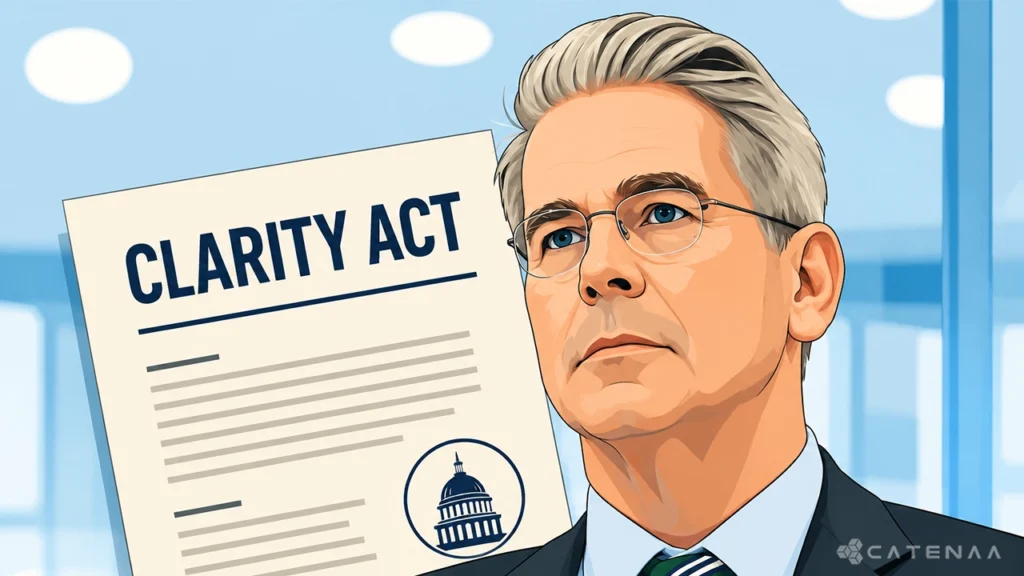


Catenaa, Thursday, June 11, 2026-US Treasury Secretary Scott Bessent told lawmakers Wednesday that the Trump administration is accelerating work on a national Strategic Bitcoin Reserve while expecting the Digital Asset Market CLARITY Act to reach President Donald Trump’s desk later this summer.
Speaking before the Senate Finance Committee during a hearing on the Treasury Department’s fiscal year 2027 budget request, Bessent said officials were moving forward rapidly on implementing the administration’s digital asset agenda, including plans announced through a 2025 executive order establishing a Strategic Bitcoin Reserve and broader digital asset stockpile.
The comments represent one of the clearest signals yet that the administration intends to make digital asset policy a central component of its financial and economic strategy.
Bessent described the reserve initiative as a complex undertaking involving new technology, custody systems and long-term governance structures designed to ensure durability for future administrations.
The United States currently controls approximately 328,372 bitcoin seized through law enforcement actions and criminal forfeitures, making the federal government one of the world’s largest known bitcoin holders.
At current market prices, those holdings are valued at roughly $21.5 billion.
The Strategic Bitcoin Reserve was first outlined through an executive order signed by President Trump in 2025.
The initiative seeks to consolidate government-held bitcoin and digital assets into a formal national reserve structure rather than liquidating seized cryptocurrencies through periodic auctions as previous administrations often did.
Treasury officials indicated earlier this year that no immediate plans existed to acquire additional bitcoin beyond assets already seized by federal authorities.
However, lawmakers and industry observers continue debating whether future administrations could eventually authorize direct bitcoin purchases.
The reserve concept has attracted strong support from cryptocurrency advocates who argue bitcoin should be treated as a strategic national asset similar to gold reserves.
Critics have questioned whether governments should maintain speculative digital assets on public balance sheets.
Several US states have also begun pursuing similar initiatives independently.
Texas recently passed legislation creating a state-controlled cryptocurrency reserve, becoming one of the first jurisdictions to formally adopt such a framework.
Bessent also addressed growing momentum behind the Digital Asset Market CLARITY Act, one of the most significant cryptocurrency regulatory bills currently advancing through Congress.
The legislation seeks to establish comprehensive rules governing digital assets while clarifying the respective oversight responsibilities of the Securities and Exchange Commission and Commodity Futures Trading Commission.
The House of Representatives previously approved its version of the bill, while Senate Banking and Agriculture Committee lawmakers recently advanced separate versions addressing securities and commodities regulation.
Senators must still reconcile those versions before a final vote can occur.
Bessent encouraged lawmakers to support the legislation, arguing it would help bring digital asset activity under clearer US regulatory oversight while strengthening market infrastructure and investor protections.
The Treasury Secretary indicated the administration expects Senate approval sometime during the summer legislative session.
The CLARITY Act forms part of a broader transformation underway in Washington’s approach toward cryptocurrency regulation.
For years, disagreements between the SEC and CFTC created uncertainty regarding which assets qualified as securities and which fell under commodities regulation.
The legislation aims to establish clearer boundaries while providing a more consistent framework for exchanges, issuers, custodians and blockchain developers.
Industry groups have repeatedly argued that regulatory ambiguity discouraged investment and pushed innovation overseas.
Supporters believe the CLARITY Act could significantly improve legal certainty while preserving consumer protections.
The bill has become a central pillar of the administration’s wider digital asset policy agenda alongside stablecoin legislation and the Strategic Bitcoin Reserve initiative.
Bessent’s testimony also touched on growing geopolitical implications surrounding cryptocurrency reserves and enforcement activity.
The Treasury Secretary did not clarify whether approximately $1 billion in digital assets reportedly seized from Iran would eventually become part of the national reserve system.
US officials have increasingly linked cryptocurrency enforcement to broader sanctions and national security strategies.
Recent Treasury actions targeted Iranian crypto exchanges and digital asset networks accused of facilitating sanctions evasion.
As governments increasingly accumulate seized digital assets, questions surrounding reserve management, custody and strategic deployment continue growing in importance.
The administration’s push for both the Strategic Bitcoin Reserve and the CLARITY Act reflects intensifying global competition surrounding digital asset leadership.
Governments worldwide are developing cryptocurrency regulations, blockchain infrastructure strategies and digital reserve frameworks designed to strengthen economic competitiveness.
Several countries have explored sovereign bitcoin holdings, while financial institutions increasingly integrate blockchain technologies into mainstream markets.
Supporters argue that establishing clear regulatory frameworks and strategic digital asset reserves could help maintain American leadership in emerging financial technologies.
If Congress ultimately passes the CLARITY Act and Treasury formalizes the Strategic Bitcoin Reserve, the United States would become one of the first major economies to combine comprehensive crypto regulation with a national digital asset reserve strategy.




