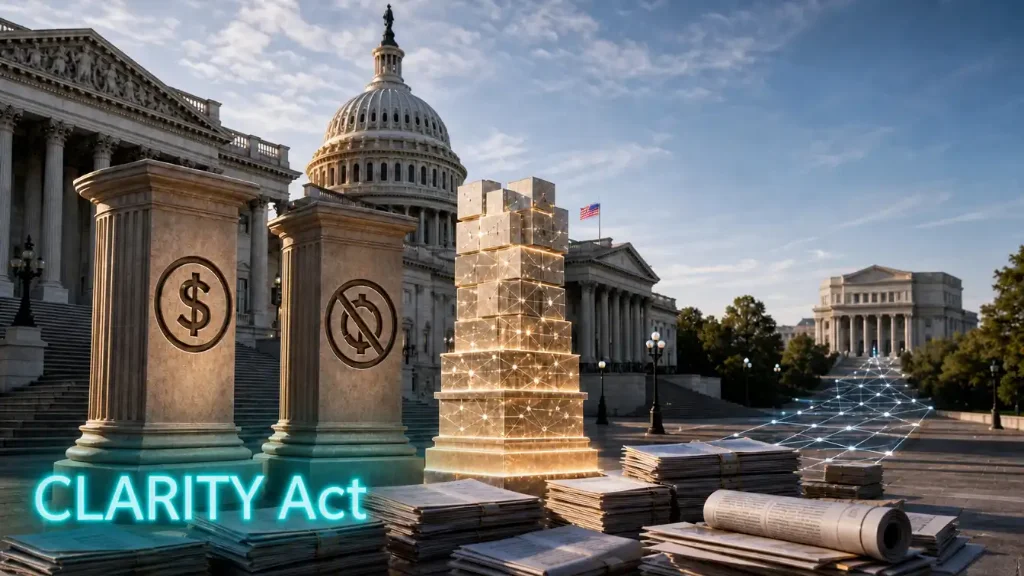


Catenaa, Sunday, July 12, 2026- The United States Congress returns to Washington this week facing what could become the most consequential legislative period for the country’s digital asset industry, with only a few weeks remaining to decide whether elected lawmakers or federal regulators will define the rules governing cryptocurrency markets.
Negotiators are expected to release the Senate’s consolidated version of the CLARITY Act as early as next week after combining proposals approved separately by the Senate Banking and Senate Agriculture Committees.
If legislative text is finalized, senators will have only the remainder of July and the first week of August to pass the bill before Congress leaves for its summer recess and attention shifts toward the November midterm elections.
The compressed timetable has transformed the legislation from a routine regulatory proposal into a test of whether Congress can establish a statutory framework before federal agencies continue filling the regulatory vacuum through administrative action.
The legislative calendar has become one of the bill’s greatest challenges.
Even if the Senate approves the CLARITY Act before the August recess, the House of Representatives must still vote on the revised legislation before it can be sent to President Donald Trump.
With both chambers facing crowded agendas that include appropriations bills and the National Defense Authorization Act, floor time has become as valuable as political support.
The next three weeks may therefore determine not only the fate of the CLARITY Act but also the future structure of US digital asset regulation.
The debate has evolved beyond cryptocurrency policy.
It has become a question of institutional authority.
Last week, Commodity Futures Trading Commission Chair Michael Selig warned that failure to pass the legislation would leave regulators “writing all the rules” for digital assets through agency rulemaking rather than congressional legislation.
That warning carries additional weight because the CFTC itself is currently operating with only one commissioner while awaiting presidential appointments.
Without legislation, agencies would likely continue defining market standards through enforcement actions, interpretive guidance and administrative regulations.
Passage of the CLARITY Act would instead establish those boundaries directly in federal law.
Negotiators continue working through several politically sensitive issues.
One concerns protections for non-custodial blockchain software developers, which supporters argue are essential for innovation while law enforcement organizations warn they could complicate investigations involving illicit finance.
Another centers on ethics provisions governing cryptocurrency activities by presidents, members of Congress and other senior federal officials.
Democratic lawmakers have argued that stronger ethics safeguards remain necessary following disclosures relating to President Trump’s family’s cryptocurrency interests.
Industry representatives, however, maintain that months of bipartisan negotiations have already produced a framework capable of attracting support from both parties once the remaining issues are resolved.
The urgency surrounding the CLARITY Act reflects broader changes already taking place across US digital asset policy.
Congress has enacted legislation establishing a federal framework for payment stablecoins through the GENIUS Act.
Separately, lawmakers have now prohibited the Federal Reserve from issuing a central bank digital currency under current law.
Together, those measures leave the CLARITY Act as the principal remaining pillar needed to define oversight for cryptocurrency markets, exchanges and digital asset intermediaries.
Rather than debating cryptocurrency in isolation, Congress is now assembling the legal architecture that will govern nearly every major segment of the digital asset economy.
The CLARITY Act is intended to establish the first comprehensive federal market structure framework for digital assets by dividing regulatory responsibilities between the Commodity Futures Trading Commission and the Securities and Exchange Commission. The House approved its version in July 2025, while the Senate has spent the past year negotiating revisions covering decentralized finance, consumer protections, ethics rules and oversight of blockchain software developers. As Congress approaches its August recess, the legislation faces a narrowing window for passage before political attention shifts to the November midterm elections. Failure to enact the bill could leave much of the industry’s future regulatory development in the hands of federal agencies rather than Congress.