

August 19, 2026 – Washington set out how it will police who may issue, offer, or sell a payment stablecoin, and gave the industry 60 days to answer.

In Summary
Treasury issued a notice of proposed rulemaking on 17 August 2026 covering section 3 of the GENIUS Act.
The proposal defines what counts as issuing, offering, or selling a payment stablecoin in the United States.
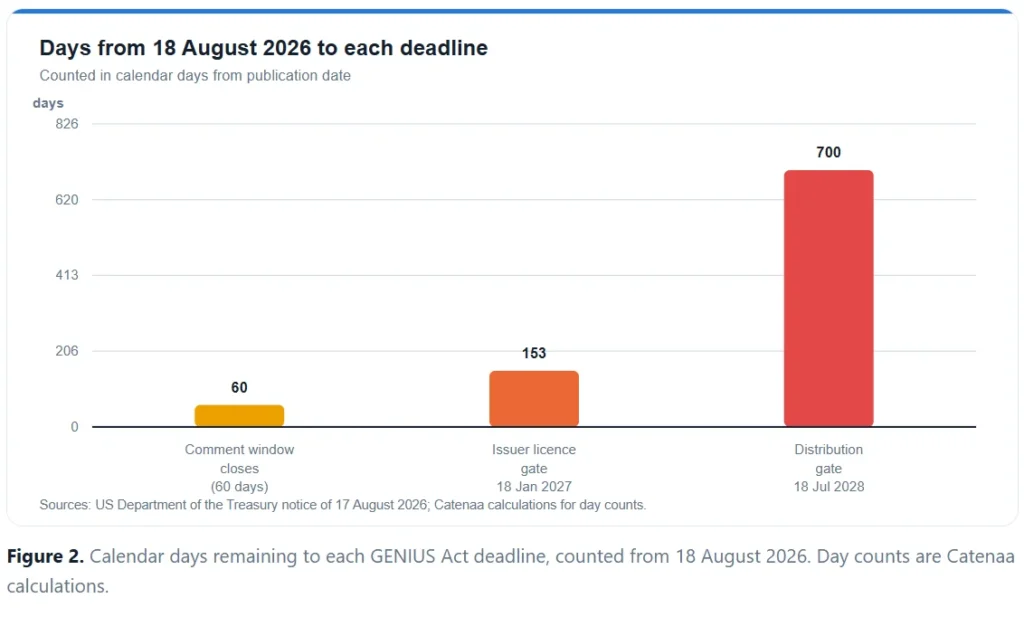
Issuers need a federal or state licence from 18 January 2027, and distributors face their own gate from 18 July 2028.
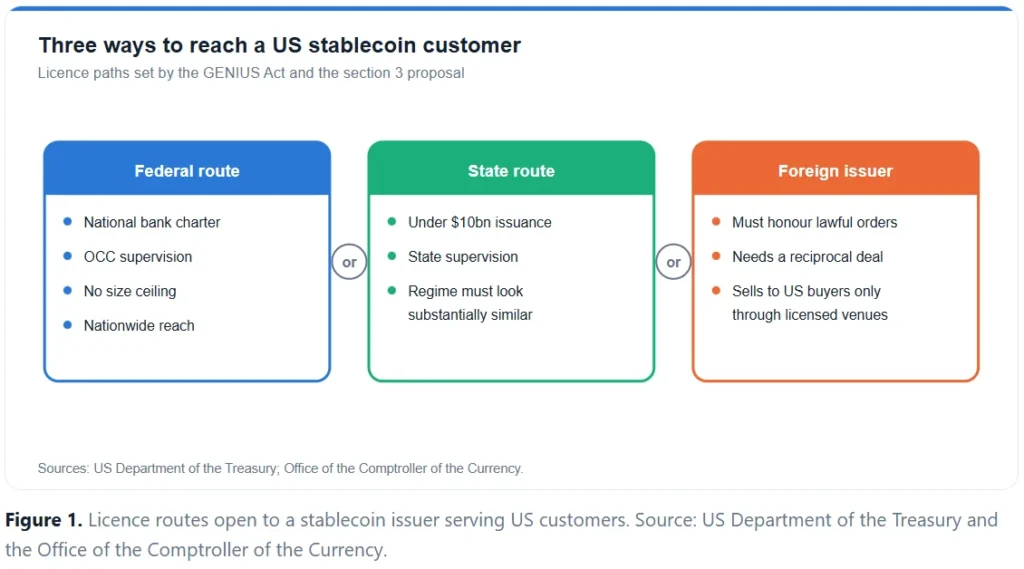
State qualified issuers below $10bn may stay under state supervision if the regime looks substantially similar.
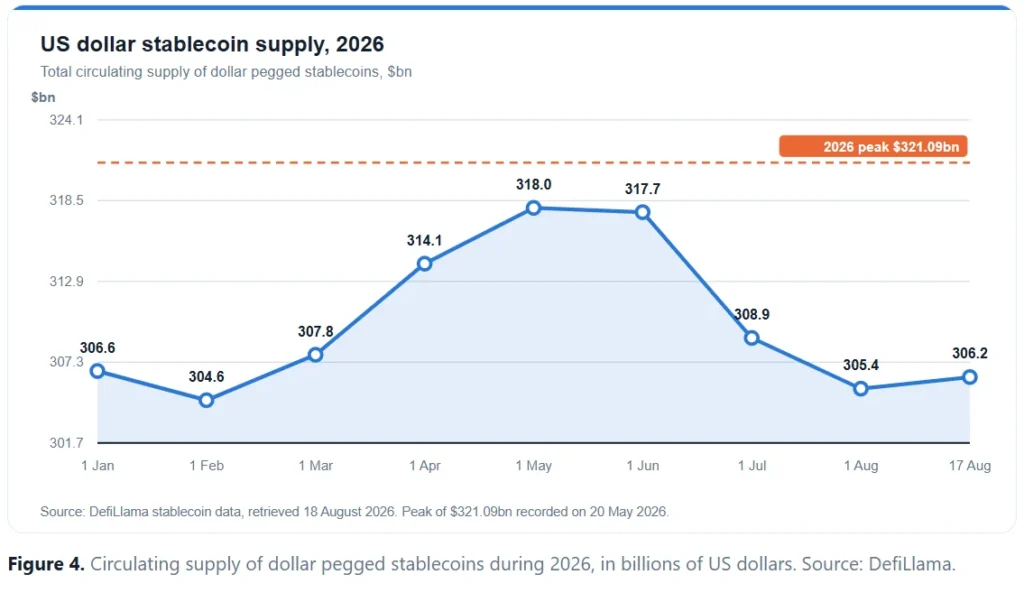
Dollar pegged stablecoin supply sat at $306.23bn on 17 August, some 4.6% below the 2026 peak.
Comments close 60 days after the notice reaches the Federal Register.
The US Treasury proposed new stablecoin rules on Monday, 17 August 2026. Officials now want public comment on section 3 of the GENIUS Act. That section governs who may issue, offer, or sell a payment stablecoin inside the United States. Moreover, it decides which firms must hold a federal or state licence.
Secretary Scott Bessent framed the notice as a speed play. “Treasury is moving quickly to implement that framework,” he said. Comments close 60 days after the notice reaches the Federal Register.
The timing matters for every issuer with American customers. Firms now have roughly five months before the first licence gate shuts. A few of them can wait for the final text.
What the new stablecoin rules actually cover
The proposal answers two narrow questions. First, what does it mean to issue a payment stablecoin in the United States? Second, what counts as offering or selling one to a person in the country?
Both questions sound technical. Even so, they draw the perimeter of the entire regime. A token from an offshore issuer may still fall inside US rules once it reaches American buyers. By contrast, a purely foreign product with no US touchpoints may sit outside.
Treasury says the definitions tell firms when a licence becomes mandatory. Therefore, wallet apps, brokers, and exchanges gain a test they can run before they list a coin. That test also shapes how they market a coin to US residents.
Monday’s notice builds on an advance proposal from September 2025. Back then, Treasury asked broad questions and collected views. This time, it puts draft definitions on the table.
Two dates now drive every compliance plan
Mark 18 January 2027 first. From that day, nobody may issue a payment stablecoin in the United States without a licence. Federal charters and qualifying state charters both count.
Then mark 18 July 2028. After that date, digital asset service providers may not sell payment stablecoins to US persons. Only coins from a licensed issuer clear the bar. In short, distribution faces the same gate as issuance.
Foreign issuers meet an extra hurdle. They need the technical means to honour a lawful order. Beyond that, Washington and the issuer’s home jurisdiction must agree to a reciprocal arrangement.
Meanwhile, exchanges must decide which listings survive the cut. Delisting work usually takes months, so planning starts long before either deadline. Custody providers face the same clock.
The rulemaking pile is nearly complete
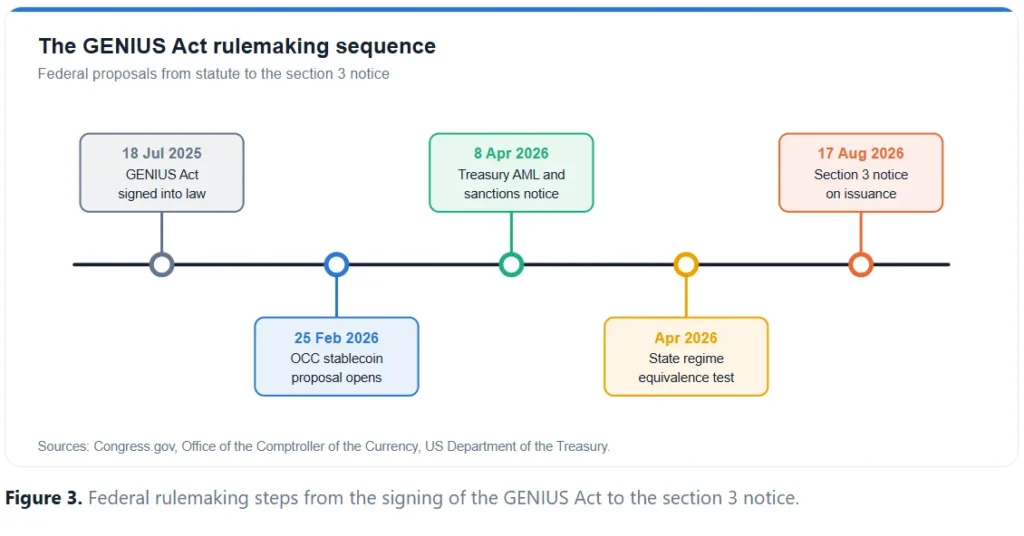
Monday’s notice closes a long sequence. The Office of the Comptroller of the Currency opened its stablecoin proposal on 25 February 2026. Treasury followed on 8 April with a joint anti money laundering and sanctions notice. Later that month it proposed a test for state regimes that look substantially similar to the federal one.
That state test matters most for smaller issuers. Below $10bn in issuance, a state-qualified issuer may stay under state supervision. Above that line, the federal route beckons instead.
Congress signed the GENIUS Act into law on 18 July 2025. Regulators then had one year to draft the core rules. Monday’s notice arrives one month past that statutory marker.
Supply shrinks while the paperwork grows
Regulatory progress has not lifted the float. Dollar-pegged stablecoin supply stood at $306.23bn on 17 August, per DefiLlama data. That figure sits 4.6% below the 2026 peak of $321.09bn on 20 May.
Supply has drifted lower for three months. It slipped to $308.01bn on 18 July, then to $305.43bn on 1 August. Since then, it has crept back a fraction.
The Act bars issuers from paying interest to holders. Consequently, yield hunters rotated into tokenised Treasury funds instead. Settlement volumes still climb, though, so a smaller float now hides busier rails.
Issuers also face a costlier reserve mix. The statute limits backing to short-dated, highly liquid assets. Margins, therefore, track short-term Treasury yields more tightly than before.
Banks and fintechs queue at the charter window
The licence race already shows up at the OCC. On 11 August, the regulator counted 40 de novo charter filings over 18 months. During 2011 to 2014, it saw fewer than four a year, and some years, none at all.
Comptroller Jonathan Gould pitches the shift plainly. “De novo chartering is a sign of a healthy banking system,” he said.
Several crypto firms won conditional national trust approvals in December 2025. One payment issuer then cleared final approval on 10 July 2026. In addition, four large banks plan a shared deposit token network for 2027.
Speed helps the queue move. Many charter decisions now land within 120 days of a complete filing, the OCC says.
Where the friction still sits
Three questions decide how this lands. Start with the Federal Register date, because it triggers the 60-day clock. Next comes the offshore line, which shapes listings far beyond American exchanges. Finally, state regimes must clear the substantially similar bar in time.
Smaller issuers face the tightest squeeze. They must pick a supervisor, raise capital, and rebuild reserve reporting at once. Larger issuers already run bank-grade controls, so they mostly need paperwork.
For now, the market reads Monday’s notice as clarity rather than a crackdown. Even so, clarity carries a price tag, and the bill lands in 2027.




