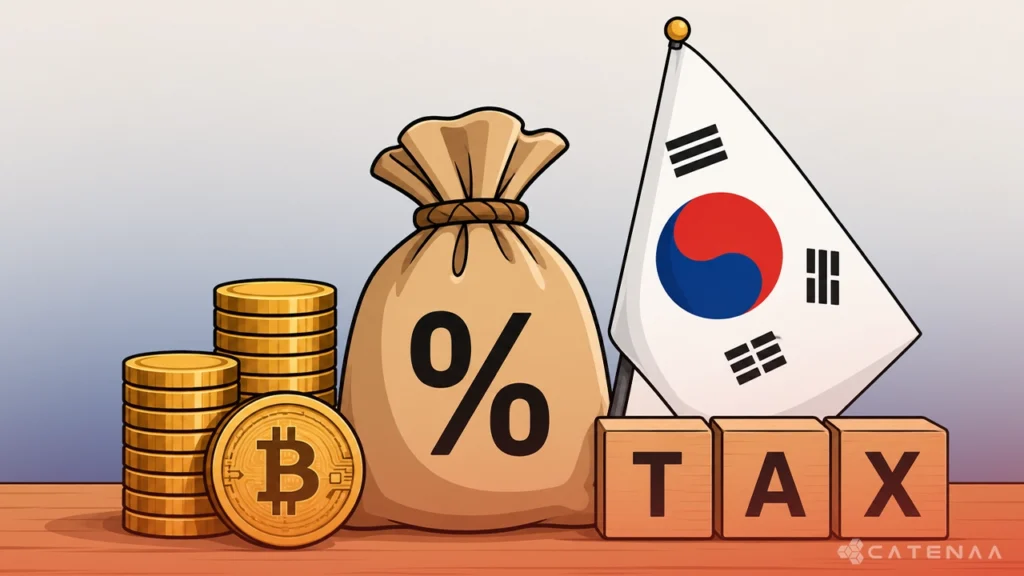


Catenaa, Thursday, June 18, 2026-South Korea has taken a significant step toward defining the future of tokenized finance after the country’s finance ministry indicated that tokenized stocks should be treated as securities rather than virtual assets, potentially opening the door to taxation under existing capital markets laws and establishing an important precedent for regulators globally.
The position, disclosed through local media reports, suggests South Korean authorities increasingly view tokenized equities as traditional financial instruments wrapped in blockchain technology rather than a new category of cryptocurrency.
If adopted by the Financial Services Commission, the interpretation could fundamentally alter how investors, exchanges and fintech firms approach one of the fastest-growing sectors in digital finance.
The decision arrives as tokenized equities experience explosive growth worldwide and financial institutions race to move traditional assets onto blockchain networks.
The core issue centers on classification.
Tokenized stocks represent ownership rights linked to real-world equities held by custodians. Investors receive blockchain-based tokens that mirror the economic benefits of underlying shares, including potential capital gains and market exposure.
Because these tokens derive value from actual stocks rather than independent blockchain networks, South Korean officials argue they more closely resemble securities than cryptocurrencies.
That distinction carries major regulatory consequences.
Cryptocurrencies often operate under separate virtual asset frameworks, while securities fall under stricter investor protection, disclosure and taxation rules.
The finance ministry’s position suggests regulators are prioritizing economic substance over technological form.
In simple terms, authorities appear to be saying that a stock remains a stock even when it is placed on a blockchain.
The classification could trigger immediate tax consequences.
Many South Korean investors had assumed tokenized stocks would remain outside the country’s current tax framework until dedicated virtual asset taxation rules take effect next year.
If regulators formally classify tokenized equities as securities, gains generated from those investments could become taxable under existing capital market legislation much sooner.
The Financial Services Commission is expected to release updates to its Token Securities Guidelines and related regulations in July.
Should those revisions align with the finance ministry’s interpretation, taxation could begin as early as the second half of 2026.
That possibility is already attracting significant attention from investors and fintech firms operating in the sector.
The timing is notable.
Tokenized equities have emerged as one of the fastest-growing segments within the broader real-world asset market.
According to industry data, the tokenized equity sector recently reached a market capitalization of approximately $5.5 billion, making it the fourth-largest category within the tokenized asset ecosystem.
Growth has accelerated rapidly during 2026 as investors seek blockchain-based access to traditional financial products.
Major financial institutions, fintech companies and cryptocurrency firms are increasingly launching platforms that allow users to trade tokenized stocks, exchange-traded funds and other securities around the clock.
The trend is part of a broader transformation known as tokenization.
Tokenization involves converting ownership rights in traditional assets into digital tokens recorded on blockchain networks.
Supporters argue the process offers several advantages over conventional financial infrastructure.
Transactions can settle faster, operating costs can decline and access to investment opportunities can expand beyond traditional market hours.
Tokenized assets can also be integrated directly into decentralized finance systems, potentially creating new forms of liquidity and financial products.
As a result, many analysts view tokenization as one of blockchain technology’s most commercially promising applications.
Unlike speculative cryptocurrencies, tokenized assets connect directly to existing financial markets and established sources of value.
South Korea’s position may extend far beyond its domestic market.
Regulators around the world are wrestling with the same fundamental question: should tokenized stocks be regulated as securities or treated as a distinct category of digital assets?
The answer will shape everything from taxation and compliance to investor protections and licensing requirements.
By emphasizing the economic characteristics of tokenized equities rather than their technological structure, South Korea appears to be aligning with a growing global regulatory trend.
Several jurisdictions have already suggested that blockchain-based representations of traditional securities should remain subject to existing securities laws.
The approach provides greater regulatory certainty but may also increase compliance costs for market participants.
For tokenization platforms, the development presents both challenges and opportunities.
Clear rules can encourage institutional participation by reducing legal uncertainty.
Banks, asset managers and traditional financial firms often prefer operating within established regulatory frameworks.
At the same time, additional taxation and compliance obligations could reduce some of the efficiency advantages that blockchain-based systems seek to deliver.
How firms adapt to these requirements may influence the pace of future adoption.
South Korea’s decision to classify tokenized stocks as securities rather than cryptocurrencies represents an important milestone in the evolution of digital finance. The move could accelerate regulatory clarity, expand institutional confidence and establish a framework for taxation, while also reinforcing the idea that blockchain technology does not fundamentally alter the legal nature of traditional financial assets. As tokenization continues reshaping global markets, regulators worldwide will be closely watching how South Korea’s approach unfolds.
Tokenized securities have become one of the fastest-growing areas of blockchain adoption as financial institutions seek to modernize traditional market infrastructure. The concept involves issuing digital tokens that represent ownership rights in real-world financial assets such as stocks, bonds and funds. South Korea first introduced Token Securities Guidelines in 2023 to establish a regulatory framework for blockchain-based securities. However, questions remained regarding how tokenized versions of conventional equities should be classified and taxed. The latest interpretation from the finance ministry signals a move toward integrating tokenized assets into existing capital market regulations rather than creating a separate legal framework. The decision comes amid growing institutional interest in tokenization and expanding efforts to bring traditional finance onto blockchain networks.