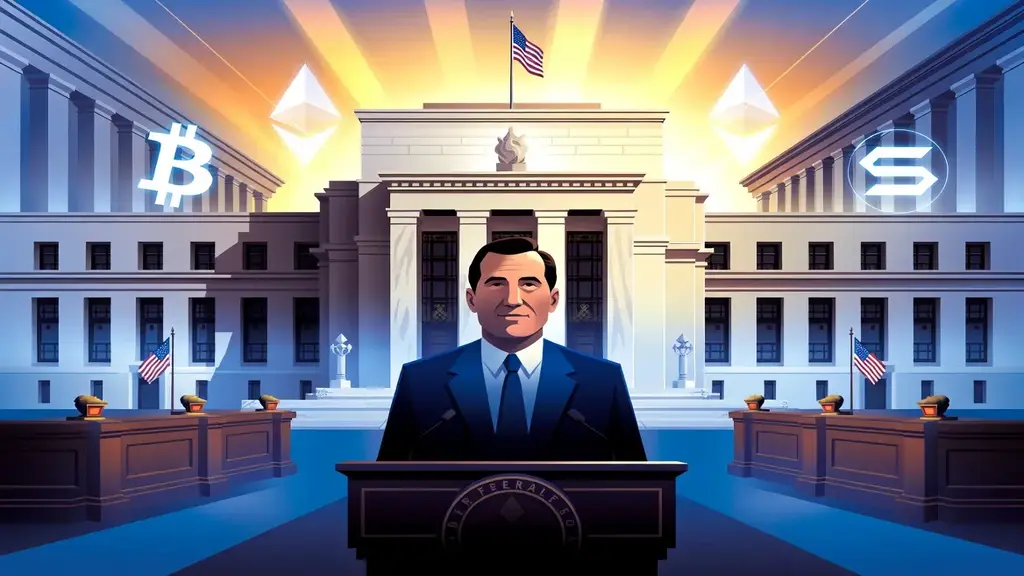


Catenaa, Wednesday, May 14, 2026- The US Senate early today confirmed Kevin Warsh as the next chair of the Federal Reserve, approving President Donald Trump’s nominee.
Warsh won in a 54-45 vote signaling a major shift toward a more crypto friendly leadership at the central bank.
Warsh will begin a four year term replacing Jerome Powell, whose term officially ends Friday, though Powell is expected to remain on the Federal Reserve Board through 2028.
The confirmation follows months of political tension surrounding interest rates, monetary policy and cryptocurrency regulation in the US financial system.
Warsh previously served on the Federal Reserve Board of Governors between 2006 and 2011 under Presidents George W. Bush and Barack Obama. Before joining the Fed, he worked at Morgan Stanley.
The Senate had already confirmed Warsh earlier this week to a separate 14 year position on the Fed’s Board of Governors.
During his nomination process, Warsh described Bitcoin as an important financial asset capable of helping policymakers understand broader monetary developments.
Financial disclosure documents also revealed exposure to several cryptocurrency related firms and blockchain projects, including dYdX, Polychain Capital, Solana, Optimism and Dapper Labs.
Analysts said Warsh’s confirmation may strengthen expectations that US monetary and regulatory policy could become more favorable toward digital assets and tokenized financial markets.
Market observers noted that his background differs sharply from Powell’s more cautious stance toward cryptocurrency markets and stablecoin infrastructure.
Researchers tracking financial policy said Warsh’s direct exposure to blockchain investments may encourage deeper institutional engagement between the Federal Reserve and emerging digital finance systems.
The leadership transition also arrives as Congress debates major cryptocurrency legislation involving stablecoins, digital market structure and tokenized financial products.
At the same time, economists cautioned that the Federal Reserve’s primary focus remains inflation, employment and broader financial stability rather than digital assets alone.
Warsh previously stated that Bitcoin represents a meaningful financial innovation and argued policymakers should pay closer attention to digital asset markets.
Financial analysts said his appointment may improve sentiment across cryptocurrency markets because investors increasingly view regulatory clarity as essential for institutional adoption.
Political observers also noted that Warsh’s confirmation strengthens Trump’s influence over monetary policy heading into the next presidential election cycle.
Critics meanwhile warned that close links between policymakers and crypto investments could trigger future conflict of interest debates.
Kevin Warsh’s confirmation marks one of the most consequential leadership shifts at the Federal Reserve in recent years.
The appointment places a figure with direct cryptocurrency exposure and relatively favorable digital asset views at the center of US monetary policy during a period of accelerating financial technology change.
The decision may also shape how the Federal Reserve approaches blockchain finance, stablecoins and tokenized markets over the coming decade.
The Federal Reserve serves as the central banking system of the United States and controls monetary policy including interest rates, inflation management and financial system stability. Jerome Powell led the institution through major economic disruptions including the COVID era inflation surge and aggressive rate hiking cycles. Cryptocurrency policy increasingly became politically sensitive in Washington as Bitcoin exchange traded funds, stablecoins and tokenized financial systems expanded globally.
President Trump previously criticized Powell repeatedly over interest rates and monetary policy decisions while also adopting a more favorable stance toward cryptocurrency markets during his recent political campaigns. Kevin Warsh emerged as one of the most prominent candidates to reshape the Federal Reserve’s relationship with digital assets because of both his public comments and disclosed investments tied to blockchain firms and cryptocurrencies. His confirmation comes amid growing debate over how central banks should respond to rapidly evolving digital financial infrastructure.