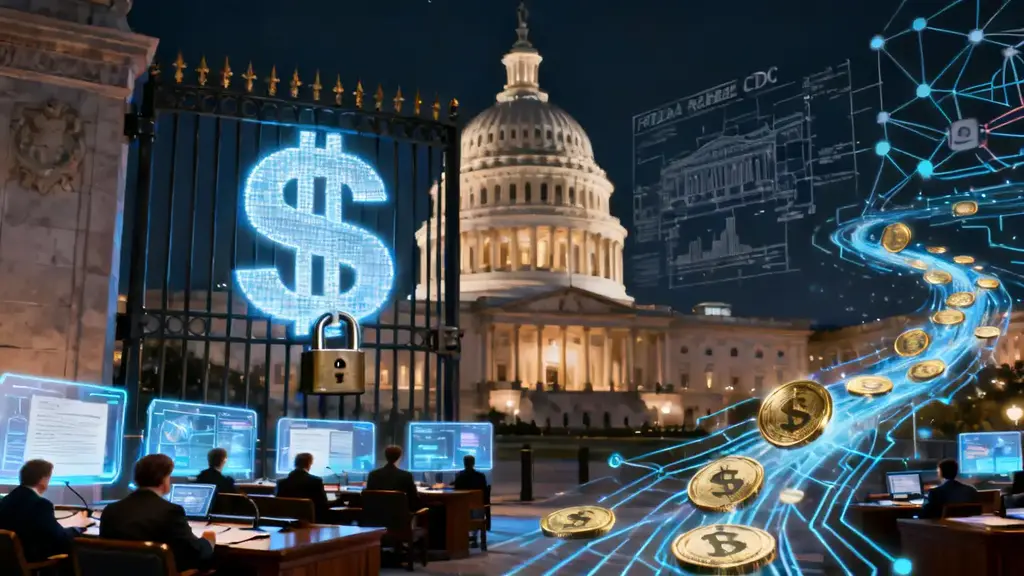


Catenaa, Tuesday, June 23, 2026- The US Senate has passed a major housing affordability bill containing a four-year prohibition on a Federal Reserve-issued central bank digital currency, effectively blocking any future digital dollar initiative until the end of 2030 and reshaping the trajectory of US digital asset policy.
The bipartisan legislation, approved by an 85-5 vote, prohibits the Federal Reserve and regional Federal Reserve banks from issuing or creating a central bank digital currency either directly or through financial institutions. The measure now moves to the House of Representatives, where lawmakers are expected to consider it in the coming weeks.
Although the Federal Reserve was not actively developing a retail CBDC, the legislation transforms political opposition into a legal restriction, signaling a decisive shift in Washington’s approach to digital money.
The CBDC ban represents one of the clearest policy statements yet from US lawmakers regarding the future of government-issued digital currency.
For several years, Republicans have argued that a digital dollar could enable excessive government surveillance of financial transactions and increase federal control over private economic activity.
Those concerns intensified following China’s rollout of the digital yuan and ongoing European Central Bank efforts to develop a digital euro.
The Senate’s action effectively removes the possibility of a US CBDC during the remainder of President Donald Trump’s current term and potentially beyond.
The legislation also aligns with Trump’s January 2025 executive order, which prohibited federal agencies from advancing CBDC development.
The biggest beneficiaries of the ban may be private-sector stablecoin issuers.
With a government-backed digital dollar sidelined, stablecoins pegged to the US dollar face less competition from a federally issued alternative.
The decision strengthens Washington’s emerging strategy of supporting regulated private digital dollars rather than creating a state-operated digital currency system.
This approach has become increasingly visible through recent stablecoin legislation and regulatory proposals designed to integrate private issuers into the broader financial system.
Rather than competing with stablecoins, policymakers appear increasingly focused on establishing guardrails that allow the sector to grow under federal oversight.
The decision creates a growing divergence between the United States and many other major economies.
China has already deployed its digital yuan across multiple regions and payment ecosystems. The European Central Bank continues preparations for a digital euro pilot expected next year, with broader deployment targeted later in the decade.
South Korea, meanwhile, is expanding real-world CBDC testing through commercial banking systems and government payment programs.
The United States is now moving in the opposite direction.
While foreign central banks continue experimenting with sovereign digital currencies, Washington is increasingly betting on private innovation led by banks, fintech firms and stablecoin issuers.
The immediate practical impact of the legislation may be limited because the Federal Reserve was not actively pursuing a retail CBDC launch.
Former Federal Reserve Chair Jerome Powell repeatedly stated that any digital dollar would require congressional approval and broad public support before moving forward.
Current Federal Reserve Chair Kevin Warsh has expressed direct opposition to a CBDC, describing it as an inappropriate policy choice during confirmation proceedings.
Nevertheless, the legislation carries long-term significance because it formally restricts future policymakers from changing course without congressional action.
The ban also reduces incentives for research, pilot programs and infrastructure development that could have supported future digital dollar initiatives.
The four-year prohibition raises broader questions about America’s role in the next generation of global payments infrastructure.
Supporters argue the measure protects privacy, preserves financial freedom and prevents government overreach.
Critics contend that abandoning CBDC development could leave the United States less prepared for an increasingly digital global financial system where programmable money, tokenized assets and blockchain-based settlements become commonplace.
The outcome may accelerate private-sector alternatives.
Banks, payment companies and stablecoin issuers could receive greater regulatory support as policymakers seek digital innovation without direct government-issued currency.
As a result, the future of the digital dollar may increasingly resemble a network of regulated private stablecoins rather than a central bank-controlled currency.
Central bank digital currencies are digital forms of sovereign money issued directly by central banks. More than 130 countries and jurisdictions have explored CBDC research, according to international financial organizations, although only a small number have launched nationwide systems.
The United States has historically approached CBDCs cautiously, emphasizing privacy concerns, financial stability risks and the potential impact on commercial banks. The latest Senate action reinforces a growing consensus among US policymakers that regulated private digital assets may offer a preferred path for financial innovation. If enacted, the legislation would prevent the Federal Reserve from issuing a CBDC until Dec. 31, 2030, making it one of the strongest legal barriers to central bank digital currency development among major economies.