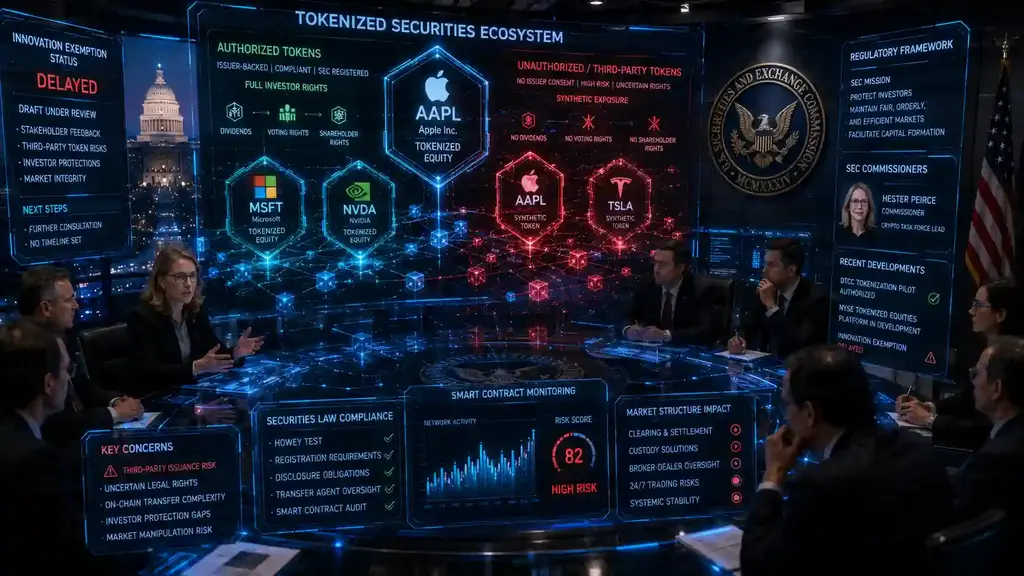


Catenaa, Sunday, May 24, 2026- The US Securities and Exchange Commission delayed release of a closely watched exemption framework for tokenized securities after regulators and market participants raised concerns about third-party blockchain tokens that may not carry the same legal rights as traditional equities, a Bloomberg news report said.
The proposed “innovation exemption” was expected to create a limited regulatory sandbox allowing blockchain-based trading of tokenized securities under SEC supervision.
According to Bloomberg Law, SEC staff had already drafted and internally reviewed the proposal before recent consultations with exchanges, legal experts and crypto infrastructure firms slowed the process.
The biggest concern reportedly centers on third-party tokenized securities issued without authorization or backing from the underlying public companies.
Rights Concerns
Former regulators warned tokenized assets must guarantee the same investor rights attached to ordinary securities including dividends, voting rights and shareholder protections.
Critics argued blockchain-based securities can move rapidly across decentralized networks, creating uncertainty over how ownership records and legal entitlements are maintained.
The debate has intensified as tokenized securities platforms increasingly attempt to merge traditional equities with blockchain settlement systems.
SEC Commissioner Hester Peirce publicly stated the exemption was always expected to remain narrow in scope.
She emphasized regulators are focusing primarily on issuer-backed tokenized equities and SEC-registered tokenization structures rather than synthetic blockchain products.
Synthetic Token Debate
Peirce warned the exemption was never intended to support synthetic securities that merely track the performance of public equities without granting direct ownership rights.
Those products have drawn intense regulatory scrutiny because investors may not receive underlying shareholder protections.
Several former SEC officials reportedly questioned whether decentralized blockchain infrastructure can fully replicate the legal framework surrounding traditional securities markets.
The SEC has not yet indicated whether the latest concerns will alter the final exemption structure.
Blockchain Infrastructure
Despite the delay, several crypto-native firms are already developing regulated tokenization infrastructure.
Securitize, Ondo Finance and Superstate have built tokenization systems integrating SEC-registered transfer agent functions designed to maintain official shareholder records.
Robert Leshner, founder of Superstate, said the SEC remains focused on issuer-led tokenization models capable of preserving all rights and obligations attached to ordinary securities.
The SEC has increasingly signaled support for regulated tokenization while maintaining strict oversight over investor protections.
Wall Street Expansion
Traditional financial infrastructure firms are also advancing blockchain-based securities systems.
The Depository Trust & Clearing Corporation recently received authorization to tokenize certain highly liquid assets using approved blockchain networks during a three-year pilot program.
Meanwhile, the New York Stock Exchange continues developing a tokenized equities platform supporting extended-hours and potentially round-the-clock trading.
The initiatives reflect growing competition between Wall Street incumbents and crypto-native firms over control of next-generation securities infrastructure.
Regulatory Crossroads
SEC Chair Paul Atkins previously described the innovation exemption as a major step toward integrating blockchain systems into regulated capital markets.
Atkins earlier suggested the exemption could launch before the end of last year.
Still, regulators remain divided over how far blockchain-based securities trading should extend into decentralized finance systems and public blockchain networks.
The delay highlights growing tension between promoting financial innovation and preserving long-established investor protections inside US capital markets.
Analysts said the final SEC framework may shape whether tokenized securities remain tightly controlled by regulated institutions or gradually expand into broader crypto trading ecosystems.




