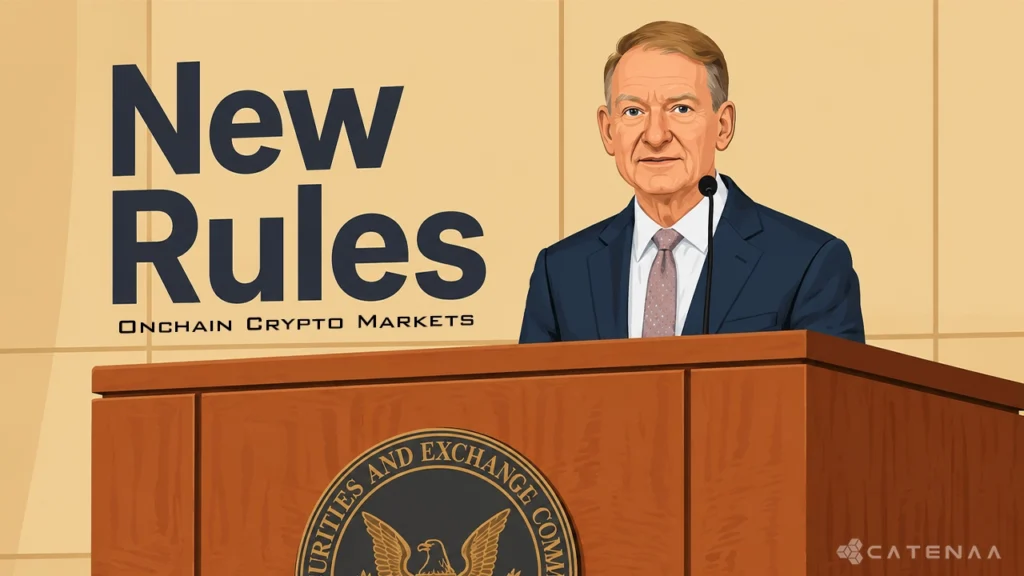


Catenaa, Saturday, May 16, 2026- US Securities and Exchange Commission Chair Paul Atkins signaled Friday that the agency may pursue new rulemaking for blockchain based financial systems and decentralized software applications as regulators reassess how existing securities laws apply to onchain markets.
Speaking at an artificial intelligence conference in Washington, Atkins said many crypto protocols no longer fit cleanly within traditional SEC categories such as broker, exchange or clearing agency, raising pressure for updated regulatory guidance across decentralized finance infrastructure.
Atkins said modern blockchain protocols often combine multiple financial functions inside unified automated systems capable of executing trades, managing collateral, routing liquidity and settling transactions within seconds.
The SEC chair argued that software driven financial systems increasingly blur distinctions between traditional market participants regulated separately under existing securities laws.
The comments reflect a major shift from the approach taken under former SEC Chair Gary Gensler, whose administration pursued aggressive enforcement actions against crypto firms and argued that many digital assets qualified as securities.
Since taking office, Atkins has taken a more open stance toward blockchain innovation and tokenized finance. The SEC recently introduced a taxonomy framework intended to clarify which digital assets may fall under securities regulations.
Last month, the SEC’s Division of Trading and Markets also released staff guidance suggesting decentralized finance wallet interfaces generally would not be classified as brokers under existing rules.
The remarks could have major implications for decentralized finance developers, crypto exchanges and blockchain based trading platforms operating in regulatory uncertainty.
Atkins said the SEC should consider formal notice and comment rulemaking processes to reassess definitions involving exchanges, brokers and clearing agencies as they relate to onchain systems.
Industry analysts said clearer classifications could reduce legal uncertainty that has slowed institutional participation across decentralized finance markets. Developers have long argued that blockchain protocols operate differently from traditional intermediaries because many systems function automatically through smart contracts rather than centralized operators.
Atkins also highlighted crypto “vault” applications that allow users to generate passive yield through blockchain based financial strategies. Analysts said those products remain one of the least clearly defined areas under US securities law.
Researchers following crypto policy noted that formal rulemaking would likely take years but could eventually establish the first broad federal framework specifically addressing decentralized financial infrastructure.
Crypto industry groups welcomed Atkins’ remarks as a positive shift toward more tailored regulation for blockchain systems.
The DeFi Education Fund described the comments as a strong signal that regulators may begin evaluating decentralized finance models according to their actual structure rather than forcing them into older financial categories.
Policy analysts at the Hyperliquid Policy Center said Atkins appeared willing to evaluate blockchain systems on their own technological design rather than applying legacy market assumptions.
Legal researchers noted that formal SEC rulemaking could create more predictable operating conditions for developers and investors after years of enforcement driven regulation.
At the same time, analysts cautioned that regulatory uncertainty remains high until the SEC formally proposes and adopts updated rules through the federal rulemaking process.
Atkins’ comments suggest the SEC is preparing for a broader reassessment of how US securities laws apply to decentralized software driven financial markets.
The shift may eventually reshape the legal treatment of decentralized exchanges, tokenized assets, crypto wallets and blockchain yield systems operating across public networks.
As crypto infrastructure increasingly merges trading, settlement and liquidity management into automated protocols, regulators now face growing pressure to modernize rules originally written for centralized financial intermediaries.
The SEC has spent several years debating how existing securities laws apply to cryptocurrencies and decentralized finance systems following rapid growth in blockchain based trading and lending markets. Under former Chair Gary Gensler, the agency relied heavily on enforcement actions against exchanges, token issuers and crypto lending firms. Critics argued the SEC failed to establish clear rules tailored to decentralized technologies. Decentralized finance protocols differ from traditional financial institutions because they often use automated smart contracts rather than centralized operators to process transactions and manage liquidity. The rise of tokenized securities, blockchain trading systems and crypto yield products has increased pressure on regulators globally to modernize financial oversight frameworks. Paul Atkins, who became SEC chair in 2025, has signaled a more innovation friendly approach while still supporting formal federal oversight for digital asset markets.




