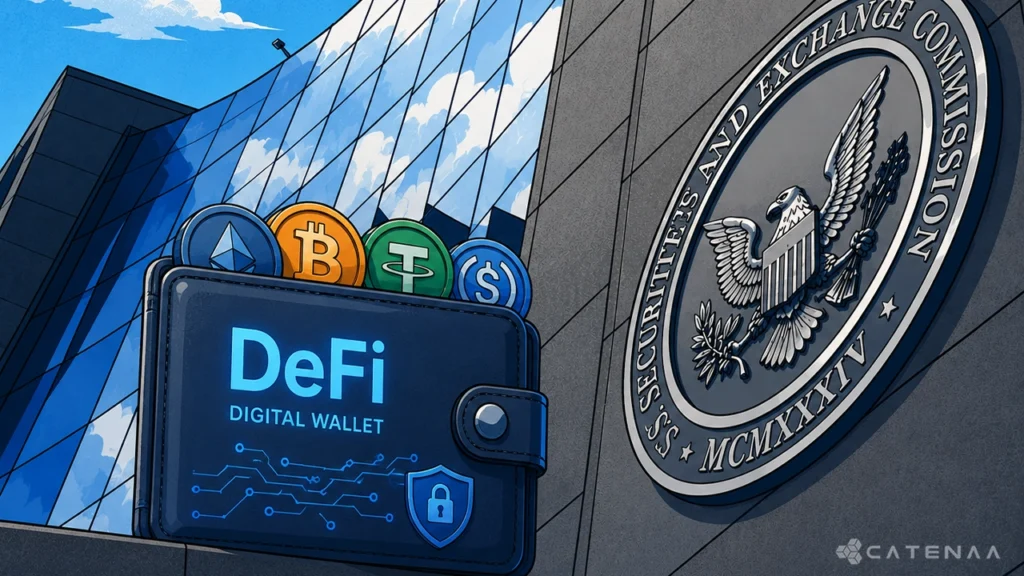


Catenaa, Monday, July 13, 2026- The US Securities and Exchange Commission has dismantled another pillar of its former cryptocurrency enforcement strategy, closing its case against Ethereum software developer ConsenSys and abandoning, at least for now, the legal theory that non-custodial wallet software can function as an unregistered securities broker.
The SEC has ended its enforcement investigation into MetaMask’s Swaps and Staking services without imposing a fine or requiring ConsenSys to admit wrongdoing. The decision removes the most immediate regulatory threat facing MetaMask, the leading gateway through which millions of users access the Ethereum ecosystem.
More importantly, the dismissal signals another step in the SEC’s transition from regulating digital assets through enforcement actions to building a formal regulatory framework for the industry.
The original lawsuit, filed in June 2024, alleged that ConsenSys operated as an unregistered securities broker by enabling users to access token swaps and staking services through MetaMask. The SEC also argued that integrations with liquid staking protocols, including Lido and Rocket Pool, involved the offering of unregistered securities.
Had that legal theory succeeded, its impact would likely have extended well beyond ConsenSys.
Most modern non-custodial wallets provide access to decentralized exchanges, staking platforms and other blockchain protocols through integrated interfaces. A court ruling in the SEC’s favor could have forced wallet developers across the industry to register as broker-dealers or remove many of the features that have become standard in decentralized finance.
That immediate threat has now receded.
While the SEC’s decision does not establish a judicial precedent, it effectively abandons one of the agency’s broadest attempts to classify blockchain software interfaces as regulated securities intermediaries.
The distinction is important.
The case was dismissed before a court ruled on the underlying legal questions. As a result, the SEC has not conceded that non-custodial wallets fall outside securities laws, nor has a federal court affirmed that position. Instead, the agency has chosen not to pursue the argument under its current leadership.
The dismissal therefore creates a policy precedent rather than a binding legal one.
The decision also fits a broader regulatory pattern that has emerged since SEC Chair Paul Atkins assumed office.
Over the past year, the commission has withdrawn or paused several high-profile enforcement actions involving Coinbase, Uniswap Labs, Robinhood Crypto, Gemini and OpenSea. At the same time, it has shifted its attention toward formal rulemaking designed to establish clearer standards for digital assets.
That transition became even more evident this week when the SEC published its 2026 Regulatory Agenda, outlining plans to rewrite broker-dealer, exchange, custody and recordkeeping rules to accommodate crypto assets within the existing securities framework.
Viewed together, the developments suggest the commission is replacing litigation with regulation.
Rather than defining crypto through courtroom battles, the SEC is increasingly relying on formal rulemaking to determine how digital assets should be issued, traded and safeguarded within regulated financial markets.
For Ethereum, the implications are especially important.
MetaMask is not simply a digital wallet. It serves as the principal interface connecting users to decentralized finance, NFT marketplaces, blockchain gaming, liquid staking and thousands of decentralized applications. Regulatory restrictions on MetaMask would likely have created friction across much of Ethereum’s user ecosystem.
Institutional interest in Ethereum has also grown steadily through 2025 and 2026, particularly following expanding staking products and tokenization initiatives. Removing uncertainty surrounding the ecosystem’s primary wallet infrastructure may further support institutional participation by reducing regulatory concerns around software providers.
The case also illustrates how regulatory priorities have evolved.
Under former Chair Gary Gensler, the SEC frequently argued that existing securities laws were sufficient to govern crypto markets, relying heavily on enforcement to establish regulatory boundaries. The current commission has instead emphasized exemptions, tailored regulations and revised market rules designed specifically for blockchain-based finance.
Although future administrations could revisit similar legal theories, the MetaMask dismissal marks another milestone in the SEC’s broader policy reset.
For developers building decentralized applications, wallet software and blockchain infrastructure, the decision offers greater operational certainty while reinforcing a growing expectation that future oversight will be shaped through transparent rulemaking rather than enforcement actions.
The SEC’s lawsuit against ConsenSys became one of the industry’s most closely watched enforcement actions because it targeted software rather than custody of customer assets. Unlike centralized exchanges, MetaMask is a non-custodial wallet that allows users to control their own private keys while accessing decentralized protocols. The case tested whether software developers facilitating blockchain interactions could themselves be regulated as securities brokers. Although the dismissal leaves the legal question unresolved in court, it removes one of the most expansive regulatory theories advanced during the previous SEC administration and reflects the commission’s broader shift toward creating dedicated rules for digital asset markets.