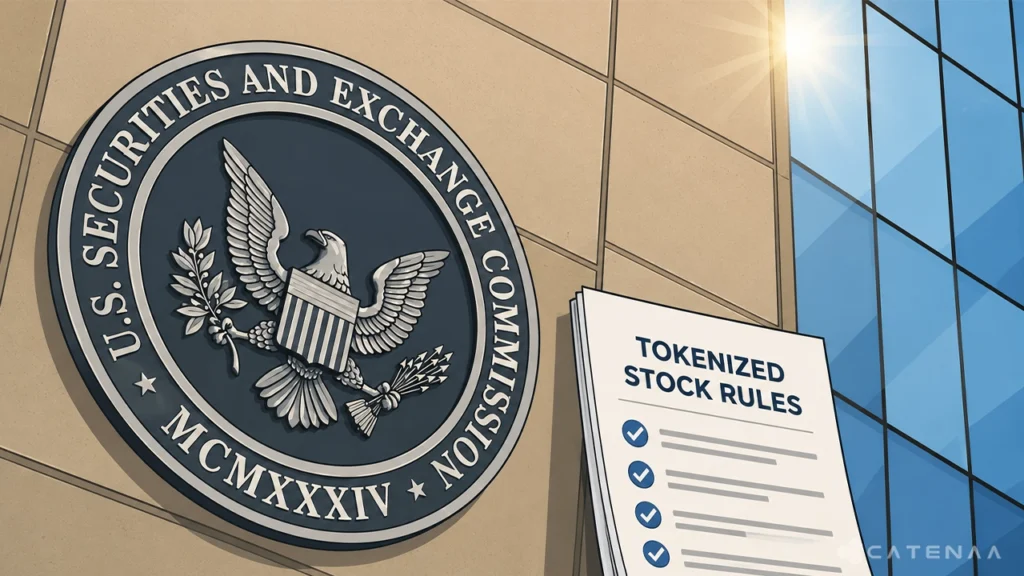


Catenaa, Tuesday, May 19, 2026 – The US Securities and Exchange Commission is preparing to unveil a new regulatory framework for tokenized stocks that could accelerate blockchain-based trading on Wall Street and reshape how equities are bought, sold and settled.
Bloomberg reported Monday that the SEC may release its proposed “innovation exemption” framework as early as this week, citing people familiar with the discussions.
The exemption would allow financial institutions to test blockchain-based securities trading systems without completing the full traditional registration process normally required under federal securities laws.
The expected move marks another step in Washington’s growing acceptance of tokenized financial markets as large exchanges, banks and crypto firms push deeper into blockchain infrastructure.
Tokenized securities are digital representations of traditional financial assets recorded on blockchain networks.
Supporters argue the technology can dramatically speed up settlement times, reduce intermediary costs and allow around-the-clock trading beyond traditional market hours.
Current US stock markets generally settle trades within one or two business days. Blockchain-based systems could reduce settlement times to seconds or minutes.
The SEC has increasingly signaled openness toward tokenized financial products while maintaining that such assets still fall under existing securities laws.
Industry analysts believe tokenized assets could eventually reach trillions of dollars in market value over the next decade.
Several major financial market operators have already secured regulatory approval to expand tokenized trading infrastructure.
In March, the SEC approved a Nasdaq rule change allowing the exchange to support tokenized shares.
The New York Stock Exchange also received approval in April for plans involving blockchain-based trading and settlement systems.
NYSE subsequently partnered with crypto exchange OKX to support the development of tokenized securities infrastructure.
Meanwhile, the Depository Trust & Clearing Corporation received SEC authorization last year to tokenize selected highly liquid assets using approved blockchain systems during a three-year pilot period.
Those approvals have fueled expectations that traditional finance firms are preparing for a broader migration toward blockchain-based trading systems.
Regulatory Experiment
The proposed innovation exemption would likely function as a temporary regulatory sandbox allowing firms to experiment under lighter compliance conditions.
Such exemptions could help exchanges, brokerages and asset managers rapidly develop blockchain settlement systems without immediately navigating the full regulatory burden tied to conventional securities markets.
Analysts said the framework may also help the SEC gather operational data before drafting broader permanent rules for tokenized securities markets.
The move comes as regulators worldwide face growing pressure to modernize financial infrastructure amid rapid advances in digital asset technology.
Europe, Singapore, Hong Kong and the United Arab Emirates have already launched various tokenized asset pilot programs.
Wall Street Competition
Major financial institutions increasingly view tokenization as one of the next major shifts in global capital markets.
Banks and exchanges believe blockchain systems could lower operational expenses while improving settlement efficiency and market access.
The race to dominate tokenized finance has intensified as crypto firms compete directly with traditional exchanges for future trading activity.
Analysts said the SEC’s exemption framework could help the United States remain competitive as other financial centers aggressively court blockchain-based finance businesses.
Still, legal uncertainties remain.
The SEC continues to insist that tokenized stocks remain securities subject to investor protection rules, disclosure requirements and market oversight.
Critics also warn that blockchain-based markets may create cybersecurity risks, operational vulnerabilities and new regulatory loopholes if oversight fails to keep pace.
Bigger Financial Transition
The push toward tokenized securities forms part of a broader shift toward digital financial infrastructure.
Financial firms increasingly expect bonds, equities, funds and other assets to eventually trade using blockchain technology rather than conventional clearing systems.
Many analysts believe tokenization could eventually transform large parts of the global financial system much like electronic trading reshaped markets decades ago.
The SEC’s expected innovation exemption could become one of the clearest signs yet that US regulators are preparing for that transition.
The SEC is preparing new rules that could speed Wall Street’s shift toward blockchain-based stock trading and tokenized financial markets.