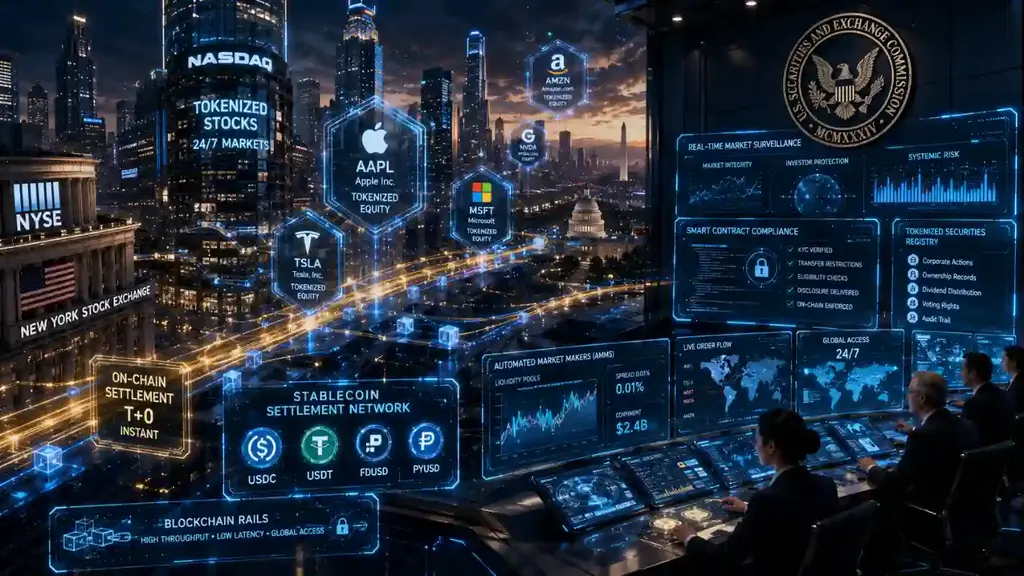


Catenaa, Thursday, May 21, 2026- The US Securities and Exchange Commission is preparing to release a temporary regulatory exemption allowing tokenized stock trading on blockchain networks, a move that could open the door for traditional equities to operate directly on crypto infrastructure under limited regulatory supervision.
The framework, expected as early as this week, would permit qualifying firms to test blockchain-based securities trading using tokenized shares, automated market makers and crypto-native settlement systems.
SEC Chair Paul Atkins and Commissioner Hester Peirce previously outlined the proposal earlier this year as part of broader efforts to modernize financial market infrastructure while preserving investor protections.
The exemption would initially apply under strict conditions including trading volume caps, whitelisted participants and temporary operational approvals.
Blockchain Equities
The SEC defines tokenized securities as traditional financial securities represented on blockchain networks while remaining fully subject to federal securities laws.
Ownership records could be maintained partly or entirely through distributed ledger systems rather than conventional brokerage and clearing infrastructure.
Under the proposed framework, smart contracts may automatically enforce compliance measures including transfer restrictions, investor eligibility rules and issuer communications.
The initiative marks one of the clearest signals yet that US regulators may permit blockchain infrastructure to directly compete with traditional stock market settlement systems.
The SEC said the framework would allow regulators and firms to test whether crypto rails can process securities transactions more efficiently than existing systems.
Wall Street Race
Major financial institutions and crypto companies are already positioning themselves for tokenized securities markets.
Nasdaq received SEC approval earlier this year allowing certain tokenized securities to trade alongside traditional equities using existing DTC settlement systems.
Meanwhile, Intercontinental Exchange, parent company of the New York Stock Exchange, is developing a separate digital trading venue supporting 24-hour tokenized securities trading and stablecoin-based settlement.
Crypto-native firms are also entering the race.
Coinbase previously sought SEC approval to offer tokenized equities directly to US investors.
Kraken has already launched tokenized US stock products for non-US markets through its xStocks platform.
Robinhood introduced stock tokens in Europe while simultaneously building blockchain infrastructure focused on tokenized real-world assets.
Settlement Revolution
The SEC’s proposal could accelerate broader changes already reshaping securities settlement.
US markets moved from T+2 to T+1 settlement in 2024, reducing settlement times and lowering counterparty risk.
Tokenized equities could push settlement much further toward near-instant execution operating continuously around the clock.
Blockchain-based securities systems may also support fractional ownership, programmable settlement and stablecoin-funded transactions.
Analysts said those capabilities could eventually reshape how global capital markets process equity trading.
Competing Models
Three competing models are emerging for tokenized securities markets.
The Nasdaq model keeps tokenized and traditional shares operating inside existing Wall Street infrastructure using conventional settlement systems.
The ICE model builds separate regulated digital securities exchanges operating alongside legacy markets.
The third model allows securities to trade directly through crypto-native infrastructure including blockchain wallets, automated market makers and decentralized trading systems.
The SEC exemption may determine how much room regulators ultimately allow for crypto-native systems to compete against incumbent financial exchanges.
Investor Risks
Regulators continue expressing concern over investor protections and counterparty risks tied to tokenized securities.
The SEC has distinguished between issuer-sponsored tokenized shares directly backed by underlying equities and third-party synthetic or custodial products carrying additional financial risks.
Robinhood’s European stock token disclosures already warn users about counterparty and insolvency exposure tied to the token issuer.
Critics argue loosely regulated blockchain securities trading could weaken protections developed over decades inside traditional capital markets.
Supporters counter that blockchain settlement systems may lower costs, improve liquidity and modernize aging financial infrastructure.
Market Potential
Despite growing interest, tokenized securities remain a tiny segment of global capital markets.
Data from DefiLlama estimates the total onchain real-world asset market at roughly $30 billion compared with global equity market capitalization exceeding $126 trillion.
Still, analysts believe the SEC exemption could become one of the most important policy shifts yet linking traditional finance with blockchain infrastructure.
The outcome may determine whether tokenized stocks become a mainstream extension of regulated capital markets or remain largely confined to niche crypto platforms.