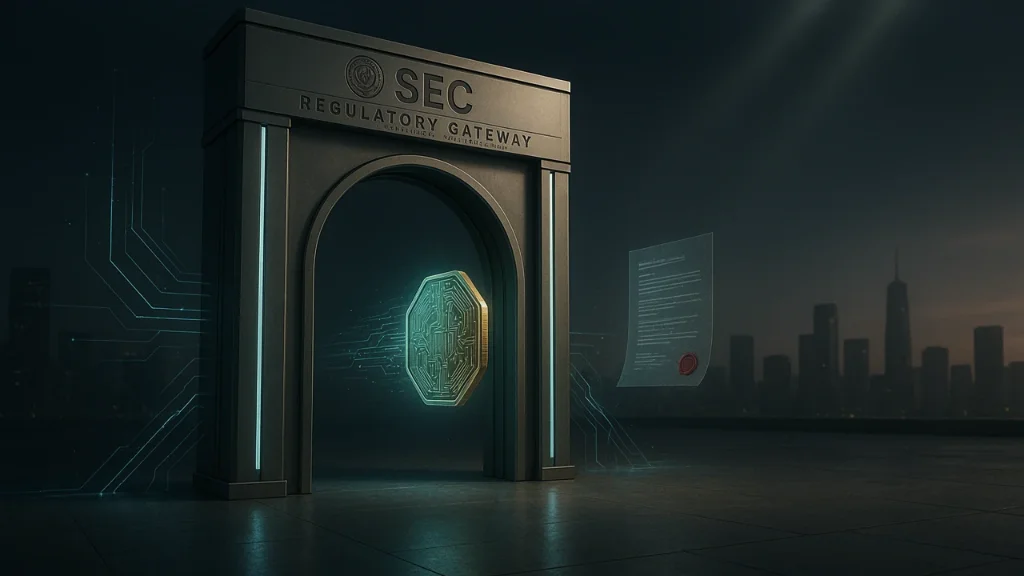


Catenaa, Thursday, August 13, 2026- The US Securities and Exchange Commission could take an early step toward creating a dedicated regulatory pathway for crypto token launches when commissioners meet Friday to consider proposed rules for certain digital asset investment contracts.
The SEC said it will consider whether to publish a proposal establishing a tailored offering regime for certain investment contracts involving crypto assets.
Details have not yet been released. However, TD Cowen’s Washington Research Group believes the proposal could begin with a safe harbor allowing crypto projects to sell tokens while their networks are still being developed.
Such an approach could address one of the longest-running regulatory problems facing US crypto projects: whether a token sold to finance development must remain subject to securities regulation as the underlying network matures.
TD Cowen Managing Director Jaret Seiberg said the possible rulemaking could establish separate disclosure and compliance requirements for crypto-related investment contracts.
Under the framework outlined by SEC Chair Paul Atkins earlier this year, a project could potentially raise money through an investment contract while developing its network.
Once the network no longer depends on the sponsor’s managerial efforts, the associated crypto asset could potentially move outside SEC securities oversight.
That distinction could alter how US regulators treat the lifecycle of a token.
Rather than permanently attaching the securities classification of an initial fundraising transaction to the token itself, the framework could recognize that the regulatory status may change as a network develops.
TD Cowen said the process could begin with a safe harbor permitting sponsors to sell tokens during early network development without automatically treating the tokens themselves as securities.
A separate regulatory test could eventually determine when an asset has developed sufficiently to be treated as a commodity rather than falling under SEC securities rules.
Projects using such an exemption could still face disclosure requirements.
TD Cowen expects issuers could be required to file a whitepaper covering the token, development roadmap, token economics, governance arrangements, developer compensation, custody structure and major risks.
The SEC had previously signaled work on such an approach in March. Atkins discussed establishing a clearer pathway for crypto assets offered through investment contracts, while the SEC and Commodity Futures Trading Commission also issued guidance addressing how existing securities laws apply to digital assets.
The timing is notable because Congress has yet to complete broader crypto market structure legislation. The Senate did not advance the Clarity Act before its August recess, leaving regulators with a larger role in determining how existing law applies.
Friday’s meeting would not create final rules.
If commissioners approve the measure, the SEC would publish a proposed rule for further consideration and public feedback before any final regulatory framework could take effect.
Catenaa View
The most consequential part of the possible SEC proposal may not be the safe harbor itself. It is the idea that the regulatory treatment of a crypto asset could change as the network behind it develops.
That could create a clearer separation between fundraising and the asset eventually circulating on a functioning decentralized network.
For crypto developers, this could reduce the uncertainty surrounding early-stage token launches while still requiring disclosures during the period when investors depend heavily on a project’s founding team.
The proposal could also become more important if Congress remains unable to settle the broader division of crypto oversight between the SEC and CFTC.
However, Friday is only the beginning. Until the SEC publishes the proposal, the precise eligibility requirements, transition tests and compliance obligations remain unknown.
What to Watch
The first issue will be whether SEC commissioners vote Friday to publish the proposal and how closely its language follows Atkins’ earlier framework.
Watch particularly for the definition of an eligible token offering, the disclosures required for safe-harbor protection and any deadline imposed on network development.
Another major question is how the SEC proposes determining when dependence on a project’s sponsor has declined enough for securities oversight to end.
Any test for transitioning a token toward commodity treatment could also affect the future jurisdictional boundary between the SEC and CFTC.
Finally, the industry’s response during a potential public comment period could reveal whether developers see the framework as a workable route for US token launches or another compliance burden.