

Catenaa, Tuesday, August 18, 2026- U.S. regulators are moving ahead with crypto rules as Congress approaches a September 15 procedural vote that could determine whether sweeping digital asset legislation advances before the midterm elections.
The Securities and Exchange Commission on Tuesday proposed Regulation Crypto Assets, a tailored framework allowing certain crypto projects to raise capital without complying with the full registration regime under existing securities laws.
The move comes as prospects for the Digital Asset Market Clarity Act have become increasingly uncertain.
White House crypto adviser Patrick Witt remains optimistic about the legislation. Solana Policy Institute CEO Miller Whitehouse-Levine puts its chances of becoming law before November at about 10%.
Ripple Chief Legal Officer Stuart Alderoty called September 15 a bellwether for the bill.
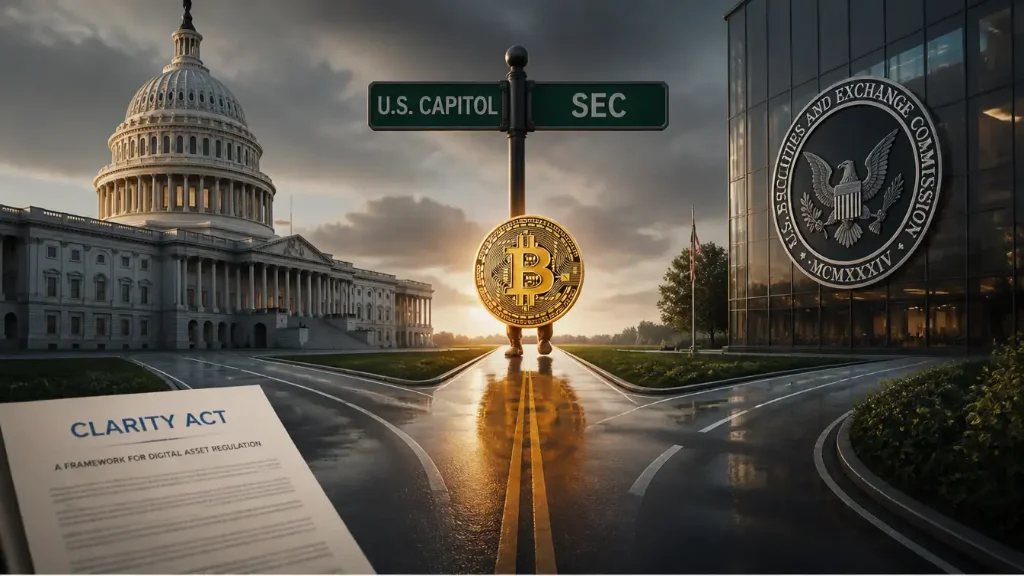
Together, the developments point to Washington pursuing two paths at once: legislation through Congress and rulemaking through federal regulators.
Regulation Crypto Assets would create two exemptions for qualifying digital asset offerings.
A startup exemption would allow eligible issuers to raise up to $5 million over four years without full Securities Act registration.
A separate fundraising exemption would permit offerings of up to $75 million over 12 months, subject to disclosure and other conditions.
The SEC also proposed a safe harbor covering circumstances in which a digital asset associated with an investment contract could cease to be treated as a security.
That could apply after an issuer completes or permanently ends the managerial work investors depended on, provided other requirements are met.
The proposal builds on crypto guidance issued by the SEC and Commodity Futures Trading Commission in March.
It is separate from a planned innovation exemption involving areas such as tokenized securities.
The SEC will accept public comments for 60 days after publication in the Federal Register.
Congress faces a much tighter timetable.
Senate Majority Leader John Thune has scheduled a procedural vote on the Clarity Act for September 15, shortly after lawmakers return from the August recess.
The vote would determine whether the Senate can formally proceed with consideration of the legislation.
It would not pass the bill.
Additional votes and negotiations would still be required, leaving little time before campaigning intensifies ahead of the November elections.
Whitehouse-Levine said the legislation is effectively stuck in “August recess purgatory” and estimated its chances of becoming law before the midterms at about 10%.
Prediction markets are somewhat less pessimistic.
Polymarket traders recently placed the probability of enactment by year-end near 21%, while Kalshi showed similar odds around 23%.
Both have fallen sharply from earlier levels.
The Trump administration is taking a more optimistic view.
Witt said officials plan to work with Democrats before the September 15 vote to resolve remaining disputes.
He also indicated that the SEC and CFTC are preparing extensive rulemaking if Congress fails to act.
The administration appears willing to give lawmakers one more opportunity to establish a statutory framework before regulators move more aggressively under existing authority.
That raises the stakes of the September vote.
A congressional breakthrough would preserve legislation as the primary route for crypto market structure.
Failure could shift more responsibility toward the agencies.
One of the bill’s recurring obstacles is stablecoin rewards.
Banks have argued that reward-bearing stablecoins could pull deposits away from the traditional banking system.
Crypto companies contend that overly broad restrictions could prevent legitimate rewards connected to payments and transactions.
Sens. Angela Alsobrooks, D-Md., and Thom Tillis, R-N.C., previously developed compromise language distinguishing rewards paid merely for holding stablecoins from those connected to transactions.
But Senate Banking Committee Chair Tim Scott said this week that the dispute has resurfaced.
Ethics provisions are another source of tension.
Democrats have sought stronger restrictions involving digital asset businesses linked to public officials as President Donald Trump’s family maintains significant crypto interests.
Trump is considering a proposal from Sens. Ruben Gallego, D-Ariz., and Tillis that would give state attorneys general enforcement authority over certain ethics provisions.
Alderoty said legislation remains preferable because it would create a more durable framework than agency rules alone.
Rules can be revised by future commissions or challenged in court.
Congress can also define the respective powers of the SEC and CFTC in ways the agencies cannot accomplish by themselves.
But regulators are no longer waiting indefinitely.
The SEC proposal addresses one of the industry’s longest-running problems: how crypto projects can raise money without automatically entering the full registration regime designed for traditional securities offerings.
The safe harbor also attempts to address when a token initially linked to an investment contract could later fall outside securities regulation.
Catenaa View
The larger development is that U.S. crypto regulation is now advancing on two tracks.
Congress still offers the industry’s preferred route because legislation can settle jurisdictional questions and create rules with greater permanence.
But the SEC and CFTC are increasingly prepared to solve narrower problems through existing regulatory powers.
That means September 15 could determine which track takes the lead.
If the Senate advances the Clarity Act, Congress retains a chance to establish a statutory market structure.
If the bill stalls, federal regulators are positioned to become the main architects of the next phase of U.S. crypto policy.
Either way, the prolonged regulatory standstill surrounding digital assets appears to be ending.
The Clarity Act seeks to establish a federal digital asset market structure and clarify the roles of U.S. regulators. The SEC’s Regulation Crypto Assets proposal would create limited fundraising exemptions and a safe harbor for certain digital assets. The SEC and CFTC have also increased coordination on crypto regulation. With lawmakers facing a compressed calendar before the midterms, the September 15 Senate vote has become the immediate test of whether legislation can keep pace with regulatory rulemaking.




