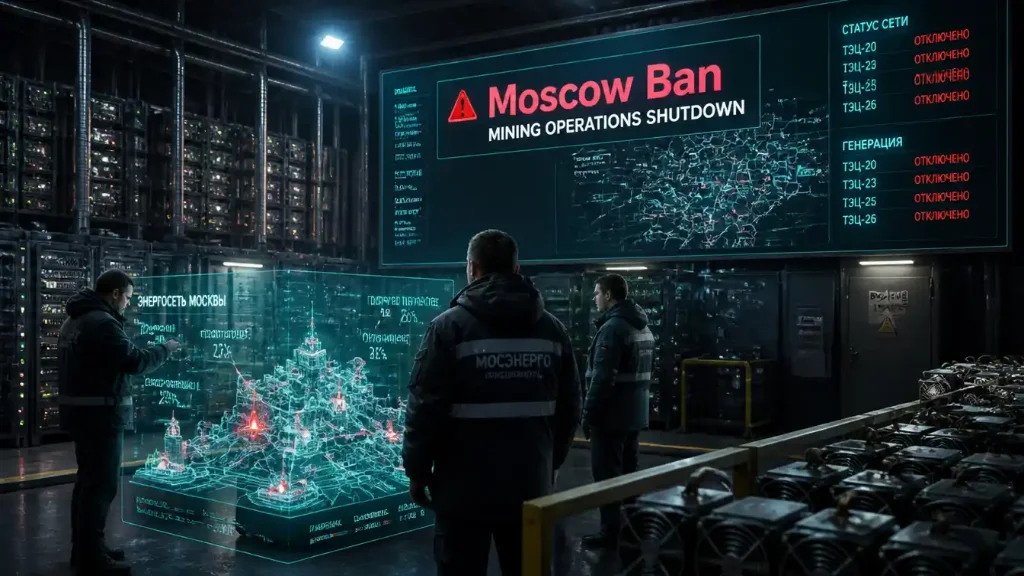


Catenaa, Monday, August 03, 2026-Russia has ordered a sweeping ban on cryptocurrency mining across Moscow, the surrounding Moscow region and parts of the Kursk region through the end of 2032, marking one of the country’s most significant regional restrictions on digital asset mining.
The prohibition, set out in Government Decree No. 936, will take effect on Aug. 15 and prohibits both cryptocurrency mining operations and participation in mining pools within the designated territories.
Rather than targeting the industry nationwide, the move reflects Russia’s growing strategy of restricting mining in regions where electricity demand threatens grid stability while allowing the sector to expand elsewhere under regulatory oversight.
Russian authorities said the restrictions are intended to protect electricity infrastructure from growing demand created by large-scale mining operations.
The measure follows a proposal released by the Energy Ministry in June warning that affected regions could face electricity shortages if mining continued throughout the year.
Officials estimate cryptocurrency mining currently consumes about 1 gigawatt of electricity across the Moscow power grid, making it one of the largest concentrations of mining-related energy demand in the country.
With data center capacity expected to continue expanding during the coming years, authorities concluded that mining restrictions were necessary to preserve electricity supplies for households, businesses and essential services.
The latest decree reinforces Russia’s evolving regulatory approach toward digital asset mining.
Instead of banning mining nationwide, Moscow has increasingly adopted region-specific policies that reflect local energy conditions.
Energy-rich regions with surplus generating capacity remain open to licensed mining operators, while electricity-constrained areas face seasonal or permanent restrictions.
The Moscow region now joins several territories where mining has already been limited because of grid capacity concerns.
Despite tightening regional controls, Russia continues developing a legal framework for cryptocurrency mining.
Legislation introduced in 2024 formally legalized industrial mining for companies and registered entrepreneurs operating within approved regulatory requirements.
Private individuals may also mine cryptocurrencies, provided their electricity consumption remains below prescribed limits.
Earlier this year, authorities launched a nationwide registry for cryptocurrency mining equipment to improve oversight, monitor electricity consumption and strengthen tax collection.
The latest restrictions illustrate the balancing act facing governments seeking to benefit from digital asset industries without compromising critical infrastructure.
Mining has become increasingly attractive in regions with inexpensive electricity, but concentrated operations can place considerable strain on transmission networks and local generating capacity.
Rather than discouraging blockchain development entirely, Russia appears to be steering mining investment toward areas capable of supporting high electricity consumption.
The decree comes as Russian lawmakers continue expanding the country’s digital asset regulatory framework.
Recent legislation passed by the State Duma would permit regulated retail cryptocurrency trading while maintaining the prohibition on using cryptocurrencies for domestic payments.
Authorities are therefore pursuing a dual-track policy that encourages regulated digital asset businesses while imposing tighter operational controls where infrastructure limitations exist.
The decision could contribute to another geographical redistribution of global mining activity.
Large operators based in Moscow and surrounding regions may relocate to Russian provinces with greater electricity availability or move operations abroad to jurisdictions offering lower power costs and more favorable regulatory environments.
Such migration has become a recurring feature of the global mining industry as governments increasingly link mining policy to national energy strategies.
Russia’s latest mining ban highlights how electricity availability is becoming one of the defining factors shaping cryptocurrency mining policy worldwide.
Rather than prohibiting the industry altogether, Moscow is directing mining toward regions with sufficient energy resources while protecting heavily populated areas from rising electricity demand.
The policy reflects a broader international trend in which energy management is emerging as a central pillar of cryptocurrency regulation.
Russia legalized industrial cryptocurrency mining in 2024 through a licensing framework requiring professional operators to register with authorities. The government has since combined legalization with targeted regional restrictions designed to protect electricity networks. Government Decree No. 936 extends that approach by prohibiting mining across Moscow, Moscow Oblast and parts of Kursk Oblast until Dec. 31, 2032, while mining remains permitted in other regions that possess adequate power infrastructure.




