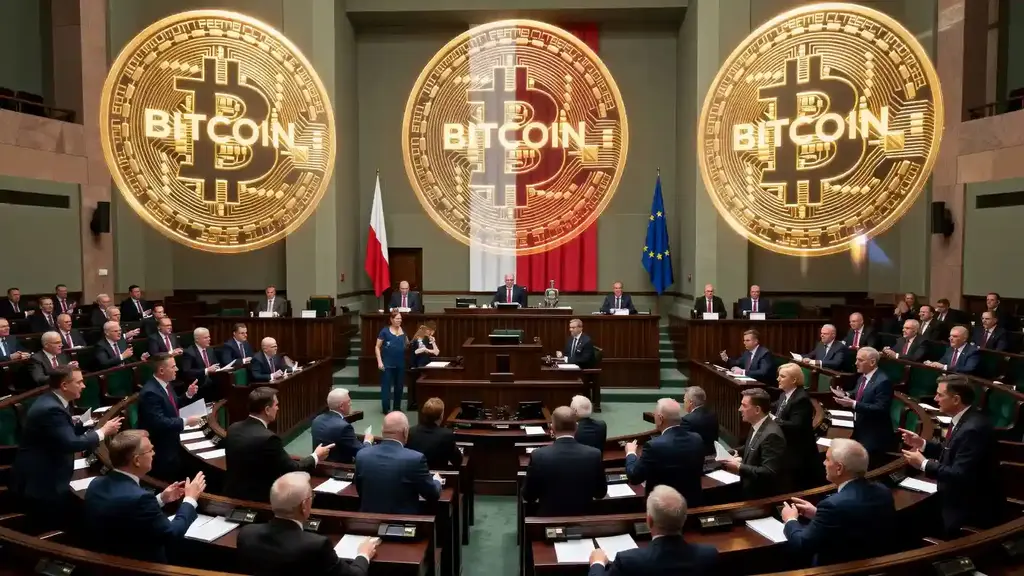


Catenaa, Wednesday, May 13, 2026- Poland lawmakers opened debate Tuesday on four competing cryptocurrency regulation bills as members of the opposition Law and Justice party simultaneously introduced a separate proposal seeking to ban cryptoasset activity entirely inside the country.
The discussions mark Poland’s latest attempt to establish a regulatory framework for digital assets after earlier legislation faced repeated presidential vetoes.
The debate began inside Poland’s parliament after Sejm Speaker Włodzimierz Czarzasty confirmed lawmakers would review proposals submitted by the government, President Karol Nawrocki, the Poland 2050 party and the Confederation party.
Second readings for the bills are expected tomorrow (Thursday).
The competing proposals differ mainly over regulatory enforcement powers and financial penalties involving cryptoasset oversight.
One major disagreement centers on the authority granted to Poland’s Financial Supervision Authority to freeze or block accounts linked to crypto activities.
President Nawrocki’s proposal would maintain penalties of roughly 20 million Polish zloty, or about $5.5 million, for obstructing regulatory inspections. The Finance Ministry’s version would increase maximum fines to roughly 25 million zloty.
At the same time, lawmakers from the Law and Justice party introduced a separate proposal Monday seeking an outright ban on cryptoasset activity in Poland.
The move followed internal political divisions after several party members withdrew support for an earlier crypto market regulation bill submitted in April.
The competing legislation highlights deep divisions inside Poland over how cryptocurrencies should be regulated as European governments continue implementing broader digital asset frameworks under MiCA rules.
Analysts said the existence of both regulatory and prohibition proposals reflects wider tensions between financial innovation, political oversight and concerns surrounding consumer protection.
The debate also signals how crypto regulation increasingly became politically sensitive in Poland amid allegations involving campaign financing and links to crypto companies.
Speaker Czarzasty publicly questioned political relationships involving zondacrypto and raised concerns about whether lawmakers or political events received crypto related funding.
Researchers tracking European crypto policy noted that Poland’s regulatory direction could influence regional adoption because the country represents one of Central Europe’s largest digital asset markets.
Political analysts said President Nawrocki’s repeated vetoes of earlier crypto legislation intensified uncertainty surrounding the country’s regulatory strategy.
Researchers following European crypto regulation noted that most European Union member states currently focus on licensing and oversight rather than outright bans.
Industry observers also warned that proposals restricting cryptoasset activity could discourage blockchain investment and digital finance development within Poland.
At the same time, consumer protection advocates argued stronger enforcement powers and financial penalties may become necessary as crypto related fraud, money laundering and political financing concerns expand across Europe.
Poland’s parliament now faces a pivotal decision over whether to pursue tighter oversight, moderate regulation or more restrictive measures targeting cryptocurrency activity.
The debate reflects broader global divisions surrounding digital assets as governments balance innovation, financial stability and political accountability concerns.
The outcome may determine whether Poland positions itself as a regulated crypto market inside Europe or moves toward far stricter controls over blockchain related activity.
European governments accelerated cryptocurrency regulation efforts after the European Union approved Markets in Crypto Assets regulations, commonly known as MiCA, establishing continent wide licensing and oversight standards for digital asset firms. Poland emerged as one of several European markets experiencing rapid crypto adoption among retail investors and fintech businesses. However, political debates intensified globally over issues involving money laundering, financial crime, speculative trading and campaign financing linked to digital assets. Several countries pursued stricter oversight frameworks while others considered partial restrictions or bans targeting cryptocurrency activities. Poland’s internal political disputes over crypto regulation now reflect wider global disagreements surrounding the role of digital assets within modern financial systems and national regulatory structures.