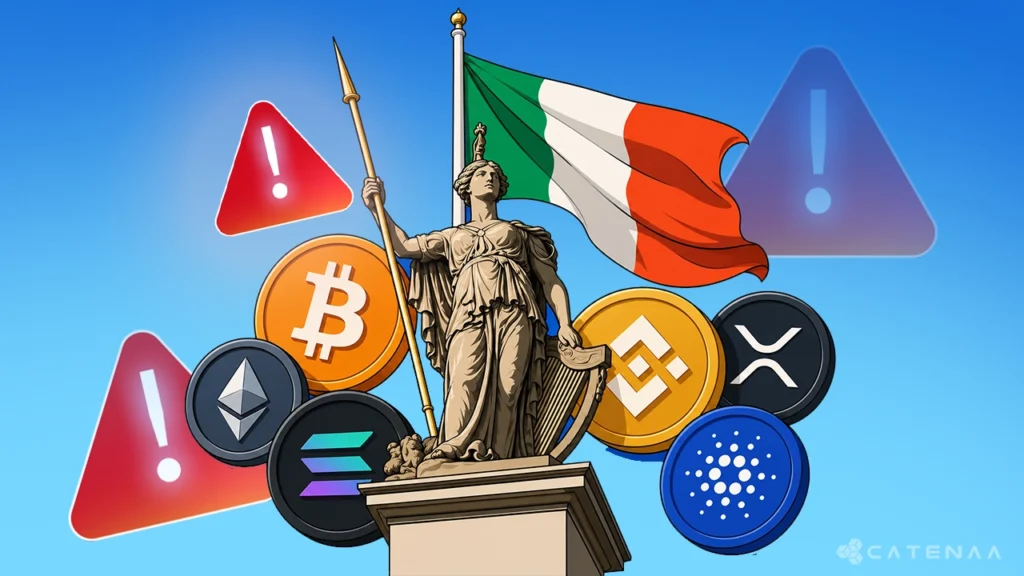


Catenaa, Wednesday, June 24, 2026-The Irish government has raised concerns over the growing role of digital assets in financial crime, releasing its first cryptocurrency-related national risk assessment in seven years and outlining plans to introduce stronger safeguards for crypto-related activities as part of a broader effort to strengthen financial system integrity.
The report, published by the Department of Finance Ireland, identifies cryptocurrency as presenting “very significant” risks related to money laundering and terrorism financing.
Officials said the assessment reflects a changing financial landscape in which digital assets have become increasingly integrated into both legitimate and illicit financial activities.
The report also noted a rise in money laundering prosecutions and fraud cases involving cryptocurrencies since Ireland’s previous assessment.
It marks the first major government review of crypto-related risks since 2019.
According to the assessment, digital assets present vulnerabilities that may facilitate sanctions evasion, tax non-compliance and bribery.
Authorities highlighted concerns that cryptocurrencies can be used to transfer value across borders with limited transparency, creating challenges for enforcement agencies.
The report also pointed to decentralized finance, commonly known as DeFi, as an area where regulatory oversight remains limited.
Officials warned that inconsistent international regulations create additional risks for Irish service providers operating across multiple jurisdictions.
As part of its implementation strategy, Ireland intends to develop industry standards governing the acceptance of crypto-related activities as a source of funds.
The framework is expected to be introduced during the second half of 2027.
While the government did not announce specific legislative measures, the report signals a move toward tighter oversight of digital asset transactions and compliance procedures.
The initiative could affect exchanges, financial institutions and businesses accepting cryptocurrency-related funds.
Ireland occupies a unique position within the digital asset industry.
The country serves as a European base for several major cryptocurrency firms and technology companies seeking access to European markets.
At the same time, crypto ownership among Irish residents remains relatively high compared with many other countries.
According to the Central Bank of Ireland, approximately 10% of the population has invested in cryptocurrencies.
That level of adoption has increased pressure on policymakers to balance innovation with consumer protection and financial stability.
The assessment follows a series of regulatory actions involving cryptocurrency firms operating in Ireland.
In late 2025, Irish authorities imposed a substantial penalty on the European arm of [Coinbase](https://www.coinbase.com?utm_source=chatgpt.com) over anti-money laundering and counter-terrorism financing compliance failures linked to transaction monitoring systems.
The action highlighted growing regulatory scrutiny of digital asset companies operating within the country.
Officials have also previously moved to limit cryptocurrency involvement in politics.
Ireland became one of the first European countries to prohibit political donations made through cryptocurrencies.
Rules introduced in 2022 prevented political parties from accepting donations in digital assets, including Bitcoin and other cryptocurrencies.
Authorities cited transparency concerns and the potential for foreign influence as key reasons behind the restriction.
Ireland has generally adopted a cautious approach toward cryptocurrency regulation, often relying on broader European Union frameworks rather than developing extensive domestic legislation. However, the introduction of the EU’s Markets in Crypto-Assets Regulation and growing concerns surrounding money laundering, sanctions compliance and decentralized finance have prompted authorities to reassess the sector’s risks. As one of Europe’s leading technology and financial services hubs, Ireland’s regulatory direction is closely watched by crypto companies operating throughout the region. The latest assessment suggests policymakers are preparing for a more active role in supervising digital asset activities over the coming years.