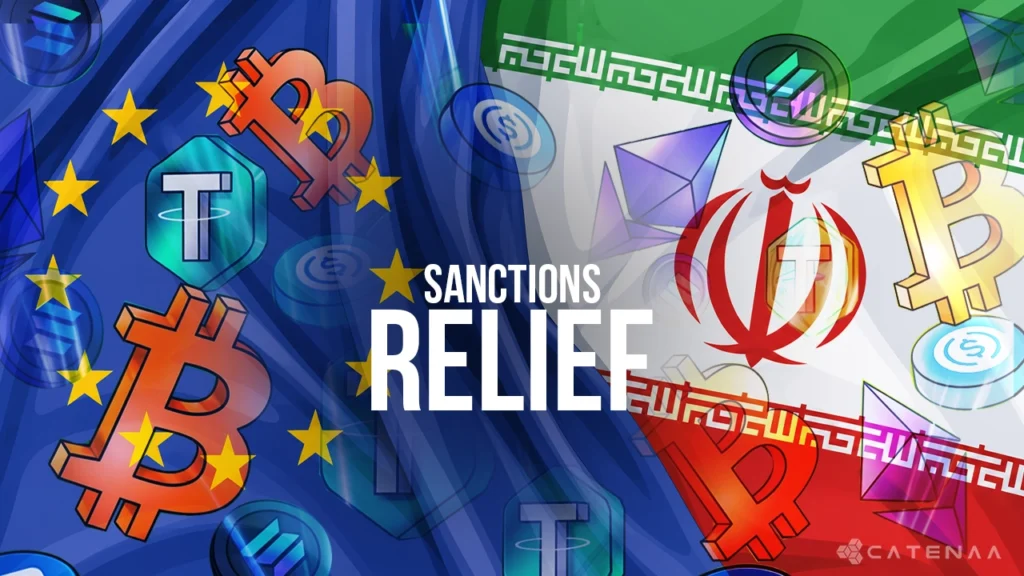


Catenaa, Wednesday, June 17, 2026- Four of Europe’s largest economies are preparing to lift sanctions on Iran following a breakthrough agreement between Washington and Tehran, a development that could reshape global energy markets, expand international trade flows and create new challenges for cryptocurrency investors navigating an increasingly fragmented regulatory environment.
Britain, France, Germany and Italy are reportedly ready to ease restrictions on Tehran as diplomatic efforts gain momentum, marking a significant reversal from policies adopted less than a year ago when European powers moved to restore pressure on Iran over concerns surrounding its nuclear program.
The development comes at a critical moment for cryptocurrency markets, which have already responded positively to signs of de-escalation in the Middle East while simultaneously facing increased scrutiny from regulators targeting Iranian-linked digital asset platforms.
The move represents a dramatic shift in European policy.
In 2025, Britain, France and Germany triggered the so-called “snapback” mechanism that restored United Nations sanctions previously lifted under the Joint Comprehensive Plan of Action, commonly known as the Iran nuclear deal.
European governments argued that Iran had exceeded agreed limits on uranium enrichment and failed to meet certain obligations under the original framework.
Now, following months of negotiations between Washington and Tehran, European leaders appear willing to revisit that position.
The reported sanctions relief would likely focus initially on trade and energy restrictions, particularly those affecting Iranian oil exports.
For global markets, the implications could be substantial.
The most immediate consequence may be felt in energy markets.
Iran possesses some of the world’s largest oil and natural gas reserves, but sanctions have significantly constrained its ability to export those resources to international buyers.
A phased easing of restrictions could increase Iranian crude exports and add additional supply to global markets.
Investors have already begun pricing in that possibility.
Oil prices moved sharply lower following reports of a US-Iran breakthrough, with traders anticipating greater supply availability and reduced geopolitical risk across the Middle East.
Lower energy prices could help ease inflation pressures that have weighed on economies worldwide over the past several years.
That prospect has also contributed to stronger sentiment across equity and cryptocurrency markets.
While traditional markets may welcome sanctions relief, the situation is more complicated for cryptocurrency participants.
The United States recently imposed sanctions on several major Iranian cryptocurrency exchanges, including platforms accused of helping users bypass international restrictions.
Those actions demonstrated that Washington remains willing to aggressively police digital asset networks even while broader diplomatic negotiations continue.
As a result, a significant regulatory gap may emerge.
European companies could eventually receive greater flexibility to engage with Iranian entities, while firms connected to the US financial system remain prohibited from doing so.
That divergence could create compliance challenges for global exchanges, payment providers and digital asset service companies operating across multiple jurisdictions.
The situation highlights one of the cryptocurrency industry’s growing challenges.
Unlike traditional financial institutions, digital asset platforms often operate across borders and serve users from dozens of countries simultaneously.
When regulatory regimes diverge, compliance becomes increasingly difficult.
A European exchange operating legally under revised sanctions rules could still face complications if it maintains relationships with US banks, investors or infrastructure providers.
Secondary sanctions remain a major concern.
These measures allow authorities to penalize foreign entities that conduct business with sanctioned organizations, even if those entities are located outside the United States.
That risk may discourage many firms from expanding Iranian-related activities despite any European policy changes.
Investors have reason to remain cautious.
The original 2015 nuclear agreement resulted in significant sanctions relief after international inspectors verified Iranian compliance.
However, the arrangement unraveled in 2018 when the United States withdrew from the deal and reimposed sanctions.
That history serves as a reminder that geopolitical agreements can prove fragile.
Financial institutions and cryptocurrency companies considering long-term strategies based on sanctions relief must account for the possibility that political conditions could change again.
The current negotiations appear more advanced than previous efforts, but implementation risks remain significant.
Several developments will determine how markets respond over the coming months.
First, investors will closely monitor the formal signing process and any verification mechanisms attached to the agreement.
Second, attention will focus on whether European sanctions relief is matched by broader international cooperation.
Third, cryptocurrency participants will watch for any changes in the US enforcement approach toward Iranian digital asset platforms.
The answers to those questions will influence not only energy markets but also the future operating environment for crypto businesses worldwide.
Europe’s willingness to ease sanctions on Iran marks a potentially significant turning point in global diplomacy and energy markets. However, for cryptocurrency investors and companies, the picture remains far more complex. While traditional trade restrictions may begin to loosen, digital asset platforms continue to face intense scrutiny from regulators concerned about sanctions compliance. The result could be a fragmented financial landscape where geopolitical progress creates new opportunities while simultaneously introducing fresh regulatory risks.
The Joint Comprehensive Plan of Action was signed in 2015 between Iran and major world powers, providing sanctions relief in exchange for restrictions on Iran’s nuclear activities. The agreement led to increased Iranian participation in global energy markets before the United States withdrew in 2018 and reinstated sanctions. Since then, diplomatic efforts to restore a framework have faced repeated setbacks. Cryptocurrency has increasingly entered the discussion because digital assets offer alternative channels for moving value across borders, raising concerns among regulators seeking to enforce sanctions. Recent US actions against Iranian crypto exchanges demonstrate how digital assets have become intertwined with broader geopolitical and financial policy objectives.




