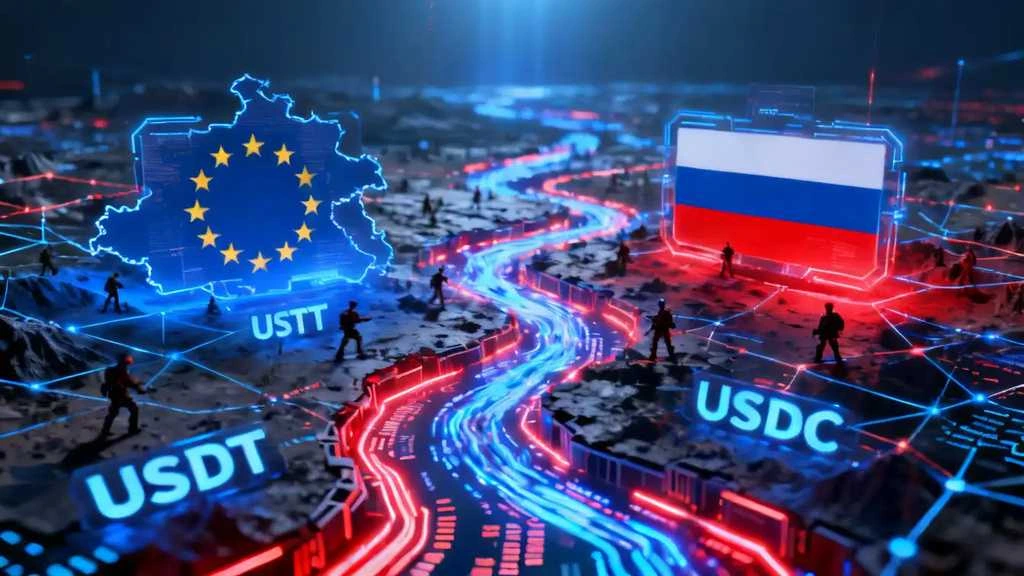


Catenaa, Thursday, June 18, 2026-The global cryptocurrency industry is facing a new era of geopolitical fragmentation after the European Union unveiled plans to ban entire foreign crypto sectors from accessing European markets if they are found to be helping Russia evade sanctions, while Moscow responded by imposing new fees on Western-linked stablecoins including USDT and USDC.
The developments occurred within hours of each other and mark one of the clearest signs yet that digital assets are becoming increasingly entangled in international power politics, economic sanctions and financial sovereignty disputes.
For years, cryptocurrencies were promoted as borderless technologies operating beyond traditional geopolitical constraints.
Recent events suggest that era may be ending.
Instead, governments are increasingly treating digital asset networks as strategic financial infrastructure subject to the same geopolitical pressures that affect banking systems, payment networks and international trade.
The European Union’s latest sanctions package introduces a significant escalation in how crypto-related restrictions could be applied.
Rather than targeting individual exchanges, companies or wallets, Brussels is seeking authority to restrict entire foreign crypto ecosystems if regulators determine those jurisdictions are facilitating sanctions evasion.
The proposed framework would allow the EU to block all crypto-asset services connected to a designated country from accessing European markets.
That represents a major departure from previous sanctions strategies.
Historically, regulators focused on specific entities accused of violating restrictions.
The new approach shifts attention toward entire jurisdictions and the broader financial infrastructure supporting them.
Analysts describe the move as one of the most aggressive regulatory tools yet proposed in the digital asset sector.
The implications extend well beyond Russia.
A jurisdiction-level sanctions model creates compliance challenges for exchanges, custodians, liquidity providers and payment companies operating internationally.
Instead of screening individual customers and entities, firms may need to evaluate exposure to entire countries and regional financial ecosystems.
Major crypto hubs including the United Arab Emirates, Hong Kong, Turkey and several Central Asian markets could face increased scrutiny if regulators conclude they are serving as intermediaries for sanctioned financial activity.
For multinational exchanges, the compliance burden could become significantly more complex.
Companies may be forced to choose between maintaining access to European markets or servicing users in jurisdictions deemed high risk by regulators.
Moscow responded almost immediately.
Russian officials announced new fees of up to 3% on transactions involving Western-linked stablecoins, including Tether’s USDT and Circle’s USDC.
The move forms part of a broader effort to reduce dependence on Western-controlled financial infrastructure and encourage alternatives that operate outside U.S. and European influence.
Stablecoins have become increasingly important in global trade, remittances and cross-border settlements.
USDT and USDC together account for hundreds of billions of dollars in transaction volume across cryptocurrency markets.
Russia’s decision signals that stablecoins are now viewed not only as financial tools but also as instruments of geopolitical influence.
The conflict highlights a growing competition over digital money.
Western-backed stablecoins remain dominant globally, but governments and financial institutions increasingly support alternative payment systems.
China is expanding its digital yuan ecosystem.
Russia continues developing the digital ruble.
Several countries in the Gulf region are investing heavily in central bank digital currency infrastructure.
Meanwhile, stablecoin regulation has become a major policy priority across the United States, Europe and Asia.
The battle is no longer simply about technology.
It is increasingly about who controls the future architecture of international payments.
Industry observers have warned for several years that cryptocurrency markets could eventually fragment along geopolitical lines.
Recent developments suggest that process may already be underway.
The original vision of a globally interconnected digital asset ecosystem is facing pressure from sanctions, national security concerns and competing regulatory frameworks.
Different regions are increasingly developing their own approaches to digital finance.
Europe is implementing MiCA regulations.
The United States is advancing stablecoin legislation and market structure reforms.
China continues building state-backed digital payment systems.
Russia is pursuing financial infrastructure designed to reduce reliance on Western networks.
The result may be a future where cryptocurrency markets remain global in technology but increasingly regional in regulation.
For exchanges and financial institutions, compliance is rapidly becoming one of the sector’s most important competitive factors.
The new European approach requires firms to understand not only who their customers are but also how broader transaction flows interact with international sanctions frameworks.
Companies operating across multiple jurisdictions may need to invest heavily in monitoring systems, legal expertise and risk-management infrastructure.
Those costs could reshape the industry’s competitive landscape.
Larger firms with extensive compliance resources may benefit, while smaller operators could struggle to navigate increasingly complex regulatory requirements.
The developments also reflect broader shifts occurring across international finance.
Governments worldwide are seeking greater control over digital payment systems, settlement networks and cross-border financial flows.
Cryptocurrencies, stablecoins and blockchain infrastructure have become central to that competition.
What began as a technology movement is increasingly becoming part of a larger struggle over financial influence, economic sovereignty and global monetary power.
The European Union’s proposed authority to ban entire foreign crypto sectors, combined with Russia’s move against Western stablecoins, marks a significant escalation in the geopolitical battle over digital finance. The measures demonstrate how cryptocurrencies have evolved from niche financial instruments into strategic assets increasingly shaped by sanctions policy, national security concerns and global economic competition. For investors and businesses, the message is becoming clear: understanding geopolitics may soon be just as important as understanding blockchain technology.
The European Union has steadily expanded sanctions targeting Russian financial activity since the outbreak of the Ukraine conflict. Earlier sanctions packages focused on individual entities, exchanges and financial institutions. The latest proposal broadens that approach by targeting entire jurisdictions that may facilitate sanctions evasion. At the same time, Russia has accelerated efforts to develop alternative financial infrastructure, including the digital ruble and expanded use of non-Western payment systems. Stablecoins have become an important battleground because they enable rapid cross-border value transfers outside traditional banking channels. As governments increasingly recognize the strategic importance of digital assets, regulation is shifting from investor protection toward broader questions of economic security and geopolitical influence.