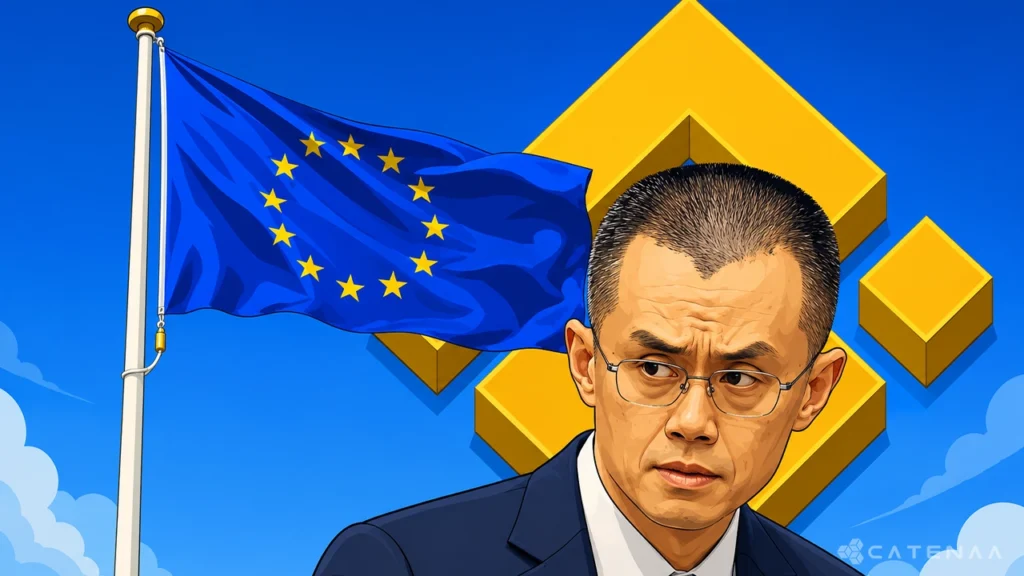


Catenaa, Friday, July 03, 2026- Binance founder Changpeng “CZ” Zhao has claimed the cryptocurrency exchange’s application for a Markets in Crypto-Assets (MiCA) licence in Greece was fully compliant and close to approval before political factors derailed the process, forcing the company to withdraw its bid.
Speaking during the inaugural episode of The Starting Block, CZ said Binance had attracted interest from two European Union member states seeking to host its MiCA authorization before “other forces” intervened.
His remarks come just ahead of the July 1 deadline requiring crypto firms operating across the European Union to hold MiCA authorization or cease regulated activities.
CZ said Binance’s application had met regulatory requirements and was progressing toward approval before being unexpectedly halted.
He described competition between two EU jurisdictions seeking Binance’s licence as a form of “bidding war” before external political factors changed the outcome.
Binance officially withdrew its Greek application last week and has since confirmed it intends to seek authorization through another EU member state.
Co-Chief Executive Richard Teng has said the exchange remains committed to obtaining a MiCA licence within the coming months.
During the interview, CZ addressed speculation that senior European policymakers may have influenced the licensing process.
While reports have suggested that European Central Bank President Christine Lagarde may have opposed Binance’s application, CZ said he had seen only public speculation and possessed no documentary evidence supporting those claims.
He also said Binance itself had not identified any verified documents confirming political interference.
The comments arrive as the European Union completes implementation of MiCA, its landmark regulatory framework governing crypto-assets.
Spain’s securities regulator has already stated that firms without authorization after July 1 will receive no extensions or exemptions.
CZ argued the failed application represents a setback for both Binance and Europe.
He compared the situation with Binance’s previous regulatory experiences in Japan and Singapore, where the company initially faced licensing setbacks before later securing approval in Japan while withdrawing from Singapore.
CZ also commented on Strategy’s recently introduced Digital Credit Capital Framework, saying he still finds the company’s STRC preferred stock difficult to understand despite repeated explanations.
He described many modern financial products as overly complex while emphasizing he has confidence in Strategy Executive Chairman Michael Saylor, whom he called a respected Bitcoin advocate.
CZ said Bitcoin’s long-term investment appeal is strong but noted that its price volatility can complicate the design of leveraged financial products.
The Binance founder also revealed he has donated $2 million to Prison Professors, a nonprofit organization supporting prisoner rehabilitation, following his release from a four-month US prison sentence.
Separately, CZ confirmed he invested approximately $500 million in Elon Musk’s acquisition of Twitter, now X, giving him roughly a 1% ownership stake.
He also disclosed that he approached Musk about integrating Binance with X Money, but Musk responded that the platform currently has no plans to incorporate cryptocurrency payments.
MiCA establishes the European Union’s first unified regulatory framework for crypto-assets, requiring exchanges, custodians and other digital asset service providers to obtain authorization from a national regulator before offering services across the bloc. The framework introduces common standards covering governance, consumer protection, capital requirements and market integrity, allowing licensed firms to passport their services throughout the European Economic Area. Binance is among several major exchanges seeking MiCA authorization as Europe becomes one of the world’s largest regulated crypto markets.