

Catenaa, Sunday, May 17, 2026- A major US cryptocurrency market structure bill over the weekend moved closer to becoming law after clearing a key Senate committee, but lawmakers, analysts and industry groups warned that political divisions, ethics disputes and regulatory concerns could still derail the legislation before a final Senate vote.
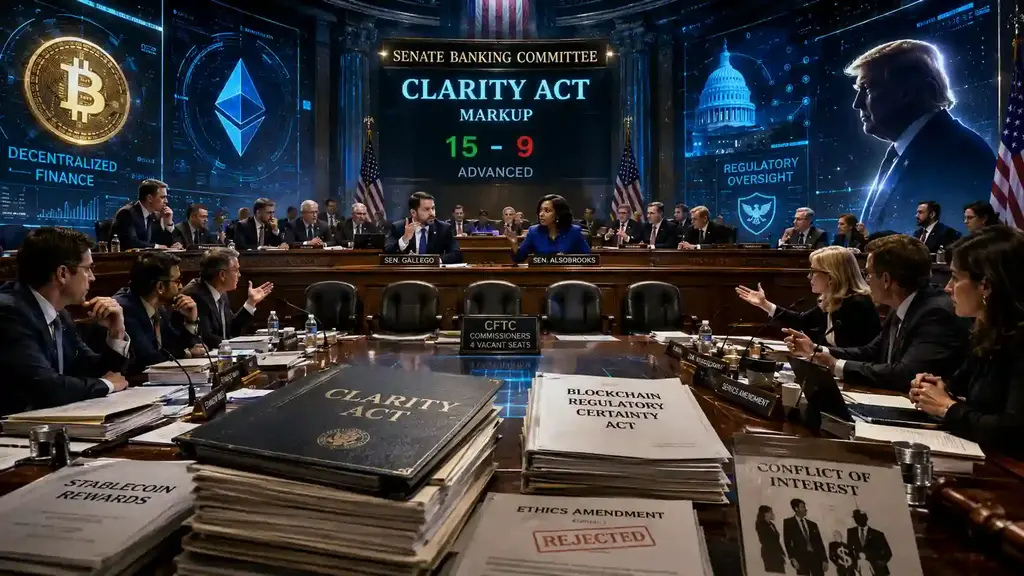
The Senate Banking Committee voted 15-9 last week to advance the CLARITY Act, a sweeping proposal that would create the first broad federal framework governing the digital asset industry. Democratic Sens. Ruben Gallego and Angela Alsobrooks joined Republicans in supporting the measure after months of negotiations involving lawmakers, regulators, banks, crypto firms and the White House.
The legislation would divide oversight of digital assets between the Securities and Exchange Commission and the Commodity Futures Trading Commission, while establishing federal rules for trading platforms, token issuers and decentralized finance projects.
Senate Questions
Despite the committee victory, analysts said the legislation still faces major obstacles before reaching President Donald Trump’s desk.
TD Cowen analyst Jaret Seiberg raised the probability of passage to 40% from roughly one-third, but said significant hurdles remain.
The Senate bill must still merge with a separate version approved earlier by the Senate Agriculture Committee before heading to the Senate floor, where at least 60 votes would likely be needed to overcome procedural barriers.
Benchmark analyst Mark Palmer said broader Democratic backing would be necessary because only two Democrats supported the Banking Committee version.
Timing may also complicate the bill’s prospects as lawmakers approach the November midterm elections.
Ethics Fight
Ethics concerns linked to Trump family crypto ventures remain one of the biggest political flashpoints surrounding the bill.
Democrats have demanded stronger conflict-of-interest rules preventing presidents, lawmakers and senior federal officials from holding or promoting digital assets while overseeing crypto policy.
Gallego warned during the markup hearing that he could vote against the legislation later unless ethics language is strengthened before the full Senate vote.
Sen. Chris Van Hollen proposed an amendment blocking elected officials and their families from owning or promoting digital assets. The amendment failed in a 13-11 vote.
Bloomberg estimated earlier this year that Trump family crypto projects, including ventures tied to World Liberty Financial, generated at least $1.4 billion since the inauguration.
Analysts said Republicans may resist a direct ethics vote because opponents could portray it as support for Trump family crypto activity during election campaigns.
DeFi Debate
Another major dispute centered on the Blockchain Regulatory Certainty Act, a provision designed to clarify that noncustodial software developers are not automatically classified as money transmitters.
Crypto firms and decentralized finance advocates strongly backed the provision, arguing that software developers should not face criminal liability simply for publishing code.
Law enforcement officials and several Democrats warned the language could weaken efforts to combat money laundering and illicit finance involving decentralized finance platforms.
Lawmakers eventually added compromise language stating developers could still face prosecution if they intentionally helped move criminal funds.
The compromise followed concerns tied to the prosecution of Roman Storm, a developer linked to crypto mixer Tornado Cash.
Sen. Catherine Cortez Masto argued during the hearing that parts of the bill could make it harder for law enforcement agencies to pursue criminals using decentralized finance systems.
Still, crypto advocacy groups welcomed the committee outcome. Peter Van Valkenburgh said protections for noncustodial developers remained intact after the markup process.
CFTC Pressure
The growing importance of the bill has also intensified pressure on the White House to fully staff the Commodity Futures Trading Commission.
House Agriculture Committee Chairman Glenn Thompson and Ranking Member Angie Craig jointly urged Trump to appoint commissioners to the four vacant CFTC seats.
The CFTC currently operates with only Chairman Michael Selig serving as commissioner after multiple departures left the agency effectively controlled by a single member.
The lawmakers said the agency would be “best served by a full five-member commission” capable of writing more durable regulations and handling increasingly complex crypto oversight responsibilities.
If the CLARITY Act becomes law, the CFTC would receive broad authority over spot crypto commodity markets, dramatically expanding its role in digital asset regulation.
The request for more commissioners also comes as the agency prepares for aggressive rulemaking covering prediction markets, decentralized finance and digital commodities.
The House Agriculture leaders noted that the CFTC has roughly 543 staff members, far fewer than the SEC’s approximately 4,200 employees, despite its growing responsibilities.
Some Democrats want safeguards added directly into the legislation. Sen. Amy Klobuchar proposed requiring at least four commissioners to be seated before major new CFTC crypto rules can take effect.
Industry Stakes
The crypto industry considers passage of the CLARITY Act one of its most important policy goals in years.
Industry-backed group Stand With Crypto said the eventual Senate floor vote could become the most important crypto-related vote lawmakers have faced.
The legislation also follows months of lobbying by major crypto firms, including Coinbase, which previously helped delay an earlier Senate markup amid disagreements over stablecoin reward provisions.
Meanwhile, Sen. Mark Warner joked during the hearing that months of negotiations had left him trapped in “crypto purgatory.”