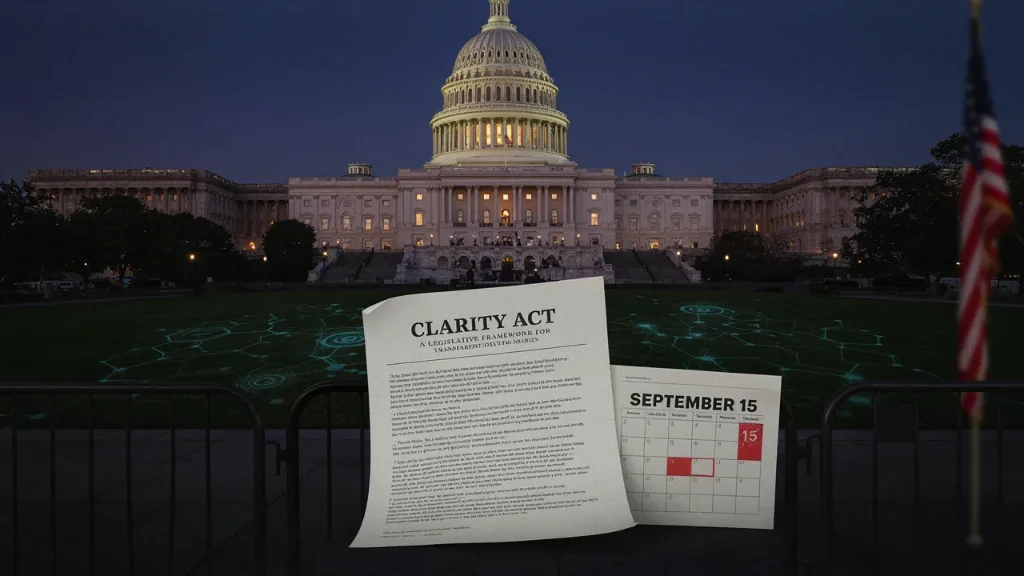


Catenaa, Thursday, August 13, 2026- The US Clarity Act faces an increasingly difficult path through Congress after Senate leaders postponed an initial procedural vote until Sept. 15, leaving lawmakers a narrow window to resolve disputes over stablecoins, ethics and illicit finance.
Senate Majority Leader John Thune filed for a cloture vote before lawmakers left Washington for their August recess. The Senate is scheduled to return Sept. 14.
The delay does not kill the crypto market structure bill. However, it compresses negotiations into a short legislative period already crowded with government funding and defense measures.
TD Cowen’s Washington Research Group estimates the legislation has only a 25% chance of becoming law within the next few months.
The stakes extend well beyond another piece of crypto legislation.
The Clarity Act seeks to establish a federal framework for digital assets and give the Commodity Futures Trading Commission broader authority over parts of the crypto market.
One unresolved dispute concerns stablecoin rewards.
A compromise negotiated earlier this year would prevent platforms from paying rewards simply for holding stablecoins while permitting certain rewards linked to payments and transactions.
However, banking groups continue seeking tighter restrictions, raising the possibility that lawmakers could reopen the provision.
Ethics rules have emerged as another obstacle amid scrutiny of President Donald Trump’s crypto interests.
A proposal from Sens. Ruben Gallego, D-Ariz., and Thom Tillis, R-N.C., would allow state attorneys general to enforce restrictions preventing public officials and their spouses from issuing or sponsoring digital assets.
Concerns over illicit finance and consumer protection remain unresolved as well. Some lawmakers argue the legislation does not give authorities sufficient tools to combat illegal activity, while crypto industry groups dispute that assessment.
Timing may now become as dangerous to the bill as the policy disagreements.
The Senate and House are scheduled to remain in Washington only until Oct. 2 before leaving for October. The approaching November elections could make floor time increasingly difficult to secure.
Even Senate passage would not finish the process.
The House passed its own version of the Clarity Act last year, but differences remain between the two measures. The House version, for example, does not contain the Senate’s current provisions covering stablecoin rewards.
That means further negotiations could be required before identical legislation can clear both chambers and reach the president.
Meanwhile, regulators are moving ahead without waiting for Congress.
The Securities and Exchange Commission is scheduled to meet Friday to consider proposing a tailored offering regime for certain crypto-related investment contracts.
The SEC and CFTC are also pursuing regulatory changes under their joint Project Crypto initiative.
Agency action could offer the industry some near-term clarity. However, regulatory rules and exemptions can be changed by future administrations more easily than legislation enacted by Congress.
That distinction increases the importance of September’s Senate battle.
Catenaa View
The Clarity Act’s biggest threat may now be the congressional clock rather than outright opposition to crypto legislation.
Several disagreements remain, but the Senate’s September calendar gives lawmakers little room for prolonged negotiations. A failed procedural vote or another delay could push the legislation deeper into an election-focused period.
There is also an emerging second track.
While Congress struggles to establish permanent statutory rules, the SEC and CFTC are moving ahead with their own crypto frameworks. That could gradually reduce pressure for immediate congressional action while simultaneously creating a patchwork that future administrations could alter.
For the crypto industry, therefore, regulatory progress from Washington does not necessarily make the Clarity Act less important. It may make legislation more valuable because congressional law would give businesses greater long-term certainty than agency policy alone.
What to Watch
Sept. 15 is now the first major test. The cloture vote will indicate whether Senate leaders have enough support to move the bill toward final consideration.
Watch whether lawmakers reopen Section 404 covering stablecoin rewards. Renewed negotiations there could consume valuable time and revive the banking industry’s dispute with crypto companies.
The proposed ethics compromise involving public officials and digital assets will also matter. Failure to resolve that issue could cost votes needed for Senate passage.
Attention should then turn to the House. Even if the Senate approves the measure, differences between the chambers could prevent a quick path to the president’s desk.
Finally, watch the SEC and CFTC. The more regulatory policy they establish while Congress remains stalled, the more the United States could develop its crypto framework through agencies before lawmakers agree on permanent legislation.