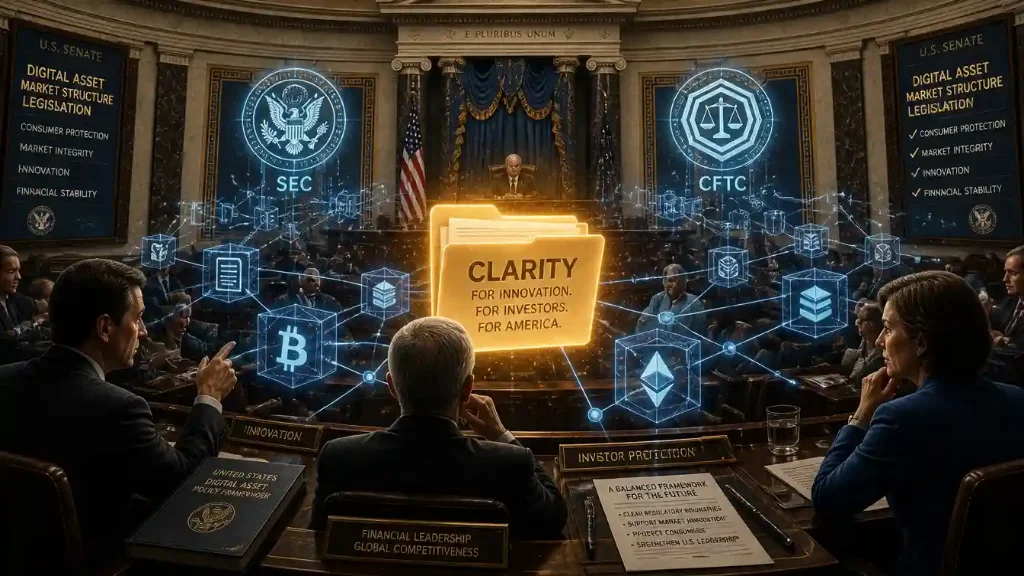


Catenaa, Wednesday, August 05, 2026- The US Senate is heading toward a pivotal vote on the Digital Asset Market CLARITY Act this week, setting the stage for what could become the most consequential legislative test yet for the American cryptocurrency industry.
Senate Majority Leader John Thune has confirmed the legislation will be brought to the Senate floor before lawmakers leave for the August recess. However, supporters still face the difficult task of securing the 60 votes needed to overcome a filibuster.
Although Republicans broadly back the legislation, several Democratic votes remain uncertain as negotiations continue over ethics provisions, stablecoin regulations and other contentious amendments.
The CLARITY Act would establish the first comprehensive federal framework governing digital asset markets by clearly dividing regulatory authority between the Securities and Exchange Commission (SEC) and the Commodity Futures Trading Commission (CFTC).
Under the proposal, the SEC would retain oversight of investment contracts and tokenized securities, while the CFTC would assume primary authority over spot markets for digital commodities, ending years of regulatory ambiguity surrounding many cryptocurrencies.
The legislation is viewed as particularly important for crypto exchanges, token issuers and decentralized finance projects seeking clearer legal classifications.
Bitcoin is expected to be largely unaffected because it is already widely treated as a commodity under existing regulatory interpretations.
Negotiators, however, continue to face three major obstacles before the bill can secure bipartisan support.
The first involves restrictions on stablecoin rewards. The Senate Banking Committee’s version would prohibit interest-bearing stablecoins in certain circumstances, a provision that parts of the digital asset industry argue could hinder innovation and place crypto firms at a competitive disadvantage against traditional banks.
A second dispute centers on ethics provisions tied to public officials’ cryptocurrency activities.
Several Democratic senators continue pushing for stronger restrictions on elected officials and their families issuing or promoting digital assets, concerns that have intensified amid scrutiny surrounding President Donald Trump’s cryptocurrency ventures.
Recent negotiations have proposed temporary restrictions extending through 2029, but lawmakers have yet to reach a final compromise acceptable to both parties.
A third area of debate concerns prediction markets.
Tribal gaming regulators and several senators have urged lawmakers to clarify that sports betting and casino-style prediction markets remain subject to state and tribal gaming laws rather than falling exclusively under the jurisdiction of the Commodity Futures Trading Commission.
Supporters argue such clarification would preserve existing gaming regulations, while others contend prediction markets should be addressed separately from broader cryptocurrency legislation.
Failure to pass the CLARITY Act before Congress adjourns for the August recess could significantly delay comprehensive digital asset legislation.
With lawmakers expected to shift attention toward election campaigning and federal budget negotiations after the recess, industry observers believe another realistic opportunity may not emerge until well into 2027.
The delay would leave regulators to continue shaping cryptocurrency oversight primarily through agency rulemaking and enforcement actions rather than legislation, prolonging legal uncertainty for exchanges, token issuers and institutional investors.
Analysts note that unlike Europe’s implementation of the Markets in Crypto-Assets (MiCA) framework, the United States still lacks a unified statutory structure governing digital asset markets.
Even if Congress ultimately approves the legislation, implementation would not be immediate.
The current draft provides for a 360-day transition period following enactment, followed by extensive SEC and CFTC rulemaking before most provisions take effect.
Nevertheless, industry participants view Senate approval as a landmark signal that the United States is prepared to establish a comprehensive legal framework for digital assets after years of fragmented oversight.
The Digital Asset Market CLARITY Act is designed to establish clear regulatory boundaries between the SEC and CFTC for digital assets. The legislation seeks to provide legal certainty for cryptocurrency exchanges, issuers, institutional investors and blockchain developers while creating a federal framework governing digital commodity markets. The Senate vote is widely viewed as one of the most significant milestones for US cryptocurrency regulation since the approval of spot Bitcoin exchange-traded funds.




