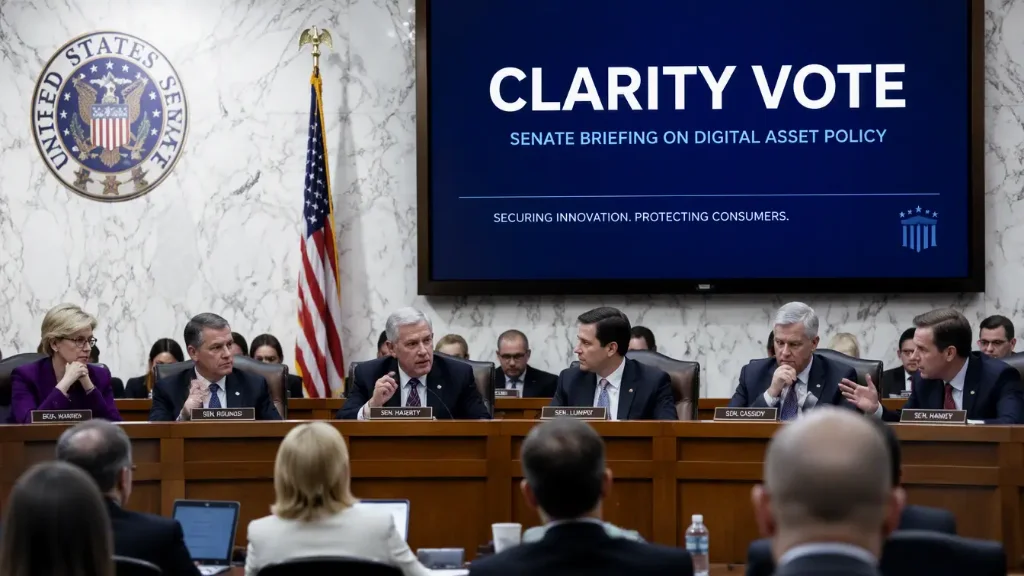


Catenaa, Wednesday, August 05, 2026- The Blockchain Association on Monday rejected claims that the Clarity Act would weaken financial crime enforcement, as the Senate enters what may be its final opportunity this year to advance the digital asset market structure bill before lawmakers leave Washington.
The industry group sent a letter Monday to Senate Majority Leader John Thune and Senate Minority Leader Chuck Schumer, responding to concerns raised by the National Sheriffs’ Association over provisions covering decentralized finance and software developers.
The dispute comes as Senate leaders consider an initial procedural vote before the chamber begins its August recess Friday. Failure to advance the legislation this week could push further action beyond the November elections.
The bill would divide digital asset oversight between the Securities and Exchange Commission and the Commodity Futures Trading Commission while establishing federal rules for exchanges, brokers and other intermediaries.
The National Sheriffs’ Association, representing thousands of sheriffs and public safety officials, warned last week that the legislation contained broad exemptions involving anti-money laundering rules, sanctions enforcement and customer identification requirements.
The association argued that decentralized finance platforms should not receive blanket exclusions from obligations applied to other financial businesses.
The Blockchain Association disputed that interpretation. It said the bill would impose strict duties on intermediaries that control customer assets or execute transactions while preserving protections for developers who publish neutral, non-custodial software.
The group also argued that the sheriffs’ position did not represent a unified law enforcement view.
It pointed to a separate letter signed by 160 former law enforcement and national intelligence officials supporting the bill’s advancement.
The competing letters show that the debate is no longer limited to financial regulators and crypto companies. Law enforcement groups are now divided over whether the proposal creates useful legal boundaries or potential gaps for illicit finance.
The disagreement centers partly on Section 10604, known as the Blockchain Regulatory Certainty Act.
The provision would create a safe harbor for developers of non-custodial blockchain software and clarify that they are not automatically treated as money transmitters.
The National Sheriffs’ Association wants the section deleted or narrowed, warning that developers and protocol operators could use it to avoid compliance duties.
The Blockchain Association said the provision draws a necessary distinction between financial intermediaries and developers who write or publish software without controlling user funds.
Under that interpretation, a developer producing open-source code would not face the same obligations as an exchange, broker or custodial service.
However, businesses that control a protocol, handle customer assets or exercise decision-making authority would remain subject to federal regulation, regardless of whether they describe their systems as decentralized.
The bill would also direct the SEC to develop rules addressing entities that claim decentralization while retaining operational control.
Although the industry group is trying to settle the DeFi dispute, ethics provisions remain the largest unresolved issue.
Senate Democrats have demanded stronger restrictions addressing President Donald Trump’s digital asset interests, including his memecoin and his family’s involvement in World Liberty Financial.
New bipartisan language was sent to the White House last week, but lawmakers had not reached an agreement by Monday afternoon.
The dispute has become central to the bill’s chances of securing the 60 votes normally required to overcome procedural barriers in the Senate.
Republicans want to establish federal digital asset rules before the election campaign dominates the congressional calendar. Democrats argue that no market structure bill should advance without enforceable limits on elected officials benefiting from crypto ventures.
The Blockchain Association’s latest intervention appears designed to remove other disputes so the measure can move quickly if an ethics agreement is reached.
Thune has not announced a date for the procedural vote, although he indicated Monday that he still expected the Senate to act before recess.
A motion to proceed would not guarantee passage, but it would show whether supporters have assembled enough votes to continue debate.
The compressed schedule leaves little time for further negotiation, amendment drafting and procedural delays.
Even if the Senate advances the bill, lawmakers would still need to reconcile differences with the House before legislation could reach the president.
The remaining process therefore extends well beyond this week. However, supporters view Senate action before recess as necessary to keep the proposal alive during the election season.
The debate illustrates how digital asset legislation has moved beyond the traditional question of which regulator should oversee crypto markets.
Lawmakers are now confronting harder issues involving software liability, decentralized protocols, sanctions compliance, political conflicts of interest and the limits of financial surveillance.
The outcome could affect whether developers can publish non-custodial software without being treated as financial institutions.
It could also determine how regulators identify the point at which a decentralized application becomes a controlled financial service.
For the industry, failure to advance the bill would extend reliance on enforcement actions, court decisions and agency interpretations.
For critics, rushing the legislation could create loopholes that become difficult to close later.
The Clarity Act enters the final days before the Senate recess with two disputes still threatening its progress.
One concerns whether developer protections weaken financial crime enforcement. The other concerns whether elected officials can continue profiting from crypto ventures while shaping the rules governing them.
The Blockchain Association has attempted to close the first dispute. The bill’s immediate future may now depend on whether senators can resolve the second before Friday.
The Clarity Act is a proposed U.S. digital asset market structure law designed to define the roles of the SEC and CFTC. It would establish federal standards for digital asset intermediaries, customer protection, market supervision and illicit finance controls. The legislation also includes protections for developers who create non-custodial blockchain software without controlling customer assets. Supporters say the measure would replace fragmented oversight with clear national rules. Opponents argue that some provisions could weaken investor protection, sanctions enforcement and anti-money laundering safeguards. The Senate’s current draft also contains ethics language responding to concerns about elected officials holding or promoting digital assets while influencing federal policy.