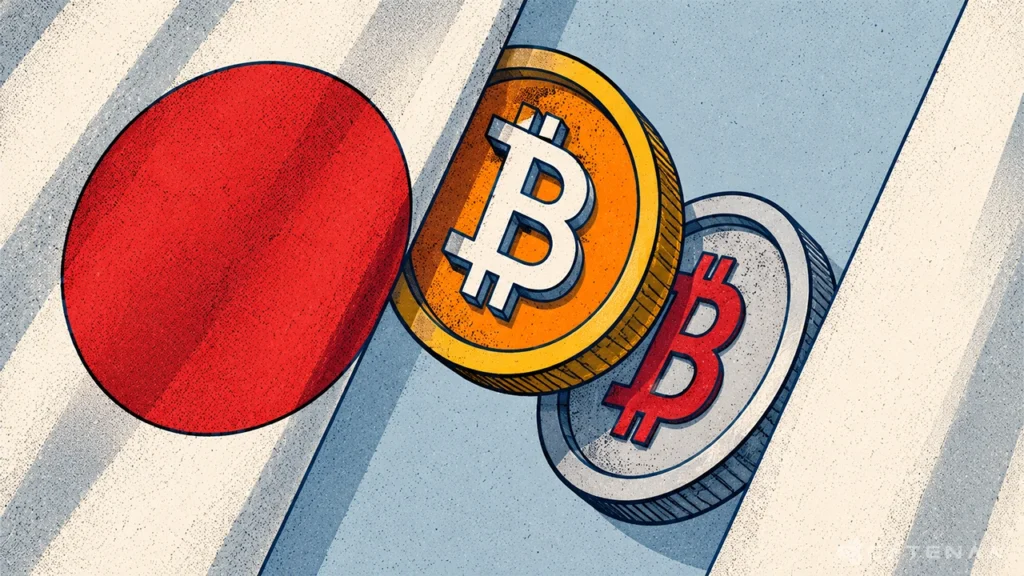


Catenaa, Saturday, August 08, 2026-The Bank of Japan’s decision to keep interest rates unchanged while maintaining its tightening stance is drawing renewed attention from cryptocurrency investors, as a stronger yen and a gradual unwinding of the long-running carry trade could reduce liquidity flowing into risk assets such as Bitcoin.
The central bank left its benchmark policy rate at 1.0% following its latest monetary policy meeting, shortly after Japanese authorities confirmed intervening in foreign exchange markets by buying yen and selling U.S. dollars to support the country’s currency.
Although the intervention briefly pushed the yen sharply higher, the currency later surrendered much of its gains, reinforcing market expectations that intervention alone cannot reverse longer-term exchange rate trends without broader monetary policy support.
The policy decision matters well beyond Japan’s borders because the Japanese yen has long served as one of the world’s cheapest funding currencies.
Global investors have traditionally borrowed low-cost yen before investing in higher-yielding assets, including equities, bonds and increasingly digital assets.
That strategy, known as the yen carry trade, depends largely on the wide interest rate differential between Japan and the United States.
As the Bank of Japan gradually raises interest rates while the U.S. Federal Reserve approaches the end of its tightening cycle, that gap could narrow, making leveraged positions less attractive.
For cryptocurrency markets, changes in global liquidity often matter more than changes in industry-specific news.
A stronger yen or faster-than-expected Japanese monetary tightening could encourage investors to unwind leveraged positions funded through yen borrowing, reducing capital available for speculative investments such as Bitcoin.
Markets witnessed a similar dynamic during Japan’s surprise policy shift in 2024, when a stronger yen contributed to widespread deleveraging across global financial markets and weighed on cryptocurrency prices.
While analysts note current conditions appear less severe because investors already anticipate gradual policy normalization, Japan’s monetary policy is becoming an increasingly important macroeconomic variable for digital assets.
Japan has repeatedly intervened in currency markets over the past two years to support the yen.
However, previous interventions produced only temporary gains before broader interest rate differentials reasserted themselves.
That pattern repeated following the latest operation, suggesting that exchange rate movements will continue to depend primarily on monetary policy rather than direct market intervention.
Market participants are now focusing on future guidance from Bank of Japan Governor Kazuo Ueda for indications of when additional rate increases may occur.
The immediate impact on cryptocurrency markets may remain limited if Japan continues raising interest rates gradually.
An orderly normalization would likely allow investors sufficient time to adjust leveraged positions without triggering broad market disruptions.
However, an unexpectedly rapid pace of tightening or another sharp appreciation in the yen could increase volatility across cryptocurrencies, equities and other risk-sensitive assets.
For Bitcoin investors, Japanese monetary policy has evolved from a regional economic issue into an increasingly influential component of the global macro environment.
The Bank of Japan’s latest decision underscores how global central bank policies continue shaping digital asset markets.
While the central bank left interest rates unchanged, its commitment to gradual tightening keeps attention focused on the future of the yen carry trade, a longstanding source of liquidity supporting global risk assets.
As monetary policy gradually normalizes, Bitcoin investors may increasingly need to monitor Tokyo alongside Washington when assessing macroeconomic risks.
The yen carry trade is a long-established investment strategy in which investors borrow Japanese yen at relatively low interest rates to finance purchases of higher-yielding assets elsewhere. Because Japan maintained ultra-low interest rates for decades, the strategy became a major source of global liquidity supporting investments across equities, bonds, commodities and cryptocurrencies. As the Bank of Japan gradually exits its ultra-loose monetary policy, investors are closely watching whether higher Japanese borrowing costs will reduce leverage across international financial markets.




