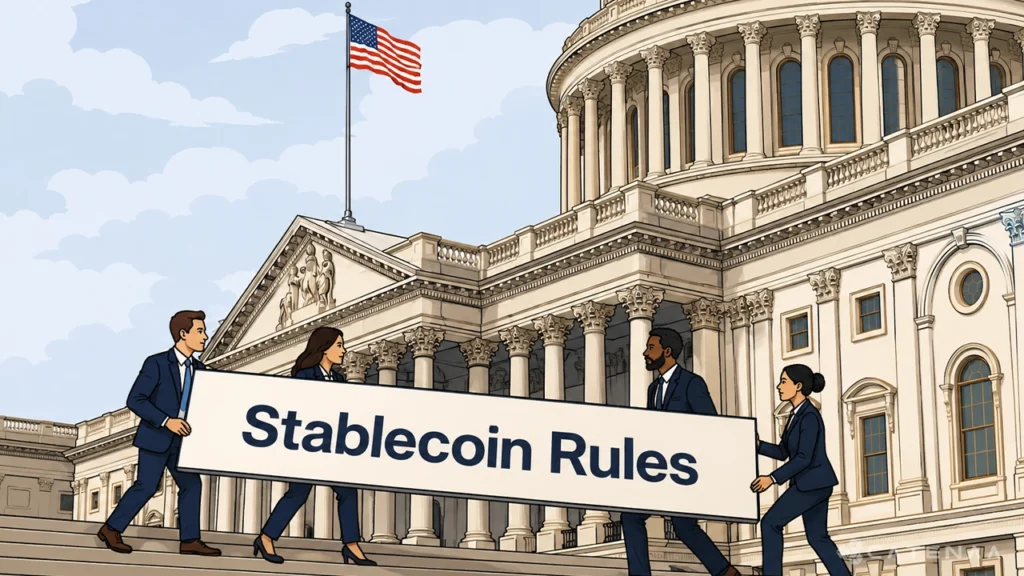


Catenaa, Thursday, May 14, 2026-The American Bankers Association launched a final lobbying push ahead of a pivotal Senate committee vote on crypto legislation, warning lawmakers that weak restrictions on stablecoin rewards could trigger a shift of deposits away from traditional banks.
ABA Chief Executive Rob Nichols sent an urgent letter to bank executives Sunday night urging them to pressure senators before Thursday’s Senate Banking Committee markup hearing on the Clarity Act and related stablecoin provisions. The banking industry argues the latest compromise language still leaves openings for crypto firms to offer rewards that function similarly to bank interest payments.
The Senate Banking Committee is preparing to review one of the most expansive crypto regulatory packages ever considered in Congress. The legislation would establish a federal framework for digital asset oversight and define how stablecoins operate within the US financial system.
Stablecoins are digital tokens typically tied to the US dollar and widely used across crypto trading and payments networks. Banking groups fear these tokens could increasingly compete with savings accounts if issuers or exchanges offer financial incentives for holding them.
The dispute intensified after Congress passed the GENIUS stablecoin law last year. While the law blocks stablecoin issuers from directly paying interest, crypto platforms may still offer reward programs tied to token holdings.
Coinbase and other crypto firms have defended rewards programs as part of normal digital finance competition. Banking groups argue the structure could drain deposits from smaller banks and weaken lending capacity across local economies.
The latest Senate compromise attempts to limit those risks by banning “covered parties” from offering yield or interest like payments solely for holding stablecoins. The language also bars incentives considered economically equivalent to bank deposit interest.
At the same time, lawmakers carved out exceptions for transaction based rewards tied to legitimate activities. That exemption has become the latest source of disagreement between banks and crypto firms.
Banking trade groups warned senators last week that the wording remains vague and could allow firms to bypass restrictions through creative reward structures. Industry groups pointed to scenarios where platforms pay customers fixed monthly rewards tied to growing stablecoin balances.
Crypto companies argue tighter restrictions would reduce innovation and weaken the US digital asset industry against overseas competitors. Some lawmakers also worry aggressive restrictions could push stablecoin activity outside regulated markets.
The White House has attempted to broker negotiations between both sides for months as pressure builds to finalize crypto legislation before the August congressional recess.
Banking executives said the current Senate proposal still threatens financial stability by encouraging customers to move funds away from insured bank deposits. Financial industry groups warned that regional and community banks could face liquidity pressure if stablecoins gain broader consumer adoption.
White House crypto adviser Patrick Witt rejected criticism from the banking sector and accused industry leaders of refusing earlier negotiations organized by federal officials. Witt said the administration attempted to resolve the reward dispute during meetings held in February.
Policy analysts said lawmakers now face a difficult challenge balancing banking sector concerns with demands from crypto firms seeking broader digital payment adoption. Market observers believe stablecoin regulation has become one of the most politically sensitive sections of the broader crypto legislation package.
Researchers tracking the sector said the Senate’s handling of stablecoin rewards could shape how digital dollar systems evolve across the US financial market over the next decade.
The fight over stablecoin rewards has become one of the largest obstacles facing Congress as lawmakers work toward federal crypto regulation. Banks fear deposit losses and weaker lending activity, while crypto firms argue restrictive rules could damage innovation and limit consumer choice.
Last Thursday’s Senate Banking Committee hearing may determine whether lawmakers can move the legislation forward before the election cycle intensifies political divisions in Washington.
Even if the bill advances, negotiations over stablecoin rewards, ethics rules and financial oversight are expected to continue for months as both industries push aggressively for influence over the final framework.
Stablecoins became one of the fastest growing sectors in crypto markets during the past five years as traders and payment firms searched for blockchain based dollar alternatives. The market expanded rapidly after firms including Tether and Circle gained global adoption.
US lawmakers increased scrutiny following the collapse of TerraUSD in 2022, which erased billions of dollars and exposed weaknesses in algorithmic stablecoin systems. Since then, regulators and banks have debated how stablecoins should operate alongside traditional finance.
Banking groups worry large scale stablecoin adoption could reduce deposits held inside regulated banks, affecting lending and financial stability. Crypto firms argue stablecoins can modernize payments and reduce transaction costs. The latest Senate negotiations reflect wider tensions between traditional finance and digital asset companies as Washington works toward the first large scale federal crypto rulebook.




