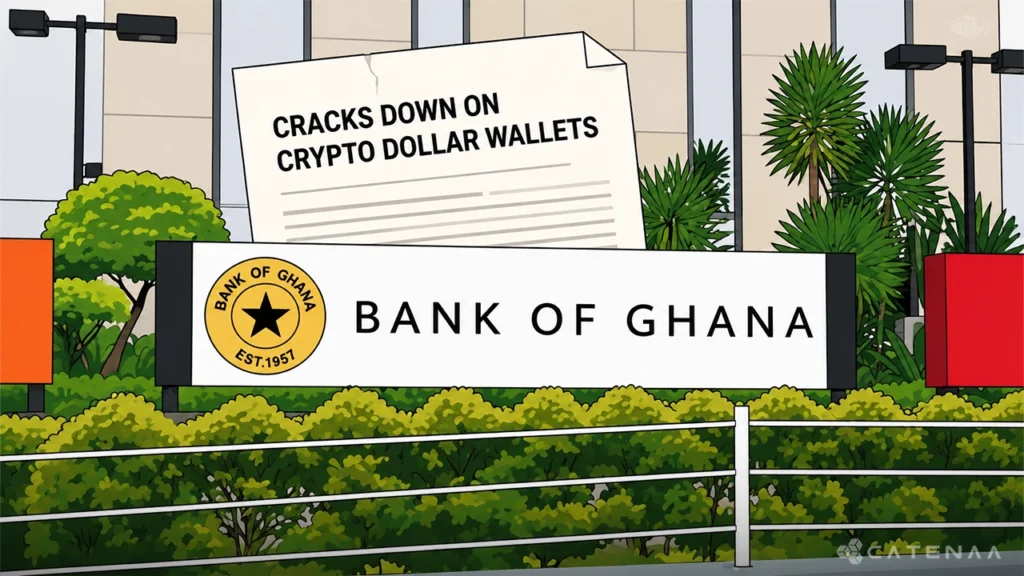


Catenaa, Friday, June 19, 2026- The Bank of Ghana has ordered all regulated financial institutions to immediately cease supporting foreign currency digital wallets offered by cryptocurrency platforms, marking one of the country’s strongest regulatory actions against crypto-linked financial services and raising new questions about the future of digital asset adoption across Africa.
The directive, issued on June 12, requires banks, payment service providers, electronic money issuers and deposit-taking institutions to terminate relationships that facilitate cryptocurrency platforms offering U.S. dollar-denominated wallet services.
The move reflects growing concern among policymakers about unofficial dollarization, foreign exchange controls and the expanding role of cryptocurrency platforms within national payment systems.
Financial institutions that fail to comply face potential enforcement actions from the central bank.
The Bank of Ghana’s order does not directly prohibit cryptocurrency ownership.
Instead, it focuses on the financial infrastructure that allows crypto platforms to operate dollar-denominated wallet services.
According to the regulator, several crypto companies have been offering digital wallets denominated primarily in U.S. dollars while relying on local banks, payment networks and card systems to facilitate deposits, withdrawals and settlements.
Authorities argue that these activities require approvals under Ghana’s existing financial legislation.
The central bank maintains that the platforms involved have not obtained the necessary authorization.
As a result, the banking relationships supporting these services are now considered non-compliant.
Dollar-backed wallets have become increasingly popular in many African markets facing currency volatility and inflation pressures.
For users, such products can offer protection against local currency depreciation while enabling faster cross-border transactions.
Cryptocurrency platforms have frequently positioned these services as alternatives to traditional banking products.
However, central banks often view widespread foreign-currency usage as a threat to monetary policy effectiveness.
When citizens increasingly store value in dollars rather than local currencies, authorities lose part of their ability to influence economic conditions through domestic monetary tools.
The Bank of Ghana’s latest action appears aimed at preventing that trend from accelerating.
The decision places Ghana alongside a growing number of African nations seeking greater control over cryptocurrency-related financial activity.
Nigeria, South Africa and Kenya have all introduced new frameworks governing digital asset service providers over the past two years.
While approaches differ, regulators across the continent are increasingly attempting to integrate cryptocurrency activity into existing financial supervision systems.
The objective is generally not to eliminate crypto usage but to ensure platforms operate within established banking, foreign exchange and anti-money laundering regulations.
Ghana’s directive reflects that broader shift toward tighter oversight.
The immediate effect is likely to be felt by local cryptocurrency users who rely on banking channels to fund dollar-denominated wallets.
Some platforms may suspend services entirely.
Others may seek alternative arrangements while pursuing regulatory approval.
Industry participants warn that restrictions could temporarily reduce access to digital financial services and cross-border payment options.
Supporters of the policy argue that stronger regulation could ultimately increase consumer protection and market stability.
The long-term outcome will likely depend on how quickly licensed alternatives emerge.
The move also arrives as central banks worldwide continue exploring central bank digital currencies.
The Bank of Ghana has been among African regulators evaluating digital currency initiatives as part of broader financial modernization efforts.
Some analysts believe restrictions on private dollar-denominated crypto wallets could strengthen the case for regulated digital payment systems backed directly by central banks.
Governments increasingly want innovation without surrendering oversight of monetary systems.
That balancing act is becoming one of the defining challenges of the digital finance era.
For banks and payment providers, the directive leaves little room for ambiguity.
Institutions must now conduct reviews of existing relationships and ensure they are not facilitating unauthorized wallet operations.
The order demonstrates that regulators are increasingly willing to hold traditional financial institutions accountable for crypto-related activities occurring through their networks.
That trend is becoming common across global markets.
Banks are increasingly expected to act as the first line of defense in digital asset compliance.
The Bank of Ghana’s decision to halt support for cryptocurrency-linked dollar wallets marks a significant moment in African digital asset regulation. By targeting the banking infrastructure behind these services, authorities are seeking to curb unauthorized foreign currency activity while reinforcing existing financial laws. The move may slow certain forms of crypto adoption in the short term, but it also highlights the growing determination of regulators to shape how digital assets integrate with national financial systems.
Cryptocurrency adoption has expanded rapidly across Africa over the past decade, driven by inflation concerns, remittances, currency instability and limited access to traditional financial services. Stablecoins and dollar-backed digital wallets have become particularly popular in countries facing foreign exchange pressures. Central banks, however, have increasingly expressed concerns about the impact such products could have on monetary policy and financial stability. Ghana’s Payment Systems and Services Act of 2019 and Foreign Exchange Act of 2006 form the legal basis for the latest directive. The country continues exploring broader digital finance initiatives while seeking greater oversight of cryptocurrency-related activity.