

August 03, 2026 – Washington bought yen alongside Tokyo for the first time since 1998. The official ledger, however, still shows nothing at all.

In Summary
The New York Fed sold euros for yen on behalf of the US Treasury on Friday.
Washington last bought yen on 17 June 1998, so the true gap runs 28 years.
Japan’s record monthly operation reached 11,734.9 billion yen this spring.
The official ledger covering 29 June to 29 July still reads zero yen.
A 273 basis point two-year carry gap still rewards traders who short the yen.
US yen intervention came back to global markets on Friday, and few traders saw it coming. The Federal Reserve Bank of New York sold euros for yen on behalf of the Treasury. Meanwhile, Tokyo had already struck twice in the same week. Together, the two sides ran their tightest currency teamwork in decades.
The move capped a brutal stretch for Japan’s currency. Market reports put the dollar near 164 yen on Thursday, a four-decade high. Then joint buying dragged the pair back toward 157 yen by Friday’s close.
Washington Joins Tokyo In The Yen Market
Treasury Secretary Scott Bessent made the intent plain. He told a US network that the yen looked very cheap. Also, he warned that wild swings in the currency were not healthy.
His notepad said even more. A news photographer caught it at a cabinet meeting in Camp David. Under a bold heading sat one line: buy Japanese yen, five to ten billion dollars.
Bessent later hinted that the display was no accident. Still, dealers read the note as policy, not theatre. The yen rose within hours.
The US Yen Intervention Record Tells A Different Story
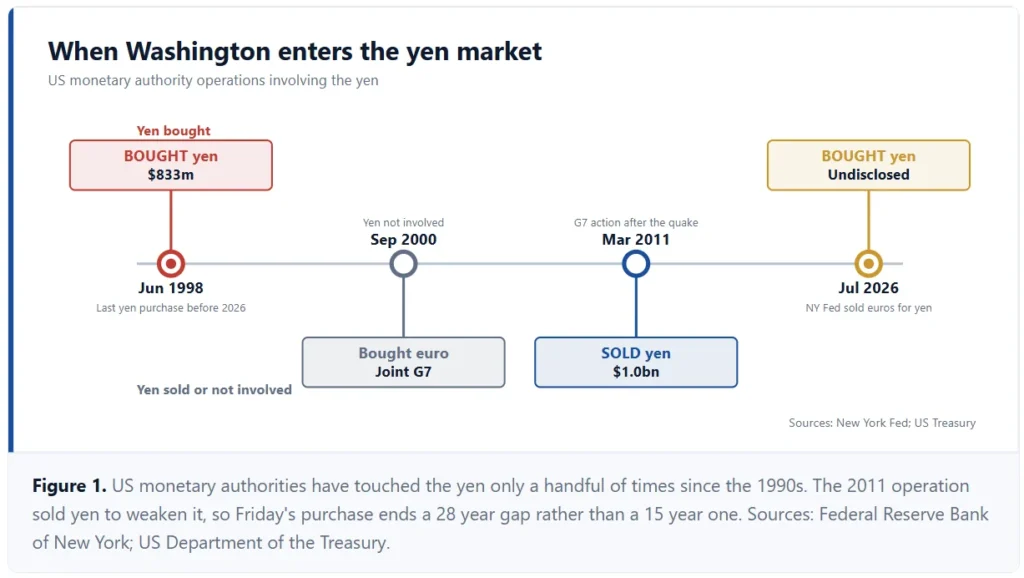
Most reports framed Friday as the first US yen move since 2011. But the primary record says something else. In March 2011, the G7 sold yen to push it down after Japan’s quake. That trade weakened the yen. It did not lift it.
Buying yen is the opposite trade. Washington last did that on 17 June 1998. On that day, US officials sold 833 million dollars against the yen. Also, the Exchange Stabilization Fund and the Federal Reserve split the cost evenly.
So Friday ended a 28-year absence, not a 15-year one. That gap matters for anyone pricing the odds of a repeat. Tools left idle for 28 years rarely get used just once.

Tokyo’s Firepower Reaches A New Scale
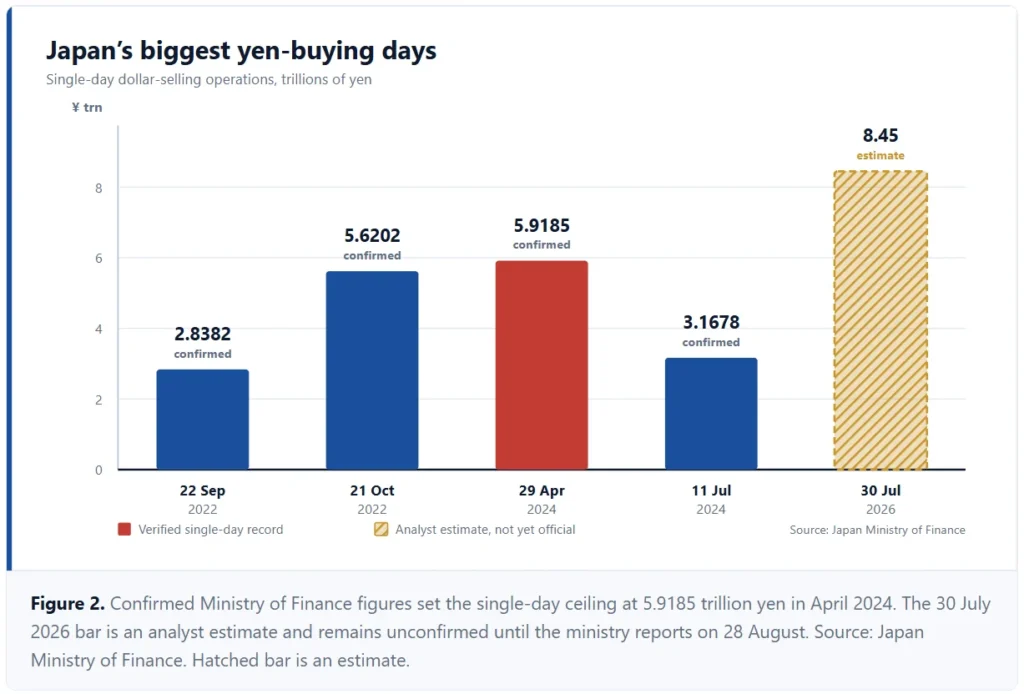
Japan’s own numbers dwarf the US share. Official data show a record 11,734.9 billion yen of buying between 28 April and 27 May. That single window beat every monthly total since records began in 1991.
Analysts think Tokyo spent roughly 8.45 trillion yen on 30 July alone. By comparison, the largest verified single day sits at 5.9185 trillion yen, set on 29 April 2024. If the guess holds, Thursday’s move beat that record by about 43 percent.
Treat the 8.45 trillion figure with care. It comes from central bank account math, not from an official release. Catenaa flags it as an estimate throughout.
The Official Ledger Still Reads Zero
Here lies the twist most readers miss. Japan’s finance ministry put out its latest report on 31 July. It covers 29 June through 29 July. The total reads zero yen.
The 30 July move falls into the next window. That window closes on 26 August. So hard proof lands only at the end of August. Until then, every headline number stays a smart guess.
Markets are trading on hints, not on data. Yet that gap between action and proof breeds its own volatility.
The Carry Gap Still Rewards Selling Yen
Buying yen treats the symptom. Interest rates cause the disease.
Japanese bond yields have climbed hard. Ministry data put the ten year JGB at 2.801 percent on 30 July. At the start of July, it paid 2.711 percent. Meanwhile, the thirty year hit 3.971 percent.
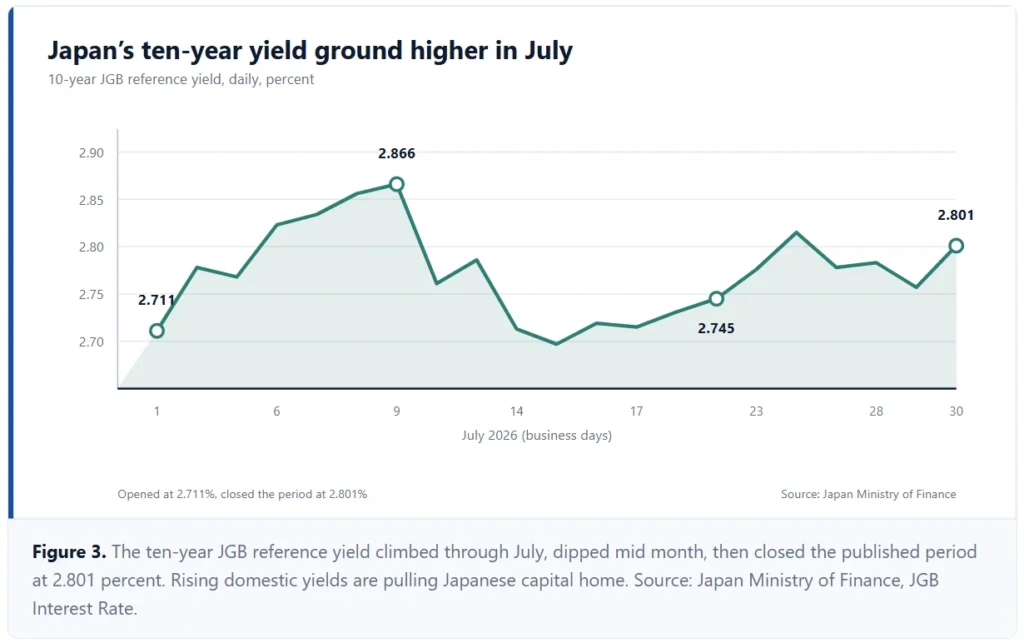
Those levels look steep by Japanese standards. Yet US yields sit higher still. The two year Treasury paid 4.23 percent on the same date.
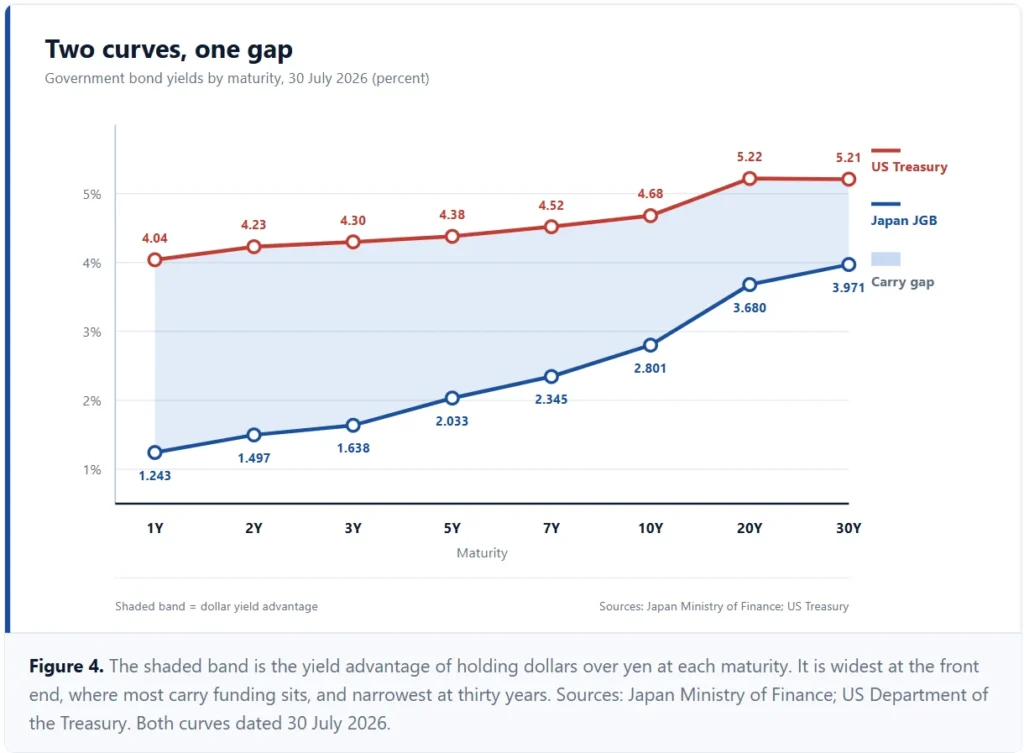
So consider the simplest version of the trade. Fund in two-year yen. Then lend in two-year dollars. That still banks about 273 basis points. Such a cushion has thinned. Even so, it has not gone. The core case for shorting the yen survives every headline.
The gap also shrinks as maturities lengthen. At five years, it runs near 235 basis points. At ten years, it drops to roughly 188. Catenaa calculates each spread from the two official curves.
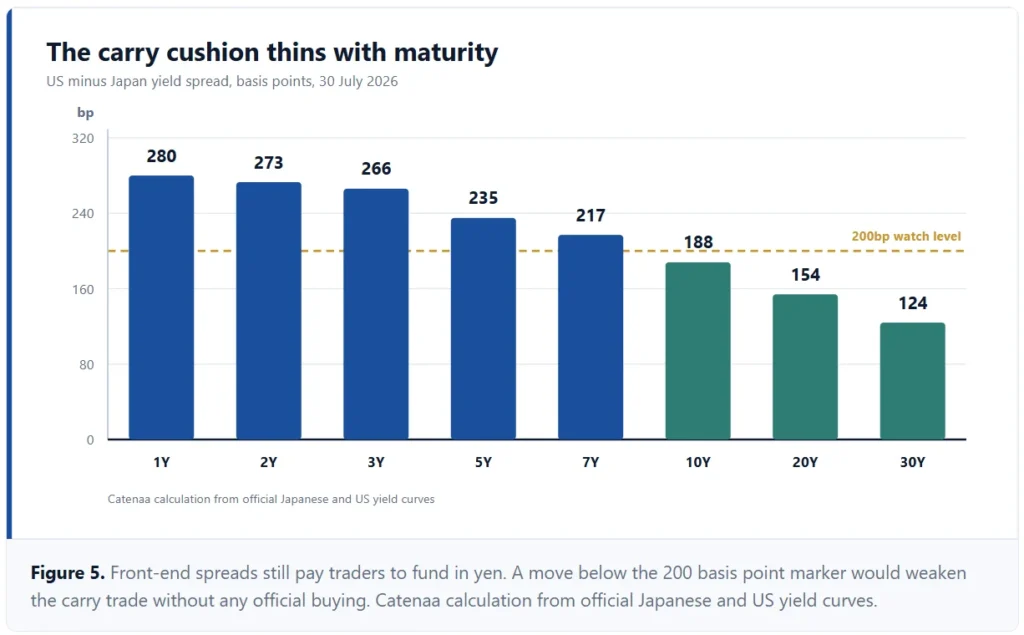
The long end tells a kinder story. At thirty years, the gap narrows to about 124 basis points. Japanese life firms and pension funds notice that shift at once. More and more, they can match debts at home instead of abroad.
Money coming home would do what buying yen cannot. It shifts capital for good, and no ministry has to fund it.
Japan’s long bonds now yield almost as much as its forty-year debt. That flatness signals real stress at the far end. Investors clearly want more reward for lending to Tokyo.
Why Digital Asset Desks Are Watching
Cheap yen funding sits under a wide range of leveraged trades. So a violent yen rally forces selling across asset classes. Crypto desks learned that lesson the hard way in August 2024.
A repeat looks likely but far from certain. Joint action clearly raises the cost of shorting the yen. Still, a 273 basis point cushion absorbs a lot of pain before trades break.
Risk teams should watch funding costs, not spot headlines. Spot moves fast. Funding decides who survives.
What To Watch Next
Three dates now matter. First, 26 August closes the current window. Second, 28 August brings the ministry’s next official total. Third, the New York Fed reports each quarter on US trades.
Watch the two-year yield gap above all else. Should it fall below 200 basis points, the carry trade unwinds on its own. Until that day, both sides must keep spending to hold the line.
One more signal deserves attention. Repeated buying at rising price levels usually means officials are losing. By contrast, fewer and smaller trades would suggest the floor is holding.
Joint action has bought Tokyo time. It has not yet bought a floor.




