

April 13, 2026 – After 21 hours of historic talks, US-Iran negotiations collapsed over nuclear demands. Global oil markets and equities now face a fresh storm as the Strait of Hormuz remains effectively closed.
In Summary
Talks collapse after 21 hours. Vance left Islamabad on April 12 with no peace deal. Iran refused to commit to abandoning nuclear weapons development.
The Strait of Hormuz is still choked. Less than 10% of normal shipping traffic flows through. The waterway handles roughly 20% of the global oil supply.
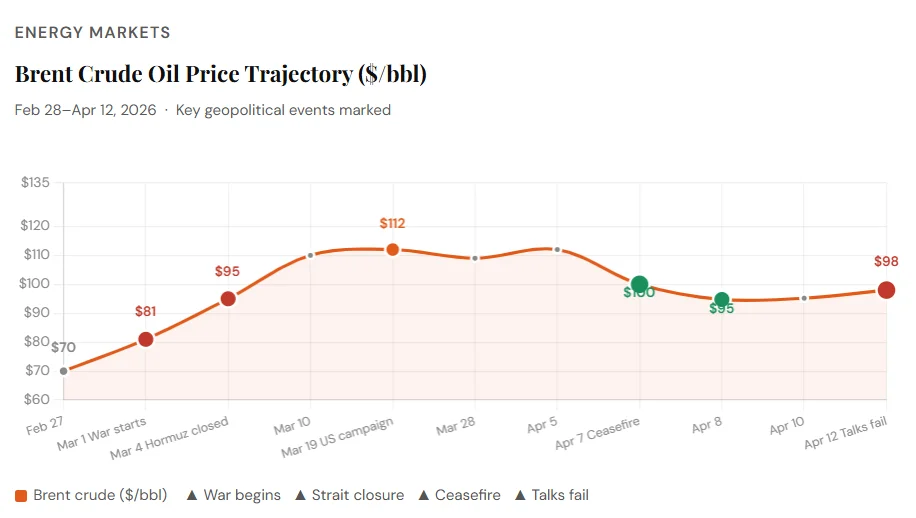
Oil prices face a sharp reversal. Brent crude surged from $70 pre-war to a peak of $119/bbl. It briefly fell to $94.75 on news of the ceasefire, now at risk of rebounding.
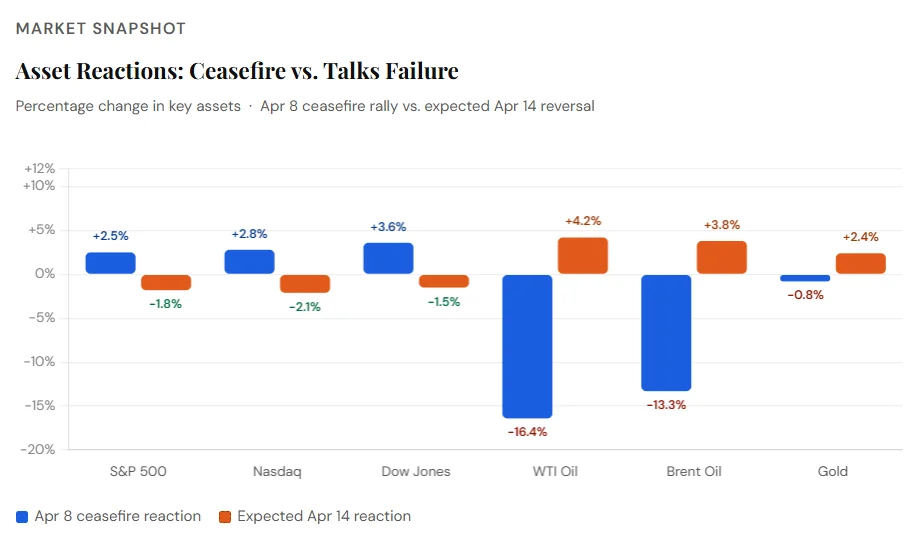
Equity markets brace for Monday. The S&P 500 gained 2.5%, and the Dow jumped 1,325 points on the April 7 ceasefire. Analysts expect significant losses at Monday’s open.
Stagflation risk rises. The IEA calls this the “largest oil supply disruption in history.” European gas nearly doubled; the ECB has postponed rate cuts.
US Vice President JD Vance boarded Air Force Two on Sunday morning. He left Pakistan’s capital without a peace deal. The 21-hour US-Iran negotiations ended in total deadlock. The war, now in its seventh week, continues to shake global energy markets.
Iran refused Washington’s core demand. The US required a firm commitment to abandon nuclear weapons development. “We need to see an affirmative commitment that they will not seek a nuclear weapon,” Vance told reporters. Tehran called the US demands “excessive.”

The Nuclear Sticking Point
The Islamabad summit was the highest-level US-Iran meeting since the 1979 Islamic Revolution. Iran’s delegation was led by Parliamentary Speaker Mohammad Bagher Qalibaf. The US side included Special Envoy Steve Witkoff and Jared Kushner. Vance said he spoke to President Trump up to a dozen times overnight.
The talks were mediated by Pakistan at a critical moment. A fragile two-week ceasefire had been brokered on April 7. It was conditional on Iran reopening the Strait of Hormuz. That condition remains unmet.
“The bad news is that we have not reached an agreement, and that’s bad news for Iran much more than for the United States.”
— VP JD Vance, press conference, Islamabad, April 12, 2026
The Energy Shock in Numbers
The International Energy Agency called this the “largest supply disruption in the history of the global oil market.” Before the war, Brent crude traded near $70 per barrel. The benchmark surged beyond $119 at its peak. It settled near $95 after the ceasefire, but that relief may be brief.
The Strait of Hormuz carries roughly 20% of global seaborne oil trade. Iran has effectively blocked it since February 28. Kuwait, Iraq, Saudi Arabia, and the UAE lost a combined 10 million barrels per day of output by mid-March. BCA Research estimates global supply has shrunk by 4.5 to 5 million barrels per day.
European energy markets face structural damage. Dutch TTF gas benchmarks nearly doubled to over €60/MWh by mid-March. The European Central Bank postponed planned rate cuts on March 19. UK inflation is forecast to breach 5% this year.
What Markets Face Next
Analysts expect oil to rebound and equity markets to fall sharply at Monday’s open. The ceasefire rally, which sent the S&P 500 up 2.5% and the Dow up 1,325 points, is now at risk. WTI oil had tumbled 16.4% on April 8. That drop may fully reverse.
Pepperstone strategist Dilin Wu flagged a critical scenario. If the Strait stays constrained, markets shift from risk-off to stagflation risk. Energy and defence stocks are expected to outperform on Monday. Gold may attract safe-haven buyers. Treasury yields face competing pressure from inflation and flight-to-safety demand.
Pakistan’s Foreign Minister Ishaq Dar called for calm. He said Islamabad will try to facilitate a new dialogue. Iran’s foreign ministry has not closed the door entirely. That nuance may limit the worst of Monday’s selling.
Trump responded with escalation. He declared a naval blockade on the Strait of Hormuz. The US Navy will intercept vessels paying tolls to Iran. The war, now in its seventh week, has already killed thousands and erased trillions in global wealth.
The next 72 hours are critical. A second round of technical talks could salvage the ceasefire framework. Failing that, markets face a return to the darkest days of the energy crisis. The peace dividend from April 7 is rapidly evaporating.