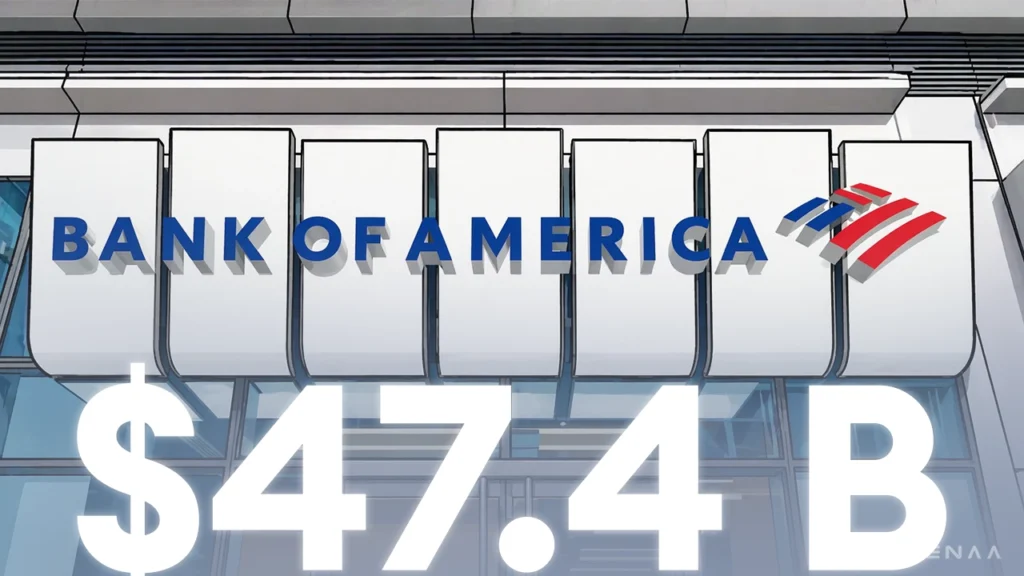


April 21, 2026 – America’s Big Six just delivered their best quarter in years. Volatility, AI investment, and geopolitical turmoil powered record trading desks. But analysts are divided on what comes next.
In Summary
$47.4 billion in combined Q1 profits. America’s Big Six banks delivered one of Wall Street’s strongest quarterly results on record.
Volatility was the catalyst. The US-Iran war, energy price spikes, and Fed uncertainty drove trading volume to record highs across CME Group (+30% YoY) and Tradeweb (+41.8% YoY).
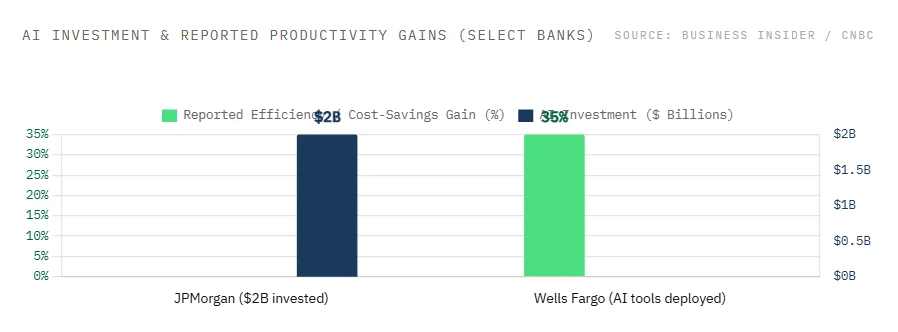
AI is reshaping bank economics. JPMorgan’s $2B AI investment has already paid off in cost savings. Wells Fargo reports 35% productivity gains in select areas.
Analysts are cautiously bullish. JPMorgan carries the strongest consensus, a $391 target implying +8.8% upside, but Morningstar calls the stock fairly valued at $311.
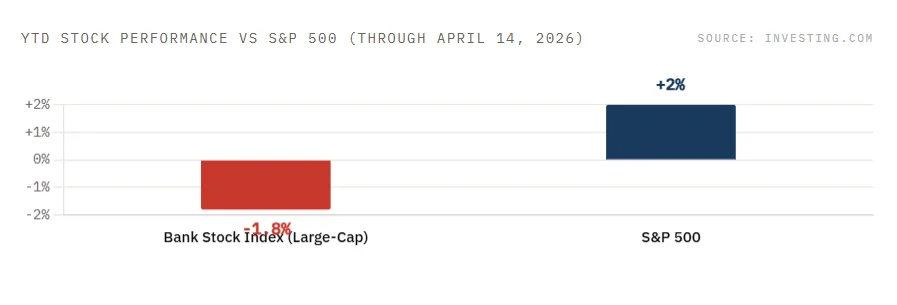
Bank stocks have underperformed the S&P 500 year-to-date (−1.8% vs +2%), signalling that investors are not yet fully pricing in the earnings beat.
Key risks remain. A prolonged Iran conflict, delayed Fed rate cuts, rising loan defaults, and unproven AI returns could all weigh on H2 2026 performance.

America’s biggest banks have just reported a blockbuster quarter. JPMorgan, Goldman Sachs, Morgan Stanley, Bank of America, Citi, and Wells Fargo collectively earned $47.4 billion in Q1 2026. That figure rivals the strongest quarters in Wall Street history.
The results were driven by a surge in trading activity. Geopolitical shocks, rate uncertainty, and AI disruption sent investors scrambling to reposition. That chaos was good news for the big banks’ trading desks.
JPMorgan’s trading revenue reached a new record high in Q1. The bank’s CFO, Jeremy Barnum, noted the market had delivered “good volatility.” He described that as active, liquid markets, not the gappy, low-liquidity kind that keeps clients on the sidelines.
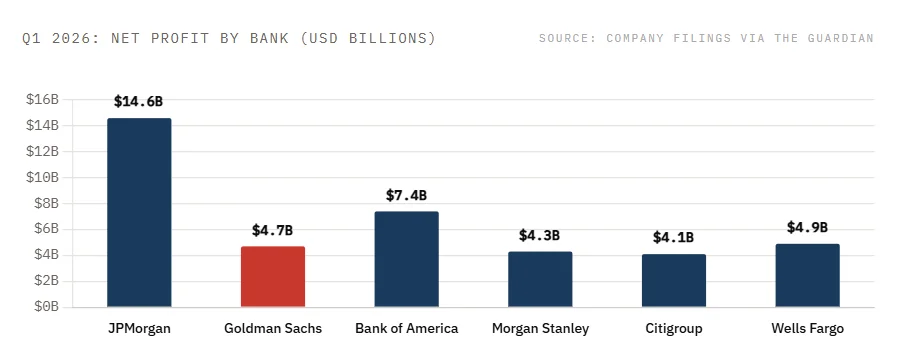
The scale of the trading boom is clear in market-wide data. CME Group reported its average daily volume jumped 30% in Q1 2026 compared to Q1 2025. Tradeweb posted an even sharper 41.8% year-on-year increase in trading volume in March alone.
The catalyst was clear. The US-Israel-Iran war shocked global markets. Energy prices spiked. The Federal Reserve tore up its rate-cut schedule. Investors needed to hedge, rebalance, and trade. Banks were there to facilitate every move.
“We haven’t really seen any so-called bad volatility.”
— Jeremy Barnum, CFO, JPMorgan Chase
How AI Is Reshaping Bank Profits
Trading volume wasn’t the only story. Artificial intelligence is quietly reshaping the economics of big banking.
Goldman Sachs’s earnings revealed higher revenue from underwriting investment-grade and asset-backed debt. This category captures fees from hyperscalers issuing bonds to fund massive AI infrastructure builds. Banks are arranging the debt, trading the bonds, and advising on the deals, all at once.
Meanwhile, banks are investing in AI for internal use. JPMorgan CEO Jamie Dimon claims his bank’s $2 billion AI investment has already paid for itself in cost savings. Wells Fargo’s CEO says AI tools have boosted productivity by 35% in certain departments.
Critics are not convinced yet. AI can automate routine tasks. But it cannot sign off on credit decisions or manage complex risk assessments. The technology remains in early stages inside the financial sector.
Still, banks keep ploughing capital into the technology. The trend signals confidence. The sector believes AI-led efficiency gains are real. And the competitive pressure to invest is intensifying.
Analyst Ratings: Buy, Hold, or Sell?
So what do the analysts say? The consensus is cautiously optimistic, but not wildly bullish.
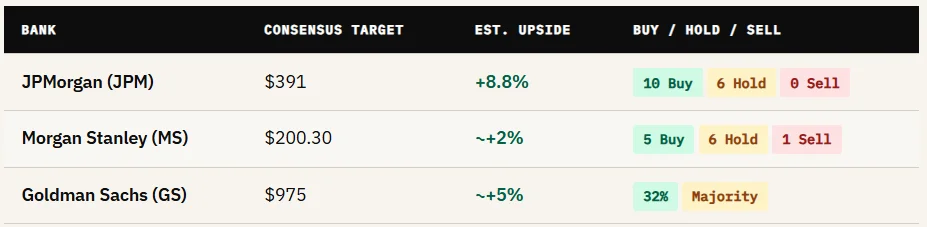
Morningstar upgraded its JPMorgan price target after earnings. But the firm calls the stock “fairly valued”, not cheap. They peg the fair value at $311. They describe JPMorgan as “the strongest banking franchise in the United States.” Yet they see limited upside this year.
The Risks That Could Derail the Boom
Despite the record profits, bank stocks have underperformed the broader market. A large-cap bank stock index was down 1.8% year-to-date through April 14. The S&P 500, by contrast, was up 2% over the same period.
That tells a story. Markets are pricing in risk. Goldman CEO David Solomon warned analysts that a prolonged Middle East conflict would pressure inflation trends in Q2 and Q3. That could complicate the Fed’s rate path and squeeze margins.
JPMorgan also revised its 2026 net interest income (NII) guidance downward. The bank trimmed its full-year NII forecast from $104.5 billion to $103 billion. It is a small cut, but investors noticed.
Key Risks for US Bank Stocks in 2026
- Prolonged US-Iran conflict driving persistent inflation
- Federal Reserve delaying or reversing rate cuts
- Rising interest rates are boosting net interest income in the short term, but increasing default risk
- AI investments failing to deliver projected efficiency gains
- The renewed US-China trade war is dampening loan demand
On interest rates, history offers a mixed picture. Rate rises can boost net interest income. But they also raise borrowing costs for consumers and businesses. That compresses loan growth and can trigger a rise in defaults.
The Bottom Line: What Investors Should Watch
The Big Six banks delivered a historically strong quarter. Profits of $47.4 billion reflect a unique combination: high trading volume, AI tailwinds, and geopolitical dislocation. These factors may not all persist.
Senior banking analyst Mike Mayo told CNBC that big banks have three years of strong earnings growth ahead. He cited deregulation as a key driver. He said he would buy on any post-earnings dip.
But markets are not moving sharply in either direction. Investors appear to be waiting for clarity. The Iran conflict, the Fed’s next move, and the pace of the AI buildout are all unresolved. Until the fog lifts, bank stocks may trade sideways.
For active investors, the data suggests a selective opportunity. JPMorgan has the strongest analyst consensus. Bank of America raised its full-year NII growth guidance. Wells Fargo’s productivity gains are measurable. But the picture is not uniformly bullish.
Watch for Q2 loan growth data, any Fed signalling in May, and developments in the Middle East. Those three variables will likely determine whether the Q1 earnings boom translates into sustained stock outperformance.