


May 16, 2026 – Federal ethics filings show President Trump executed over 3,600 stock trades in Q1 2026. Purchases in Nvidia, Palantir, and Axon preceded favourable policy decisions by days. Eric Trump calls conflict claims “blatantly false.”
In Summary
President Trump filed over 3,600 stock trades in Q1 2026, totalling up to $750M in cumulative value.
Purchases by NVIDIA, Palantir, and Axon preceded favourable regulatory decisions by as few as 7 days.
Eric Trump states that all family assets are held in a blind trust managed by major financial institutions.
Democrats have labelled the trades a “national security disaster” and called for a federal investigation.
The ETHICS Act, which would ban presidential stock trading, has attracted over 120 co-sponsors in the House.
Federal ethics records published on May 14, 2026, paint an extraordinary picture. President Donald Trump executed over 3,600 individual stock trades in Q1 2026. The total value ranged from $220 million to $750 million. Several purchases preceded favourable policy decisions by only a few days. Eric Trump has firmly denied any family role in directing the trades.
What the OGE Filings Reveal
The U.S. Office of Government Ethics (OGE) received the filings on May 12, 2026. They cover January through March of this year. According to Benzinga, the portfolio logged 3,642 securities transactions in Q1, equivalent to roughly 58 trades per US trading day. The estimated midpoint value of all trades sits near $475 million.
The filings use broad dollar ranges rather than exact figures. This is the standard format for OGE Form 278-T disclosures. The White House has not disputed any of the disclosed numbers.
This marks a sharp shift in Trump’s investment approach. In 2025, he primarily held corporate and municipal bonds. The move into individual stocks in early 2026 sets a new precedent in modern presidential history.

Key Trades and Policy Overlaps
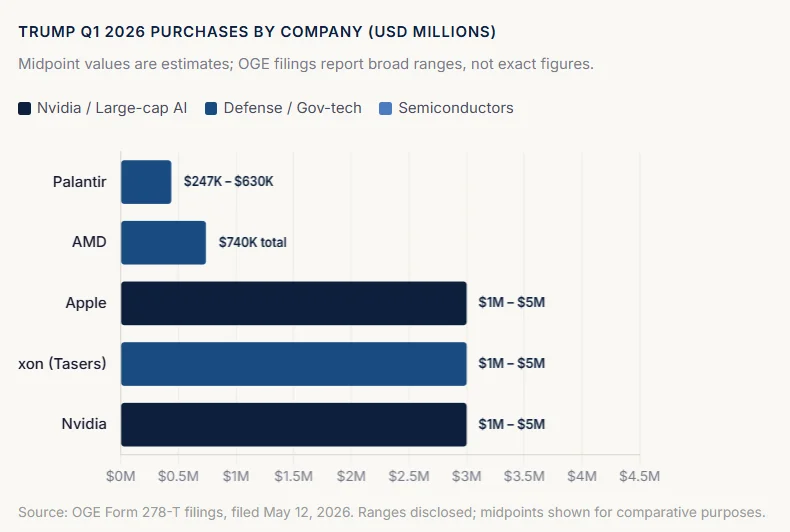
NVIDIA stands out as the central case. On January 6, Trump purchased up to $1 million of Nvidia stock. Just one week later, the Commerce Department revised AI chip export rules, directly benefiting Nvidia’s market position. On February 10, Trump bought another $1 million to $5 million of Nvidia. Approximately one week after that, Nvidia and Meta announced a major AI processing partnership.
Palantir was another significant position. Trump purchased between $247,008 and $630,000 of Palantir stock in Q1. He then publicly praised the company on Truth Social, citing its ticker symbol. Palantir holds a Department of Homeland Security contract worth over $1 billion. It also holds a Pentagon AI contract exceeding $1 billion for attack-planning systems.
Axon, the Taser manufacturer, followed a strikingly similar pattern. Trump bought $1 million to $5 million worth of Axon stock on February 10. Fourteen days later, ICE announced a $220 million Taser procurement plan.
Eric Trump’s Defense
Eric Trump responded swiftly and directly on the social media platform X. He stated: “All of our assets are invested in a blind trust by the largest financial institutions in broad market indexes.” He insisted that no family member selects individual stocks or directs specific trades.
“To suggest that individual stocks are being bought or sold at the discretion of any member of the Trump family would be a lie and blatantly false.”
-Eric Trump, Executive Vice President, Trump Organization
White House spokesman Davis Ingle confirmed to CNBC that the assets are held in a trust managed by Trump’s children and that “there are no conflicts of interest.” A Trump Organization statement described all trading as part of “automated investment processes.” Third-party institutions reportedly hold “sole and exclusive authority” over all investment decisions.
However, some entries in the filing were labelled “unsolicited,” suggesting active broker involvement in at least some trades. The OGE declined to clarify the designation when contacted by media outlets.
The Legal and Historical Context
Legally, presidents face fewer restrictions than ordinary federal employees. Under 18 U.S.C. Section 208, the conflict-of-interest rules that govern federal workers do not formally apply to the president. Trading individual stocks while in office is, therefore, not illegal under current law.
History, however, sets a starkly different standard. Every modern president since Lyndon Johnson has used a true blind trust or broad index funds. Richard Painter, former White House ethics counsel, told Fortune: “I’ve gone through every president. I don’t think we’ve had any president trade in the stock market.”
Political Fallout
Democrats responded sharply across multiple platforms. Senator Elizabeth Warren accused Trump of buying Nvidia stock ahead of negotiating AI chip access with China. She called the situation “a national security disaster.” Illinois Governor JB Pritzker labelled Trump “the most corrupt president in American history.”
Donald K. Sherman, President of Citizens for Responsibility and Ethics in Washington, said Trump “prioritized serving himself at the expense of the public.” His group is a nonpartisan government watchdog. Sherman noted that Trump’s trading contrasts sharply with how previous presidents managed their personal finances.
Legislative Push for Reform
The disclosures are accelerating calls for new legislation. Treasury Secretary Scott Bessent has backed a congressional stock-trading ban. The ETHICS Act would ban stock trading by members of Congress, the president, and the vice president. It has attracted more than 120 House co-sponsors. Senators Ashley Moody and Kirsten Gillibrand introduced a Senate companion bill in January 2026.
No comprehensive ban has yet become law. Key disagreements remain. Lawmakers disagree on whether existing holdings must be divested. There is also debate over whether spouses and dependents fall under any proposed ban. The political path forward remains highly contested.
What This Means Going Forward
Trump’s Q1 2026 portfolio is unprecedented in modern presidential history. The scale and timing of the trades have alarmed ethics experts and legal scholars alike. Several stocks in the filing have gained over 100% in value since purchase. These include AMD, Intel, SanDisk, and Bloom Energy.
No formal investigation has been announced. Federal authorities have not filed charges. Whether the disclosures drive legal reform or remain politically deadlocked depends on Congress. For now, public scrutiny of the president’s portfolio is unlikely to fade.




