

April 26, 2026 – The largest IPO in history is six weeks away. Bitcoin and crypto occupy the same risk-on pool it will draw from. Analysts are running the numbers, and they are sobering.
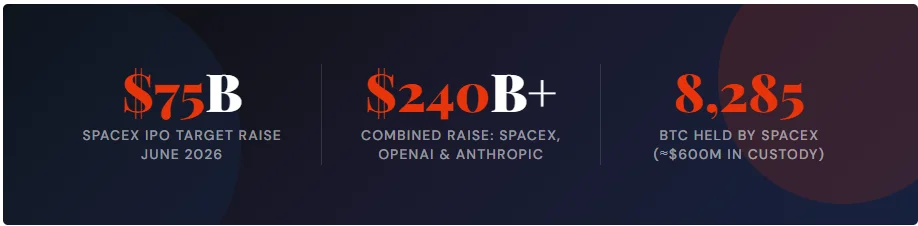
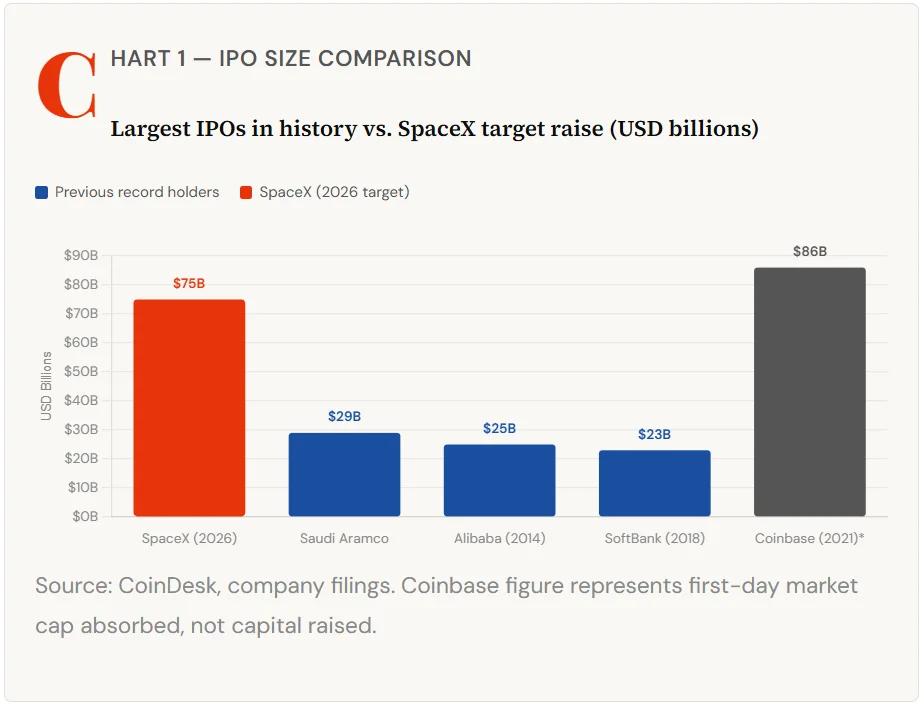
One of the biggest financial events of the decade is approaching fast. SpaceX has filed a confidential S-1 with the SEC, targeting a $75 billion capital raise. The planned June listing carries a staggering $1.75 trillion valuation. If it prices near that level, it will surpass Saudi Aramco’s $29 billion record. That makes it the largest stock-market debut in history by a wide margin. And crypto sits directly in its liquidity crosshairs.
The Scale of the Event
Size matters here. SpaceX at $75 billion is more than 2.5 times the size of Aramco’s 2019 record-breaking IPO. Prediction markets on Polymarket assign a 65% probability to a June listing. They also give a 53% chance that the first-day market cap tops $2 trillion. These are not fringe scenarios; they reflect consensus expectations baked into live markets.
Two Direct Links to Crypto Flows
SpaceX is not a crypto company. But two structural features tie this IPO directly to digital asset markets.
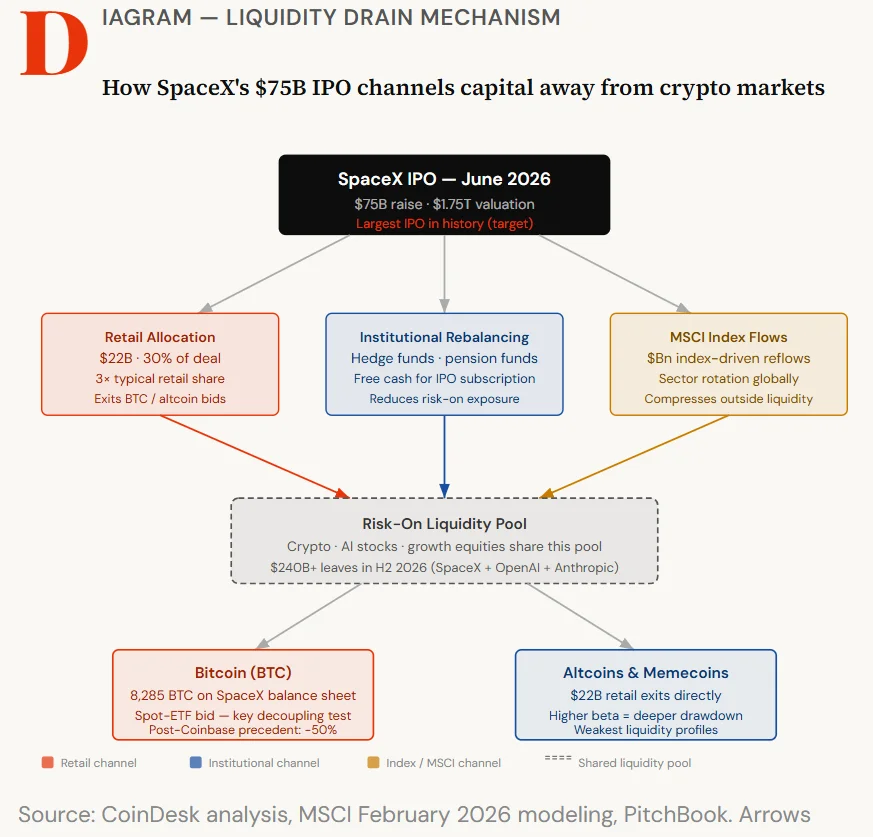
First, the retail allocation. The offering reserves 30% of shares for retail investors. That is roughly $22 billion directed at everyday buyers. It is three times the typical retail share on a deal this size. Every dollar a retail investor commits to SpaceX is a dollar not bidding on Bitcoin, Solana, or memecoins. The capital overlap is not theoretical; it is mechanical.
Second, SpaceX itself holds Bitcoin. The company holds 8,285 BTC, worth approximately $600 million, in Coinbase Prime custody. This makes SpaceX’s listing the first-ever public-market debut of a company with a material BTC position under the new fair-value accounting rules. Those rules, which took effect in late 2024, require real-time mark-to-market disclosure of BTC. Institutional allocators will now get indirect Bitcoin exposure through a SpaceX position in any passive index fund.
“After the SpaceX IPO, I think you start to get very bearish equities. That’s the Solana $300 moment.”
— Alex Good, Founder, Post Fiat (crypto AI project), via CounterParty TV
The $240 Billion Stress Test
SpaceX is not acting alone in this capital pull. OpenAI is targeting a Q4 public listing at a valuation near $1 trillion. Anthropic is reportedly planning an October debut. That raise could exceed $60 billion on its own. PitchBook data suggest the combined $240 billion+ figure would exceed the total of every venture-backed U.S. IPO since 2000, rolled into a single six-month window.
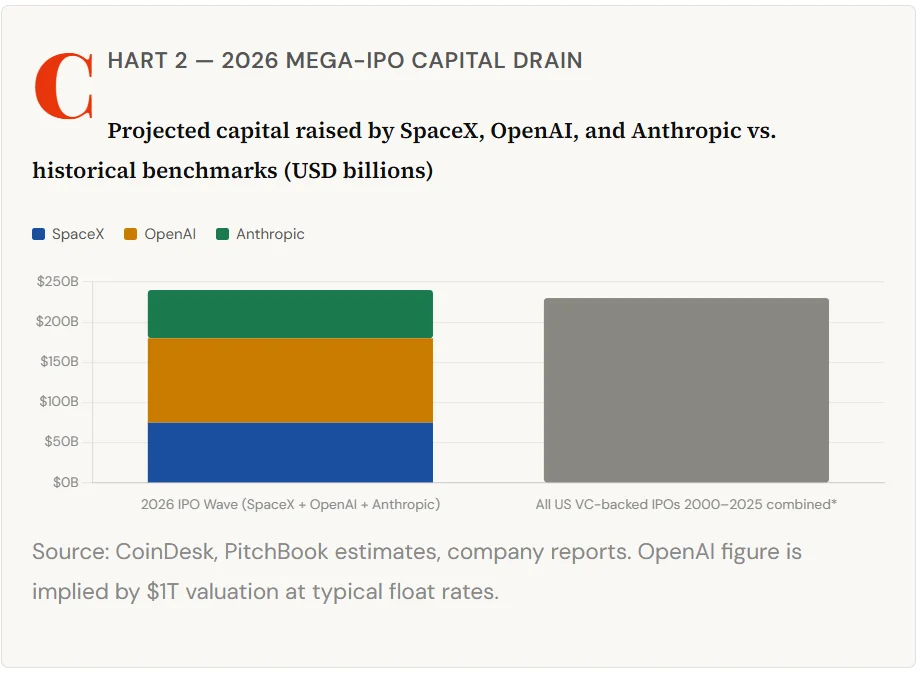
MSCI modelled this scenario in February 2026. Their analysis flagged megacap IPOs, triggering index-driven fund flows worth billions of dollars. They also warned of sector-rotation effects across global benchmarks. The result: compression of liquidity across all assets outside the newly listed names. That includes Bitcoin and the broader crypto market.
The Coinbase Precedent
History offers a useful, if uncomfortable, reference point. Coinbase went public in April 2021 via a direct listing. It absorbed $86 billion of market cap in a single day. Bitcoin reached $64,800 around that same moment. Then it fell roughly 50% over the next six weeks. The milestone became a top, not a starting line.
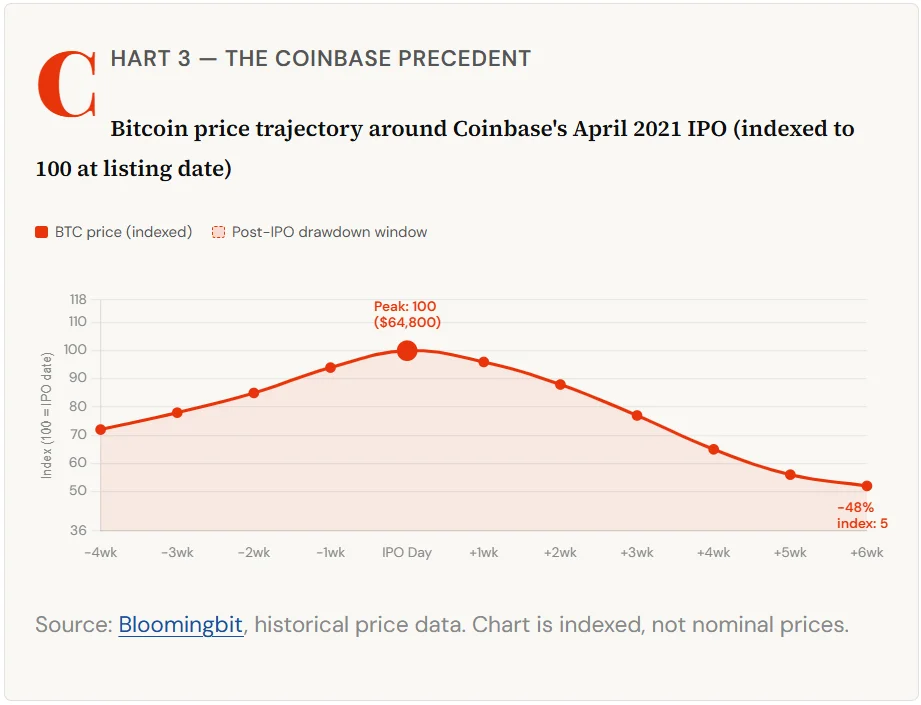
The mechanism is straightforward. Capital that chases an institutional milestone is often the same capital that was previously supporting the asset. When it rotates out, the support leaves with it. SpaceX is not Coinbase. But the structural parallel, a landmark listing acting as a cyclical signal, is hard to ignore.
The ETF Decoupling Hypothesis
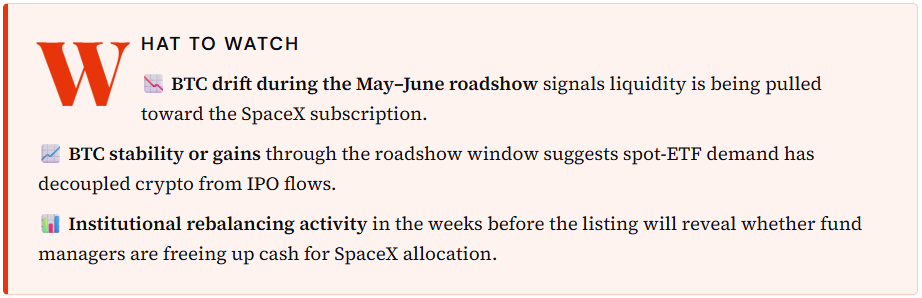
There is an important counterargument. Spot Bitcoin ETFs now provide a persistent institutional bid for BTC. This bid exists independent of retail sentiment or IPO cycles. If Bitcoin holds steady or rallies through the SpaceX roadshow in May and June, it would suggest that a partial decoupling has occurred. It would mean the ETF infrastructure has genuinely changed how crypto responds to traditional market events. That would be a structurally significant shift. It has not been proven yet.
Bottom Line
The SpaceX IPO is not just a tech-sector event. Its $22 billion retail allocation, its 8,285 BTC balance sheet, and its position at the head of a $240 billion+ IPO wave all connect directly to crypto market dynamics. Whether the outcome mirrors Coinbase 2021 or proves that spot ETFs have fundamentally changed the rules will become visible in the price tape over the next six weeks. That makes the May–June roadshow window one of the most important data points for crypto markets in 2026.




