

June 05, 2026 – One video. 17 minutes. The boldest $75B pitch in IPO history.
In Summary
SpaceX targets $75 billion, setting a new all-time IPO record.
CFO Bret Johnsen pitched retail investors in a 17-minute video on Thursday.
Up to 30% of shares go to retail buyers, triple the industry norm of 5 to 10%.
Starlink generated $3.26 billion in Q1 2026 revenue, with $1.19 billion in operating profit.
The $1.75 trillion target valuation equals roughly 94 times full-year 2025 revenue.
SpaceX has always operated on its own timeline. Now it wants public investors to share that mission. On Thursday, CFO Bret Johnsen released a 17-minute video pitch targeting retail investors globally. The presentation connects the company’s rocket, satellite, and AI businesses. It forms the centerpiece of SpaceX’s strategy to attract everyday buyers worldwide. This video arrives as SpaceX prepares for what could be the largest IPO in market history.
The 17-Minute Pitch
SpaceX filed its S-1 prospectus with the SEC on May 20, 2026. The company targets a Nasdaq listing under the ticker symbol SPCX. SpaceX expects trading to begin on June 12, 2026.
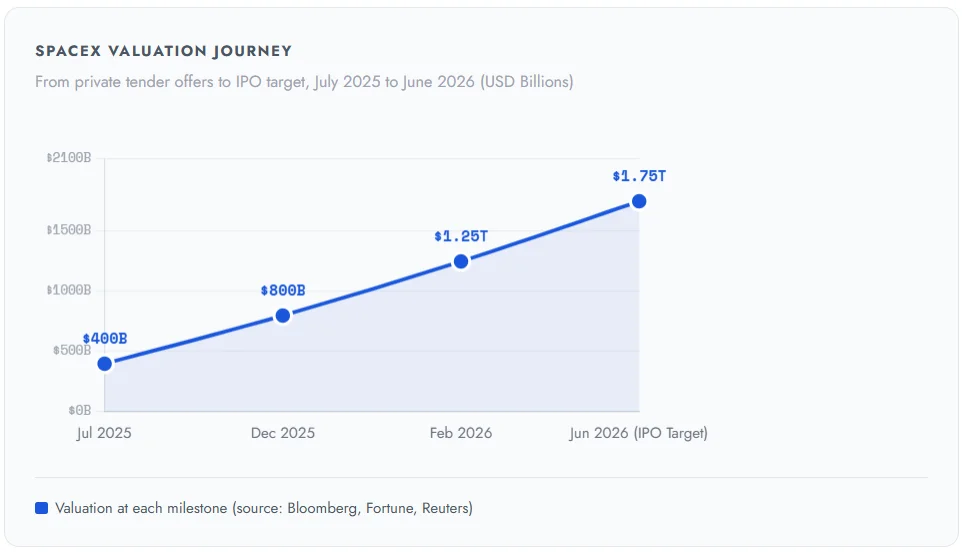
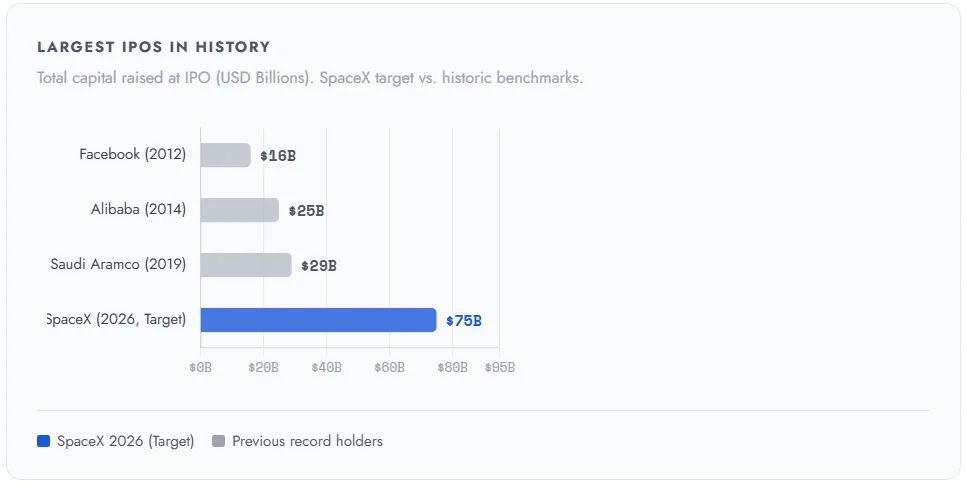
The offering seeks to raise $75 billion in fresh equity. The target valuation stands at $1.75 trillion, according to Bloomberg. Therefore, this would become the largest IPO in history by total deal size. Saudi Aramco’s $29 billion raise in 2019 currently holds the record. SpaceX plans to more than double that figure.
Internally, SpaceX calls the deal “Project Apex.” Twenty-one banks support the transaction. Morgan Stanley, Goldman Sachs, JPMorgan, Bank of America, and Citigroup lead as active bookrunners. SpaceX priced shares at $135 each. That implies roughly 555.6 million new shares entering the market.
Retail Investors Take Center Stage
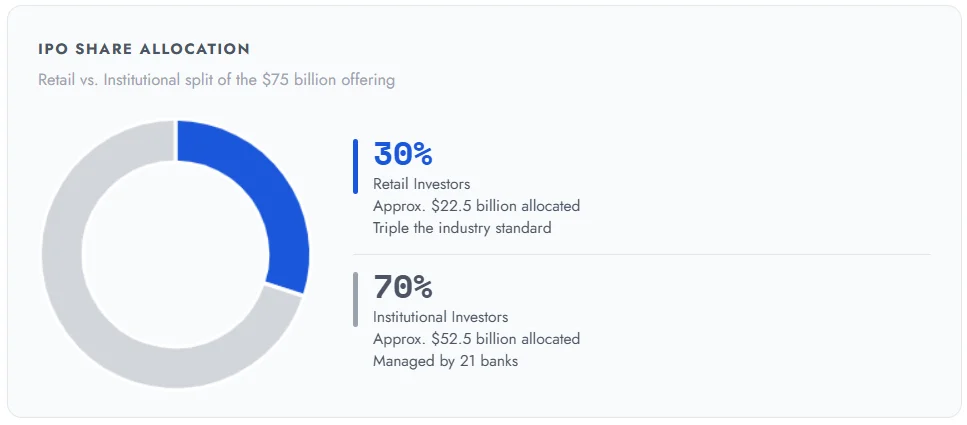
One feature sets this IPO apart from every predecessor. SpaceX plans to allocate up to 30% of shares to retail investors. Most large IPOs reserve only 5% to 10% for individual buyers.
At a total of $75 billion, the retail slice is roughly $22.5 billion. Therefore, individual investors will receive the largest retail dollar allocation in IPO history. CFO Bret Johnsen confirmed this directly with bankers in April. He stated that retail will be “a bigger part than any IPO in history.” Reuters confirmed his remarks from a virtual meeting. One lead underwriter told reporters they had “never seen anything like” the expected retail demand.
Elon Musk directly and indirectly holds approximately 42% of the company’s equity. Furthermore, his super-voting shares preserve founder control after the listing. However, Musk’s shares carry a longer lock-up period than those of other insiders. That signals a long-term commitment to the company’s mission and helps reassure markets.
What the Numbers Say
SpaceX reported $18.674 billion in full-year 2025 revenue. Q1 2026 alone contributed $4.694 billion more. However, profitability varies sharply across the three business segments.
Starlink is the only profitable division. The satellite internet unit generated $3.26 billion in revenue in Q1 2026. Operating income reached $1.19 billion in the same period. Furthermore, Starlink’s adjusted EBITDA grew 86% year-over-year in 2025. The unit now serves 10.3 million subscribers across more than 100 countries.
By contrast, the AI segment lost $2.47 billion in Q1 2026. The Space segment posted a $662 million operating loss in the same period. Therefore, Starlink’s profits effectively fund SpaceX’s broader expansion. Without Starlink, the company’s losses would look far more severe.
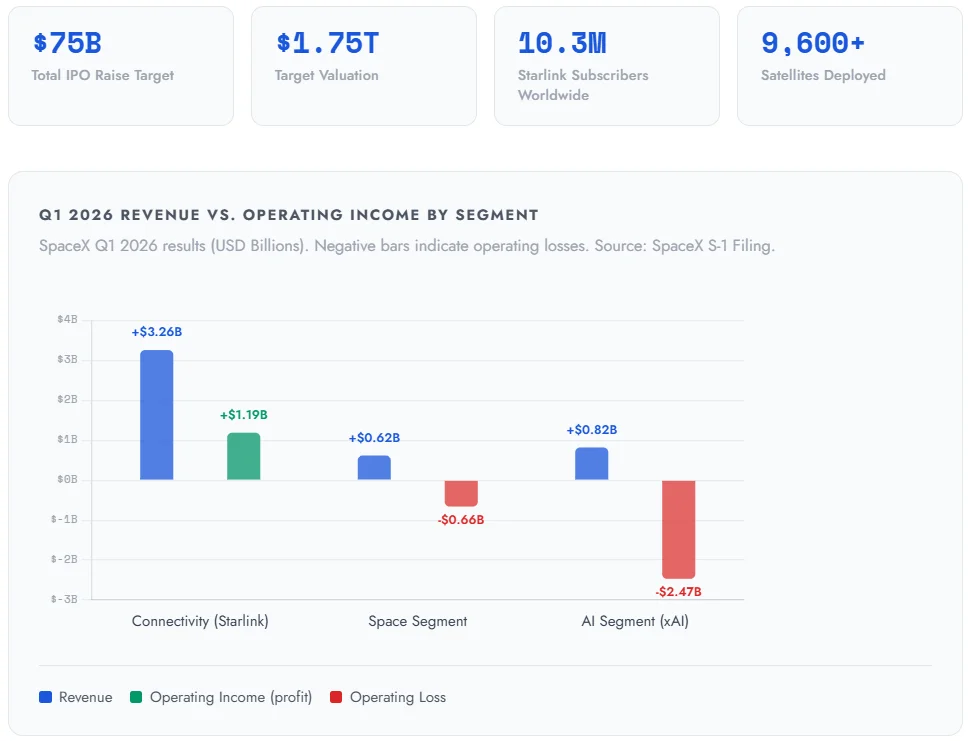
SpaceX has deployed over 9,600 Starlink satellites into orbit. The company estimates its total addressable market at $28.5 trillion. That figure spans AI infrastructure, broadband access, and commercial space services. The S-1 filing calls this “the largest actionable market in human history.”
The Risks Beneath the Hype
SpaceX posted a $2.589 billion operating loss in full-year 2025. Q1 2026 added another $1.943 billion in losses. The xAI segment alone burned through $6.355 billion during 2025.
Nevertheless, investor demand remains intense. The $1.75 trillion valuation implies roughly 94 times full-year 2025 revenue. Furthermore, the company’s accumulated deficit stands at $41.3 billion. These numbers reflect the capital intensity of building next-generation space infrastructure.
Additionally, Musk’s super-voting structure limits public shareholder power. Governance risk is a real consideration for new buyers. However, the extended lock-up on Musk’s shares aims to reassure markets about his long-term commitment.
What Comes Next
The roadshow officially began on June 4, 2026. Approximately 125 financial analysts from 21 banks attended the initial briefing. Trading under SPCX starts June 12, 2026.
Nasdaq fast-entry rules could accelerate passive demand significantly. SpaceX may qualify for Nasdaq-100 inclusion after just 15 trading days. Index fund flows would then add further buying pressure beyond the IPO itself.
However, retail demand will far exceed available shares. Most individual investors may not receive their full allocation. Therefore, the open market on June 12 becomes the main access point for most buyers.
This IPO marks more than a financial milestone. It signals the moment space exploration becomes a mainstream asset class. The 17-minute video pitch is the opening chapter of a much longer story.




