


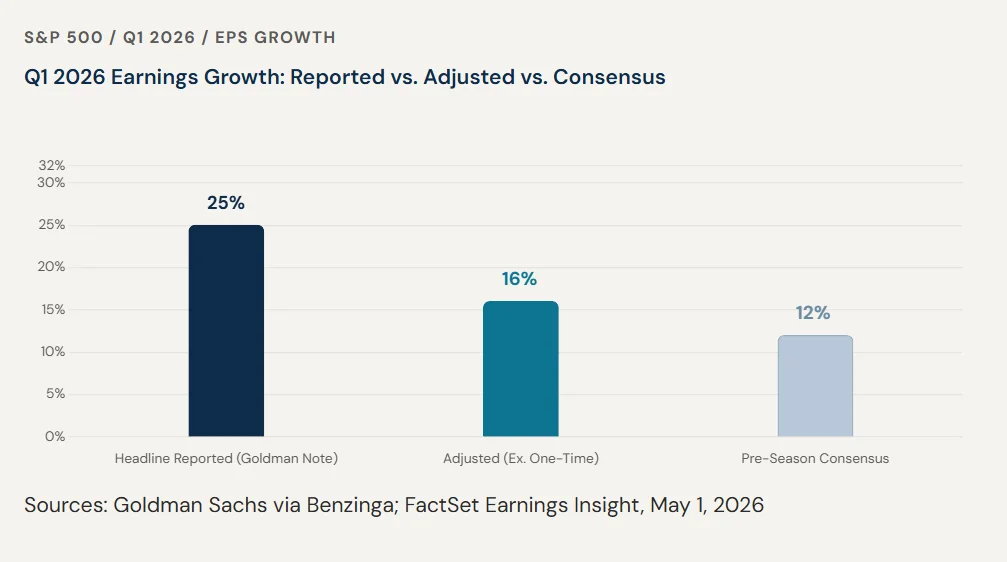
May 08, 2026 – Goldman Sachs reveals how investment gains at Amazon and Alphabet overstated Q1 2026 results, pushing headline growth to 25% while the true underlying rate sits near 16%.
In Summary
Headline S&P 500 Q1 2026 EPS growth came in near 25% (blended: 27.1%).
Goldman Sachs puts the adjusted, underlying growth rate at approximately 16%.
Pre-season analyst consensus had forecast only 12% earnings growth.
Alphabet booked a $37.7 billion net gain on non-marketable equity securities.
Amazon recorded $16.8 billion in pre-tax gains from its Anthropic investment.
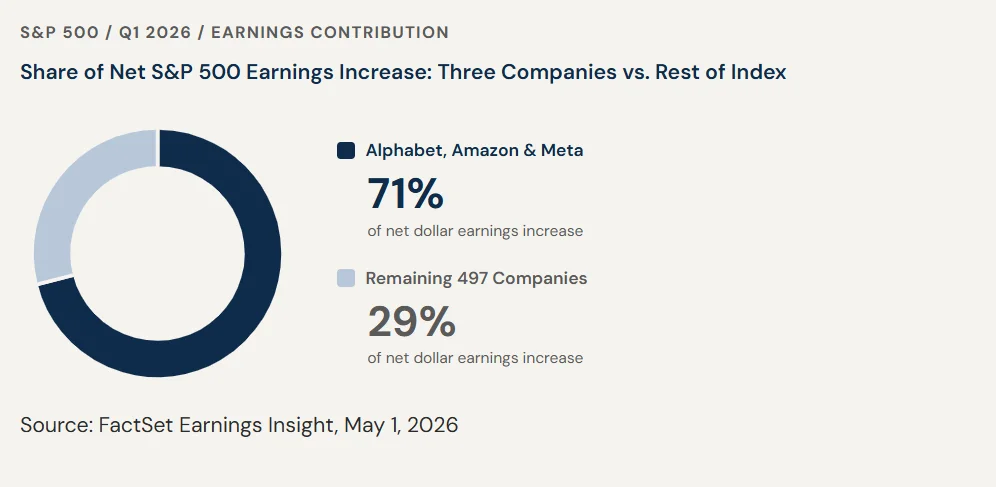
Three companies (Alphabet, Amazon, and Meta) drove 71% of the net S&P 500 earnings increase.
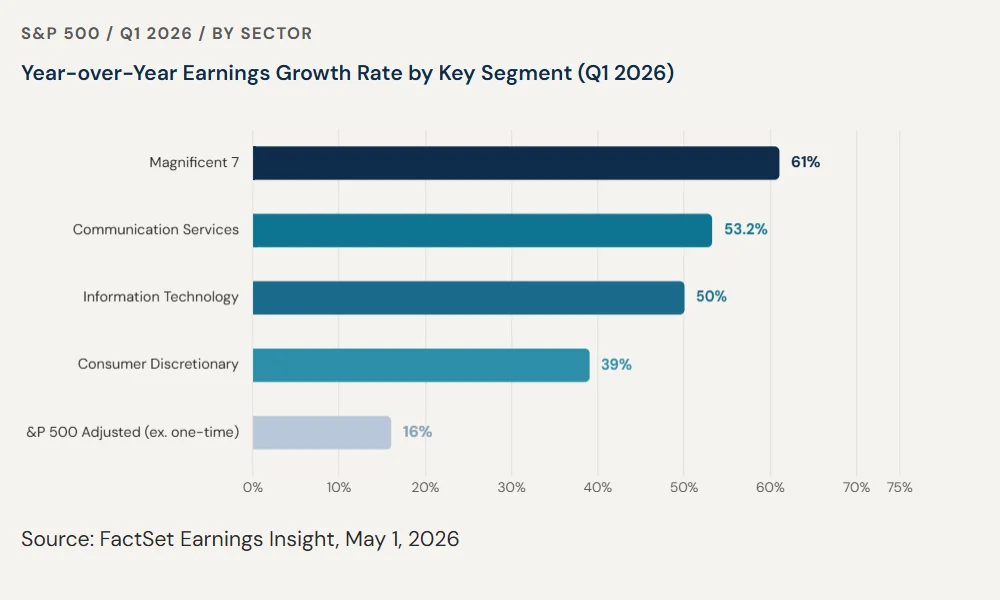
The Magnificent 7 reported a combined blended earnings growth of 61%.
Forward 12-month P/E ratio stands at 20.9x, above both five-year and ten-year averages.
Wall Street’s Q1 2026 earnings season looks exceptional on the surface. The S&P 500 reported earnings growth of approximately 25%. However, Goldman Sachs analysts have a stark warning for investors. The headline number tells only part of the story.
Goldman’s investment research team, led by strategist Ben Snider, identified a significant distortion. Investment-related one-time gains at Amazon and Alphabet significantly inflated the index-level result. Strip those items out, and S&P 500 earnings growth was closer to 16%. That is still a strong outcome. However, it is far below the eye-catching headline figure.
The Alphabet Factor
Alphabet delivered a massive earnings beat in Q1 2026. The company reported GAAP EPS of $5.11 versus a consensus estimate of $2.68. That represents a positive earnings surprise exceeding 90%.
A large part of this result came from a one-time gain. Alphabet’s results included a net gain of $37.7 billion. This came primarily from unrealised gains on non-marketable equity securities. This was not income from its core advertising or cloud businesses.
As a direct result, the Communication Services sector’s earnings growth surged. It rose to 53.2% from-3.8% recorded on March 31. That is a dramatic swing in just a few weeks.
The Amazon Factor
Amazon posted Q1 GAAP EPS of $2.78 against a consensus estimate of $1.63. That represents a positive surprise of more than 70%. Amazon’s pre-season five-year average surprise was just 29.3%.
Amazon’s results included pre-tax gains of $16.8 billion from its investment in Anthropic. This is classified as non-operating income. It does not reflect the health of Amazon’s core retail or AWS operations.
Amazon’s sector, Consumer Discretionary, saw earnings growth jump to 39.0%. Expectations on March 31 were just 1.7%.
Meta Platforms Also Contributed
Meta Platforms added further complexity to the picture. The company reported Q1 EPS of $10.44 versus an estimate of $6.67. This included an $8.03 billion income tax benefit. Meta noted that EPS, excluding this benefit, would have been $3.13 lower.
Together, Alphabet, Amazon, and Meta drove 71% of the net dollar increase in S&P 500 earnings during the reporting week. This concentration of influence is striking. Three companies reshaped the entire index’s trajectory.
The Broader Earnings Picture
Away from the one-time gains, Q1 still shows genuine corporate health. Goldman strategist Ben Snider noted that median S&P 500 stock earnings growth is tracking at 11%, above the 8% pre-season estimate. Additionally, 84% of S&P 500 companies reported positive EPS surprises. That exceeds the five-year average of 78% and the ten-year average of 76%.
The S&P 500’s net profit margin for Q1 2026 reached 14.7%. This surpasses the prior record of 13.2% tracked since 2009. Furthermore, Q1 2026 is on pace for the strongest quarterly earnings period since Q4 2021. This holds even after adjusting for one-time items.
Earnings growth is tracking at a 16% pace excluding one-time benefits. Companies have reported the lowest frequency of EPS misses in 25 years.
-Ben Snider, Goldman Sachs Strategist, via Benzinga
Sector Performance and Magnificent 7
The Magnificent 7 companies reported a combined blended earnings growth rate of 61% for Q1 2026. Expectations on March 31 were 22.4%. That is a near-tripling of the initial forecast.
Four of the five top contributors to S&P 500 earnings growth are Magnificent 7 names. Alphabet, NVIDIA, Amazon, and Meta Platforms lead the list. This concentration of earnings power raises important questions about the reliability of index-level data.
Valuation Signals to Watch
The S&P 500’s forward 12-month P/E ratio stands at 20.9x. This is above the five-year average of 19.9x and the ten-year average of 18.9x. Elevated valuations raise questions about sustainability. Markets are pricing in continued earnings strength.
Goldman Sachs forecasts full-year 2026 S&P 500 earnings growth of approximately 12.3%. The bank also expects hyperscaler capital expenditure to reach $539 billion in 2026. AI investment is described as the primary driver.
Analysts made the largest upward revision to Q2 EPS estimates in five years during April 2026. The bottom-up Q2 EPS estimate rose by 2.1% from $78.84 to $80.47. This signals continued near-term confidence despite concerns about distortion.
Why This Matters for Investors
The distinction between GAAP and underlying earnings is critical. One-time investment gains do not recur each quarter. Investors who rely solely on headline figures may overestimate corporate earnings power.
The adjusted 16% growth rate is still strong. It would rank among the best quarterly results since 2021. However, the gap between 25% and 16% is significant. It affects valuations, forward expectations, and allocation decisions.
Goldman advises investors to look beyond the headline. Mega-cap technology companies continue to skew index-level earnings signals. Understanding what drives the numbers is more important than the numbers themselves.