

April 19, 2026 – The Japanese investment giant issued six tranches across dollar and euro markets. Proceeds will refinance debt and repay a bridge loan tied to its $30B OpenAI investment.
In Summary
SoftBank raised ~$3.5B via six bond tranches across USD and EUR markets on April 16, 2026.
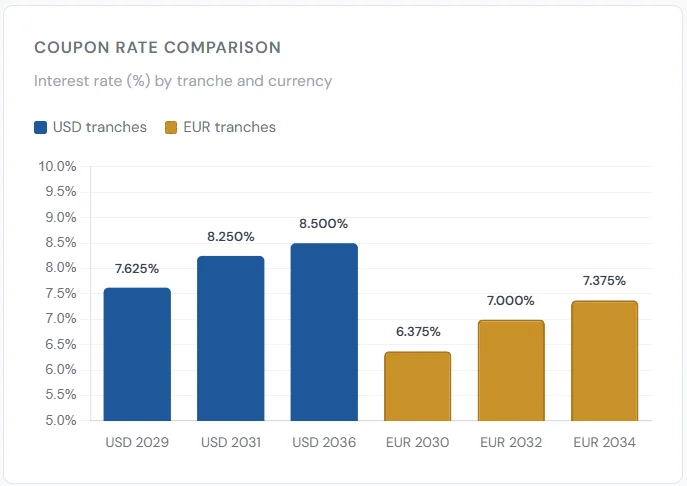
Dollar coupons range from 7.625% to 8.50%, elevated rates reflecting SoftBank’s BB+ credit rating.
Proceeds will partly repay a $40B bridge loan tied to SoftBank’s $30B follow-on investment in OpenAI.
CreditSights estimates a ~$35.7B funding shortfall but maintains an “outperform” on SoftBank’s credit.
Deutsche Bank, Goldman Sachs, JPMorgan, and Mizuho are acting as joint global coordinators.
Bonds will be listed on the Singapore Exchange, with settlement expected on April 22, 2026.
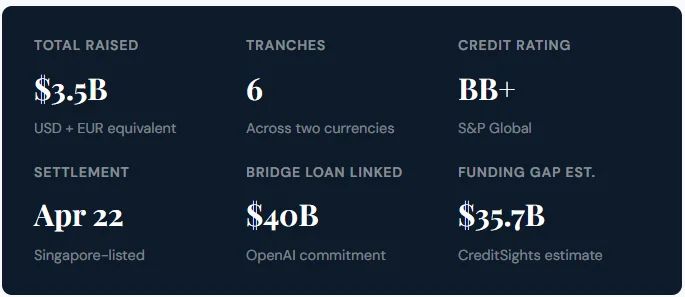
SoftBank Group raised $1.5 billion in dollar-denominated bonds and €1.75 billion in euro notes on April 16, 2026, according to a company filing. The total deal size reaches approximately $3.5 billion. It is one of the largest dual-currency bond sales by a Japanese firm this year.
The timing was deliberate. Global debt markets showed signs of recovery. Investor sentiment improved on hopes of easing geopolitical tensions. SoftBank seized the window to lock in long-term funding.
A Six-Tranche Structure With Elevated Coupons
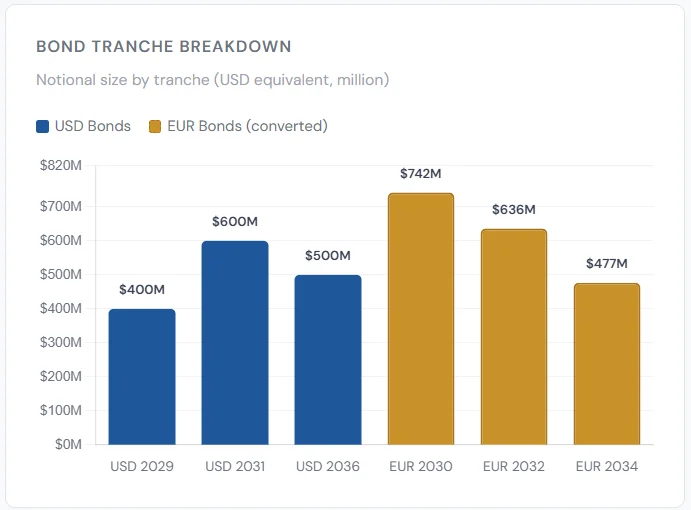
The deal is split into six tranches. The dollar portion raised $1.5 billion across three maturities. SoftBank issued $400M due in 2029, $600M due in 2031, and $500M due in 2036. Dollar coupons stand at 7.625%, 8.25%, and 8.5%, respectively.
The euro portion also covers three maturities. It includes €700M due in 2030, €600M due in 2032, and €450M due in 2034. Euro coupons are set at 6.375%, 7.0%, and 7.375%.
These are elevated rates for a BB+ rated issuer. They reflect the market’s caution about SoftBank’s leverage. But they also indicate strong investor appetite for the deal.
Proceeds Target OpenAI Bridge Loan
SoftBank’s OpenAI exposure is central to this deal. The firm first invested in OpenAI in September 2024. In January 2025, it joined the Stargate AI infrastructure project. Then, in March 2026, Bloomberg reported that SoftBank secured a record $40 billion bridge loan to fund a $30 billion follow-on investment in OpenAI.
That bridge loan carried a 12-month maturity. The bond proceeds now help repay part of it. The remainder of the proceeds will redeem existing foreign-currency senior notes. This extends SoftBank’s debt profile and reduces near-term refinancing risk.
Key Risk: CreditSights warns that a renewed risk-off shock could widen BB+ credit spreads. This would force SoftBank to refinance future debt at worse terms.
CreditSights Sees Value, But Flags Strain
Research firm CreditSights published a note ahead of the deal pricing. It estimated SoftBank’s funding shortfall at approximately $35.7 billion based on current commitments. The firm noted the balance sheet has grown more stretched since the OpenAI commitment.
Yet CreditSights maintained an “outperform” rating on SoftBank’s credit. It said asset sales or equity financing could close the funding gap. The firm also saw value in the new bonds at the marketed yield levels.
This dual view, caution on leverage, and confidence in assets, defines how many investors approach SoftBank. Its portfolio includes Arm Holdings, which adds significant underlying value.
Top-Tier Banks Lead the Syndicate
Deutsche Bank, Goldman Sachs, JPMorgan, and Mizuho are acting as joint global coordinators. Other major banks serve as bookrunners and co-managers. This blue-chip syndicate signals strong institutional confidence in the deal.
The bonds are listed on the Singapore Exchange. Settlement is expected on April 22, 2026. The Singapore listing broadens access for Asian institutional investors.
Leadership Reshuffle Underlines AI Strategy
SoftBank is also restructuring its leadership. Arm CEO Rene Haas is expected to take a broader role within SoftBank Group International. Founder Masayoshi Son is accelerating his focus on AI and semiconductors. Haas’s expanded mandate would not include the Vision Fund or energy assets. But it marks a significant internal promotion that reinforces the group’s AI direction.
What Investors Should Watch
The success of this dual-currency offering underscores improving conditions in global credit markets. For SoftBank, it demonstrates that investor demand for its debt remains strong despite high leverage.
The key question is returns. The cost of debt now exceeds 7% on the dollar side. SoftBank needs its AI bets, especially OpenAI, to generate returns that justify this cost. If OpenAI’s valuation holds and Stargate gains traction, the math could work. If not, the stretched balance sheet becomes a structural risk.
For now, the market has given SoftBank its vote of confidence. The next test comes when the bridge loan matures and when Stargate’s first results land.