

May 04, 2026 – The deal is the largest energy acquisition of 2026. It doubles Shell’s footprint in Canada’s Montney shale and adds 370,000 barrels per day to its output.
In Summary
Shell acquires ARC Resources for a $16.4B enterprise value, 2026’s largest energy deal.
The deal adds 370,000 boe/day and 2 billion barrels of proved and probable reserves.
ARC shareholders receive a 20% premium to ARC’s 30-day VWAP.
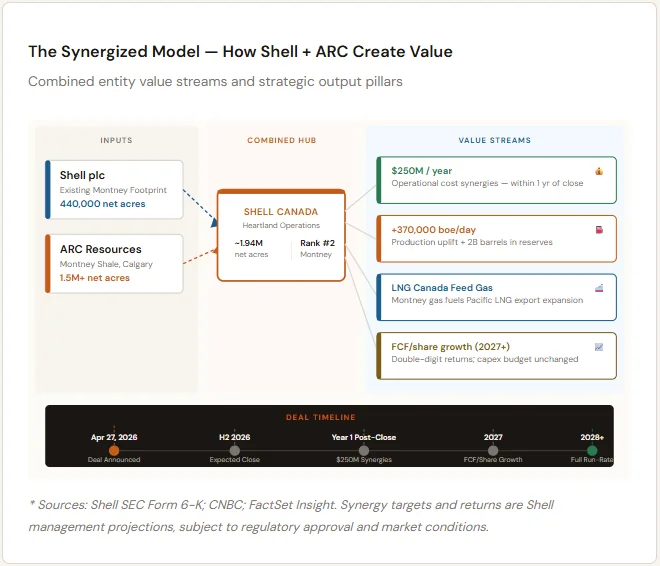
Shell jumps from the 7th to the 2nd largest Montney producer, behind only Ovintiv.
Expected synergies of $250M/year within one year of closing.
The transaction is 75% Shell shares, 25% cash. Closing expected H2 2026.
Shell announced on April 27, 2026, that it will acquire ARC Resources Ltd. for $16.4 billion. The British oil major confirmed the deal in a Form 6-K filed with the SEC. ARC Resources is a Calgary-based producer. It focuses on the Montney shale basin in British Columbia and Alberta.
The acquisition is the single largest energy deal globally in 2026. It signals Shell’s decisive return to Canada after it sold its oil sands assets in 2017.
Deal Structure
How the $16.4B Deal Breaks Down
The total enterprise value of $16.4 billion has three components. Shell will pay $3.4 billion in cash and issue $10.2 billion in new Shell shares. It will also assume approximately $2.8 billion in ARC’s net debt and leases.
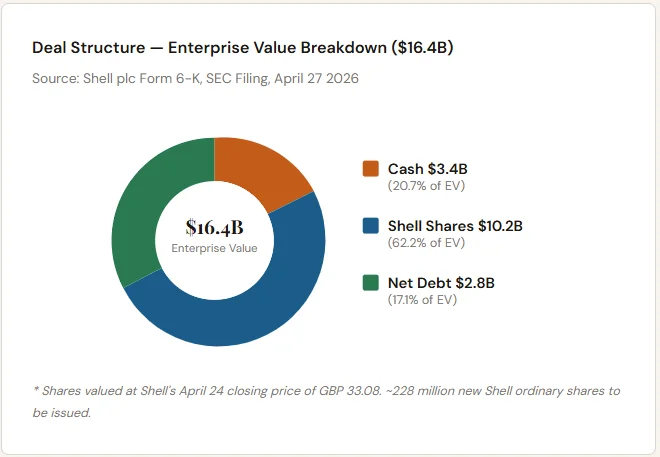
ARC shareholders will receive CAD 8.20 per share in cash. They will also receive 0.40247 ordinary Shell shares for each ARC share held. This equates to CAD 32.80 per share in total, a 20% premium to ARC’s 30-day volume-weighted average price.
Strategic Rationale
Betting Big on the Montney Basin
The Montney formation spans northeast British Columbia and northwest Alberta. It is one of North America’s most productive and lowest-cost shale basins. It also has significantly lower carbon intensity than many competing oil assets.
ARC holds more than 1.5 million net acres in the Montney. Shell currently holds 440,000 net acres in the same basin. Combined, the two companies will control nearly 2 million net acres.
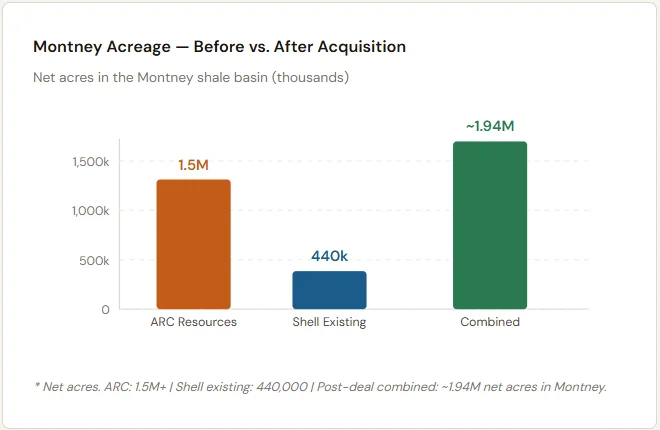
According to Enverus Intelligence Research analyst Andrew Dittmar, Shell will leap from the seventh-largest to the second-largest Montney producer. Only Ovintiv will rank higher.
“This establishes Canada as a heartland for Shell while furthering our strategy to deliver more value with less emissions.”
— Wael Sawan, CEO, Shell plc
Production Impact
Adding 370,000 Barrels Per Day
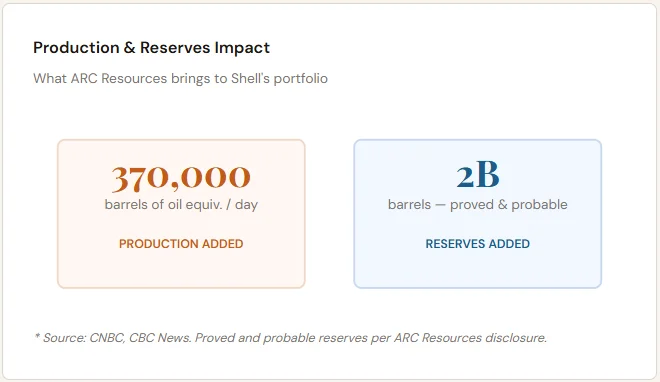
The transaction adds roughly 370,000 barrels of oil equivalent per day to Shell’s portfolio. It also adds approximately 2 billion barrels of proved and probable reserves.
Both boards unanimously approved the deal. Completion is expected in the second half of 2026. The transaction remains subject to regulatory and shareholder approvals.
Financial Outlook
Synergies, Returns, and Budget Discipline
Shell expects to generate roughly $250 million in annual synergies within one year of closing. The company projects double-digit returns on investment. It also expects free cash flow per share to grow starting in 2027.
Shell’s existing capital budget of $20–$22 billion through 2028 will not change. The company has funded the cash component through capital recycling. That includes prior divestments such as Colonial Pipeline (2025) and Jiffy Lubes (2026).
Context
Why Now and What It Signals
Shell sold its Canadian oil sands stake to Canadian Natural Resources in 2017. That exit was seen as a retreat from high-cost, high-emission assets. The ARC deal is a very different bet. Montney assets are lower-cost and lower-carbon than oil sands.
The deal also effectively rules out a Shell-BP merger in the near term. Shell CEO Wael Sawan had already cooled BP acquisition talks in 2025. The ARC deal shifts Shell’s strategic focus to organic-style growth through M&A.
Shell is also weighing an expansion of LNG Canada, its Pacific Coast liquefied natural gas terminal. More Montney gas supply directly supports that plan. Global LNG demand remains strong, driven by Asia-Pacific markets.
The deal cements Canada as a major growth platform for Shell. Combined with its existing Montney footprint, Shell now controls a resource base capable of generating returns for decades. That long runway is exactly what Shell’s strategy of “more value, fewer emissions” demands.