

June 20, 2026 – The brokerage giant will partner with Cboe on binary index contracts, joining a sector that has overtaken U.S. sports betting by volume.
In Summary
Charles Schwab will launch S&P 500 prediction markets with Cboe Global Markets.
The binary contracts pay a fixed cash amount when a forecast lands correctly.
Schwab joins Robinhood and Interactive Brokers inside a fast-growing market.
Charles Schwab is preparing its first move into prediction markets. The brokerage will partner with Cboe Global Markets on the launch, according to a Wall Street Journal report. Several outlets later confirmed the plan. The rollout is expected within the coming months.
The new contracts will track the S&P 500 index. Customers can therefore wager on where the index closes. Moreover, the products focus only on financial outcomes. Schwab will become the latest giant to enter this booming space.
A brokerage giant joins the race
Schwab manages $11.8 trillion in total customer assets. That scale makes its entry significant for the sector. CEO Rick Wurster signaled the move earlier this year. During a first-quarter earnings call, he said the firm would “likely have prediction markets”.
However, Wurster drew a clear line. Schwab will avoid contracts tied to sports, politics, or entertainment. Instead, it will focus on events with verifiable financial outcomes. Consequently, the firm stays inside familiar regulatory territory.
The decision places Schwab alongside Robinhood and Interactive Brokers. Both rivals already offer event-based financial contracts. As a result, competition among retail traders continues to intensify.
How the binary contracts will work
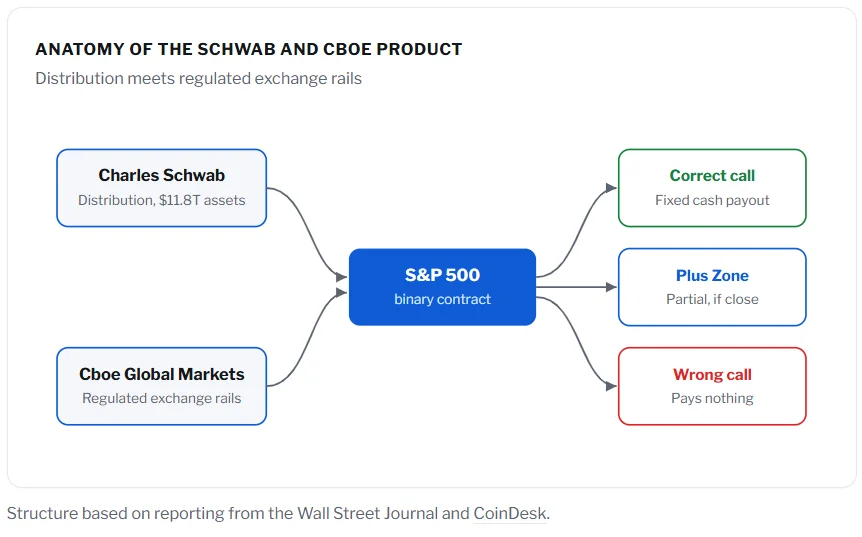
The product will function as a binary option. It pays a fixed cash amount if the forecast proves correct. By contrast, it pays nothing when the prediction misses. Cboe will list the contracts on its regulated exchange.
Schwab is also exploring Cboe’s “Plus Zone” feature. This tool rewards traders who land close to the target. As a result, a “mostly right” forecast can still earn a partial payout. Such flexibility could attract cautious retail investors.
The structure also differs from traditional prediction platforms. Kalshi and Polymarket mostly use event-style futures contracts. Schwab, by contrast, will route trades through listed options. That distinction matters for both taxes and oversight. Experienced traders often prefer the cleaner regulatory status.
A market that exploded in 2025
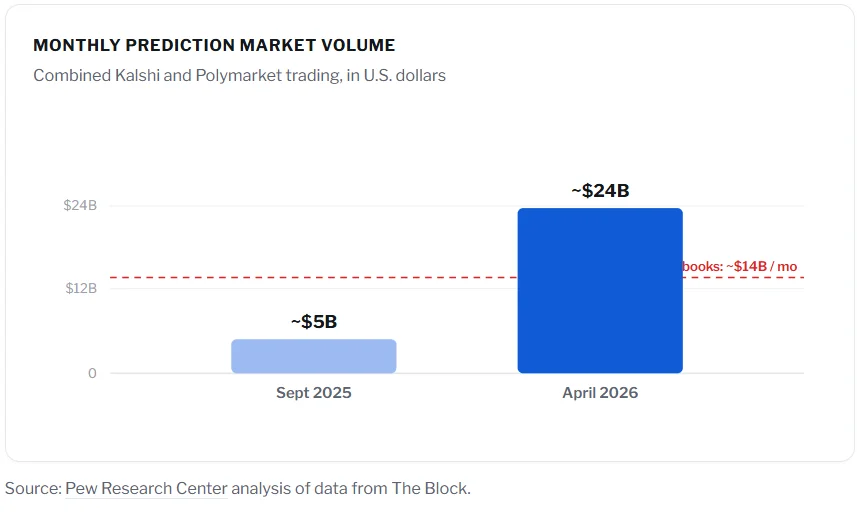
Prediction markets surged through 2025 and into 2026. Combined monthly volume on Kalshi and Polymarket tells the story. It climbed from under $5 billion in September 2025. By April 2026, that figure reached roughly $24 billion, per Pew Research.
For comparison, U.S. legal sportsbooks handled about $14 billion each month in 2025. Prediction markets have therefore overtaken regulated sports betting in terms of volume. That milestone helps explain why Schwab now wants in.
Several forces drove the boom. Kalshi won a key legal battle with the CFTC in 2025. Robinhood then plugged prediction markets into millions of brokerage accounts. Meanwhile, institutional money arrived in size. The NYSE parent company invested billions in Polymarket during the year.
Who controls the trading volume?
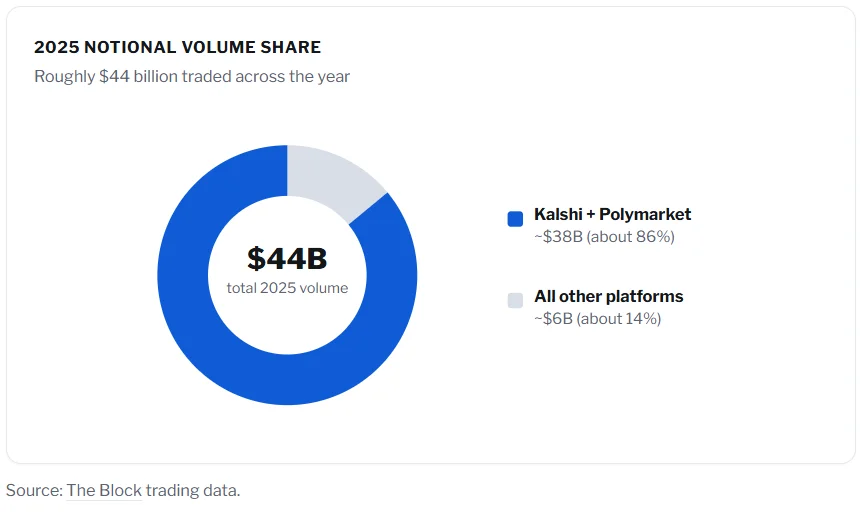
Two platforms dominate the industry today. Kalshi and Polymarket generated most of the activity in 2025. Together, they produced more than $44 billion in combined volume. That leaves smaller rivals splitting a thin remaining share.
Still, the field keeps widening. Gemini, Crypto.com, and DraftKings have all pushed in. Now Schwab and Cboe add deep distribution and regulatory credibility. Their arrival could reshape the competitive map.
What the news means for Schwab shares
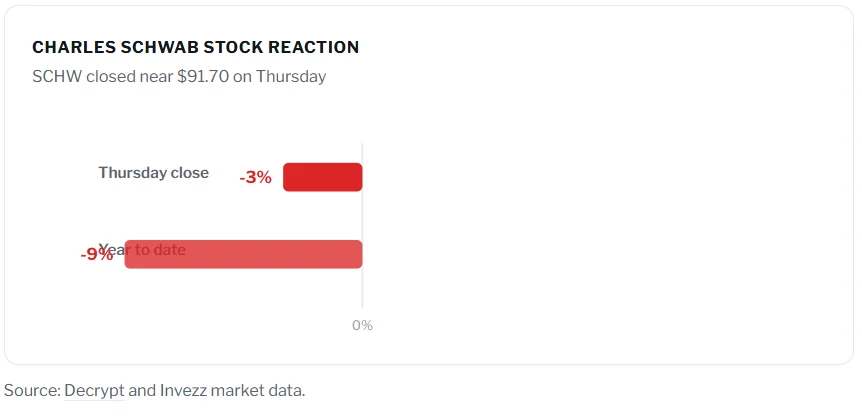
Investors reacted cautiously to the report. SCHW shares finished Thursday down nearly 3%, near $91.70. Furthermore, the stock has fallen about 9% so far this year. U.S. markets stayed closed Friday for the Juneteenth holiday.
Schwab also tightened certain margin rules recently. These moves carry different risk profiles for the firm. Prediction products can lift trading activity. Tighter margins, by contrast, may slow some client strategies.
The road ahead
Schwab continues to expand beyond traditional brokerage services. Last month, it launched spot trading in Bitcoin and Ethereum. The company may also extend prediction markets to other benchmarks. Wurster has additionally shown interest in stablecoins.
For now, the S&P 500 contracts mark a careful first step. Regulated infrastructure gives Schwab room to test demand. If volumes hold, the firm could broaden the lineup. The prediction market race, meanwhile, shows no sign of slowing.
Analysts will watch the launch closely. Schwab brings tens of millions of funded accounts to the table. That reach could pull mainstream investors into event-based trading. However, regulators still weigh how far these products should spread. The outcome may shape the sector for years.