

May 12, 2026 – Neuberger Speciality Finance backs Ripple’s institutional prime brokerage unit, signalling a deeper merger of traditional and digital finance.
In Summary
$200M facility secured from Neuberger Speciality Finance to boost institutional lending capacity.
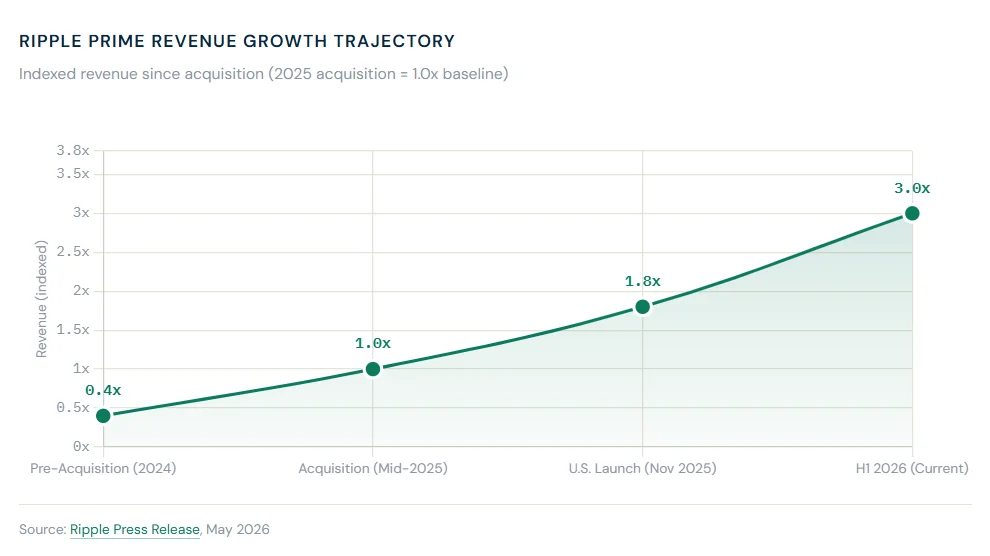
Ripple Prime tripled revenue year-over-year since acquiring Hidden Road in 2025 for $1.25 billion.
The platform now clears over $3 trillion annually across traditional and digital markets.
Neuberger Berman manages over $155 billion in private market commitments globally.
Capital will deploy in phased drawdowns, reducing systemic lending risk.
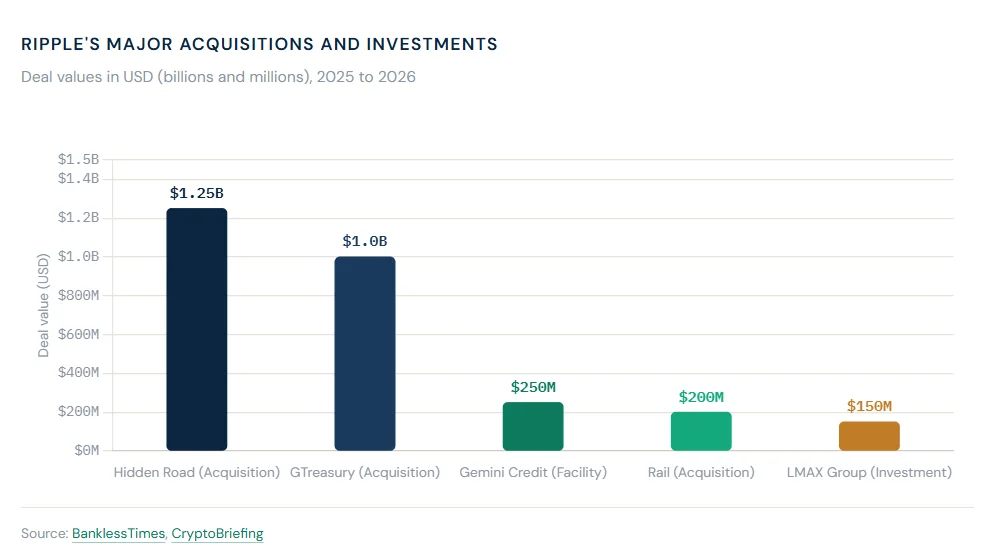
The deal follows Ripple’s multi-billion-dollar acquisition spree, including GTreasury, Rail, and LMAX Group.

Ripple Prime has secured a $200 million debt facility from Neuberger Speciality Finance. Notably, this marks a bold step in institutional crypto lending. Moreover, it signals Ripple’s growing ambition to rival established financial institutions in the prime brokerage space.
The announcement came on May 11, 2026. Specifically, Neuberger Speciality Finance is the asset-based arm of Neuberger Berman, a global investment management firm. In total, Neuberger Private Markets manages over $155 billion in investor commitments as of December 31, 2025. Consequently, the facility allows Ripple Prime to draw capital in phases, matching deployment to actual client demand rather than pre-loading unused leverage.
How the Facility Works
The structure is an asset-backed credit line. Specifically, Ripple Prime’s existing institutional loan book serves as collateral. In this way, it mirrors financing vehicles backed by credit-card receivables or auto loans. Furthermore, capital deployment is phased rather than a single lump sum. Consequently, this approach reduces the risk of overleveraging that plagued earlier crypto lenders.
Proceeds fund margin lending to clients across both markets. For instance, prime brokerage clients include hedge funds, asset managers, and large institutional traders. In addition, all these clients need unified access to financing across asset classes. As a result, Ripple Prime now offers a single framework for crypto, equities, FX, and fixed income. Therefore, managing separate margin accounts per asset class is no longer necessary.
“Dependable access to financing and balance sheet strength are critical to institutional participants in today’s dynamic markets.”
-Noel Kimmel, President, Ripple Prime
Ripple Prime’s Revenue Surge
Ripple acquired Hidden Road for $1.25 billion in 2025. Indeed, this was one of the largest deals in crypto industry history. The acquisition gave Ripple Prime a full-service prime brokerage infrastructure. Since then, revenues have tripled year over year. Moreover, the platform now clears over $3 trillion annually.
U.S. trading launched in November 2025. Moreover, this combined Ripple’s own regulatory licences with Hidden Road’s operational framework. As a result, institutional demand rose sharply after the launch. Noel Kimmel, President of Ripple Prime, cited increased participation across traditional and digital markets as the primary driver. In addition, rising demand for reliable counterparties at scale also contributed significantly.
Above all, the growth is not incidental. Indeed, institutional investors increasingly demand reliable counterparties with consistent access to capital. Accordingly, Ripple Prime’s unified cross-asset margin financing addresses a real market gap. Therefore, the $200 million facility further strengthens that competitive position.
Neuberger Berman’s Endorsement
Neuberger Berman is not a casual partner. In fact, Neuberger Private Markets has actively invested in private markets since 1987. Moreover, it manages over $155 billion across primaries, co-investments, secondaries, and private credit strategies. As such, this is one of the world’s largest alternative asset managers. Its backing, therefore, carries significant reputational weight for the entire sector.
Peter Sterling, Head of Neuberger Speciality Finance, described Ripple Prime’s platform as innovative. Specifically, he noted that it combines fintech-grade technology and agility with bank-level compliance and operational rigour. In fact, this is precisely the profile that institutional capital seeks in a prime broker. Consequently, a lender of Neuberger’s standing choosing Ripple Prime represents a strong validation signal for the sector.
Ripple’s M&A Playbook
The Hidden Road acquisition was not Ripple’s only major deal. For instance, Ripple purchased GTreasury, a treasury management software provider, for $1 billion. Additionally, Rail, a stablecoin payments platform, was acquired for $200 million in December 2025. In January 2026, Ripple further invested $150 million in LMAX Group to support cross-asset growth. A $250 million credit line to Gemini through July 2026 rounds out this acquisition run.
These moves reflect a deliberate strategy. Specifically, Ripple is positioning itself as a full-stack financial services provider spanning payments, custody, liquidity, and treasury management. Indeed, the company was founded in 2012 on cross-border payments. Moreover, XRP and its stablecoin RLUSD underpin many of its solutions. However, recent deals show that Ripple is thinking far beyond payments. Therefore, control of prime brokerage gives Ripple significant institutional leverage.
Regulatory Tailwinds
The timing of this deal is no accident. Indeed, the U.S. regulatory environment for crypto has shifted substantially. For example, the Genius Act, which governs stablecoins, has now been approved. Similarly, the Clarity Act, covering broader digital asset market structure, is advancing through markup. Both laws, therefore, benefit firms that bridge traditional and crypto finance.
Ripple Prime sits exactly at this intersection. Moreover, greater regulatory clarity reduces institutional risk perception. As a result, it lowers the barrier for hedge funds and asset managers to engage with crypto prime brokerage services. This is, consequently, a structural tailwind that benefits Ripple Prime well beyond this single deal.
Analyst Perspective
Two metrics will determine this deal’s success. First, consider how quickly the $200 million facility gets drawn down. Fast drawdown would consequently signal strong institutional demand. Second, Ripple Prime’s rate of new client acquisition among institutional allocators will be telling. Above all, these figures will ultimately reveal whether the thesis holds.
The phased drawdown structure is a meaningful safeguard. In particular, it prevents Ripple Prime from flooding the market with leverage at once. Instead, capital deployment aligns with organic demand. Moreover, this approach is more disciplined than many crypto lenders have historically adopted. As a result, it reduces the risk of overleveraged blowups seen in 2022 and 2023.
The Neuberger Berman facility also sends a message to the broader market. Increasingly, traditional finance is comfortable backing crypto-native prime brokers. Furthermore, this $200 million deal is not just operational capital. Rather, it is a validation by one of the world’s most respected asset managers. That signal may also attract institutional capital to the crypto prime brokerage space in 2026.
Overall, Ripple Prime’s $200 million debt facility is a significant development. Indeed, it confirms growing institutional confidence in crypto prime brokerage. In addition, this deal strengthens Ripple’s financial infrastructure at a critical moment. Consequently, Ripple Prime is better positioned to capture a larger share of the institutional trading market. In summary, traditional and digital finance are converging rapidly, and Ripple is actively driving that convergence.




