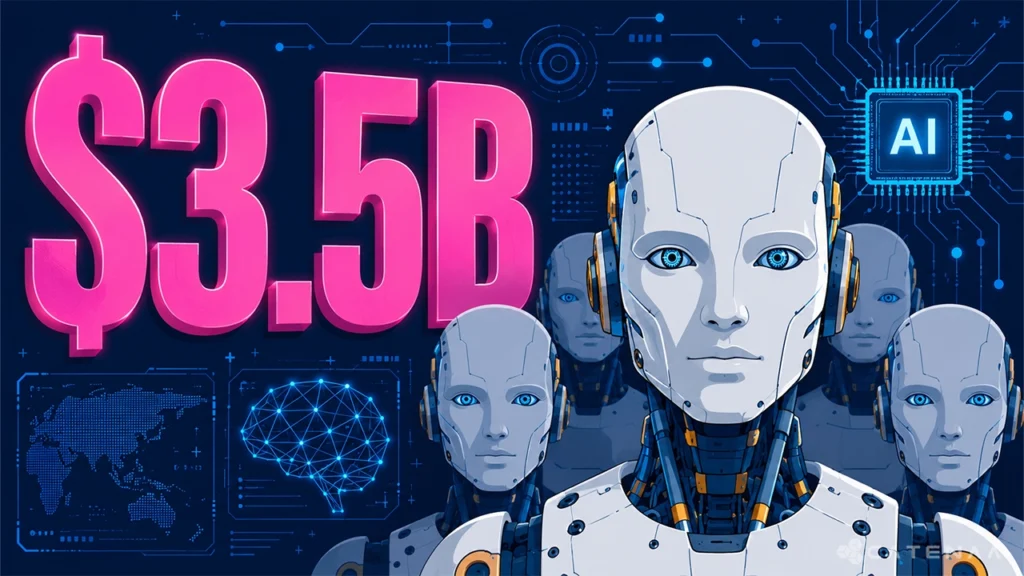


July 27, 2026 – Ten U.S. rounds drew $3.49 billion in a single week. Two venture firms sat inside deals worth more than two-thirds of that total.

In Summary
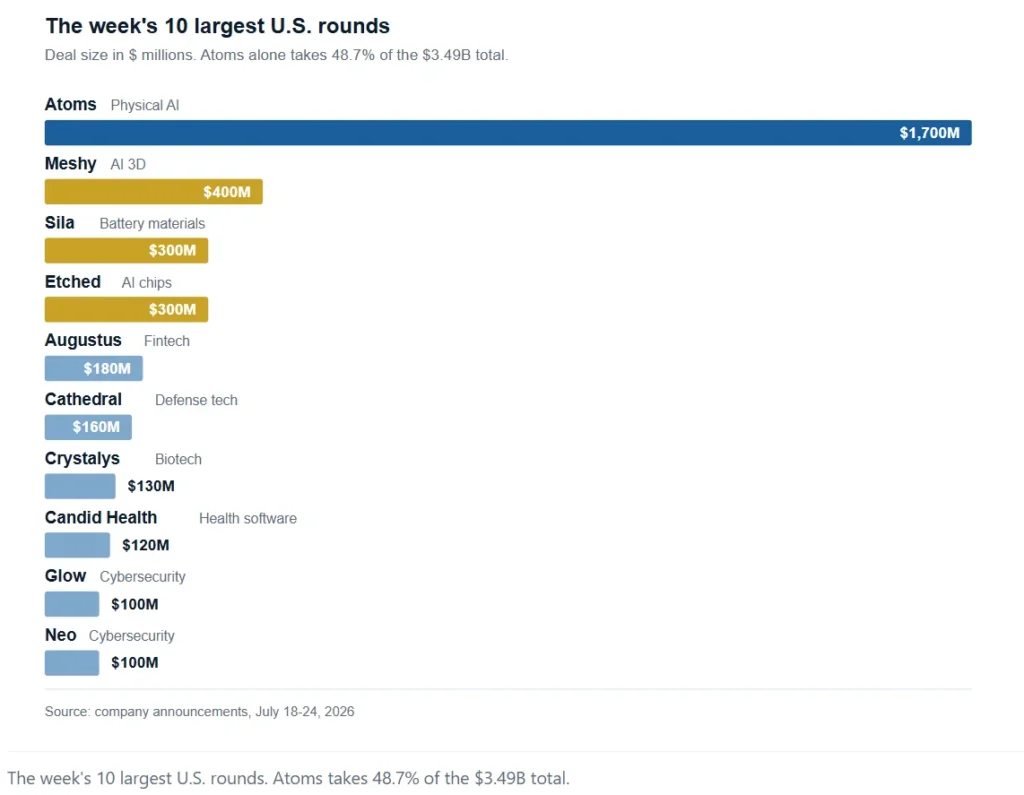
Ten U.S. rounds raised about $3.49 billion between July 18 and 24.
Atoms took $1.7 billion, or 48.7% of the weekly total, in an a16z-led round.
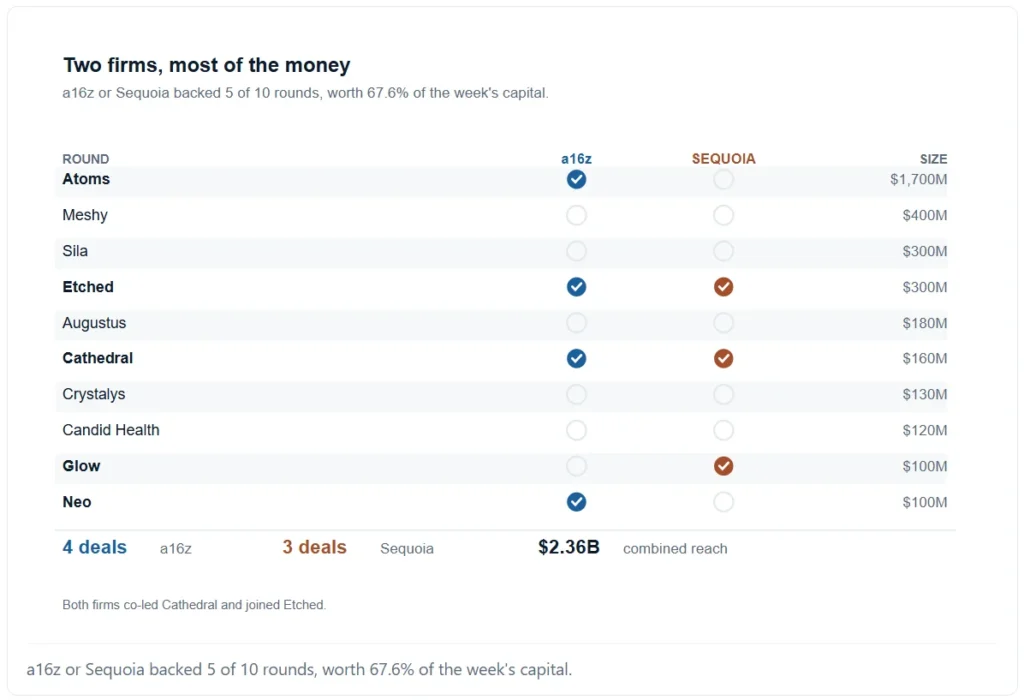
a16z and Sequoia backed five of the ten deals, worth 67.6% of the capital.
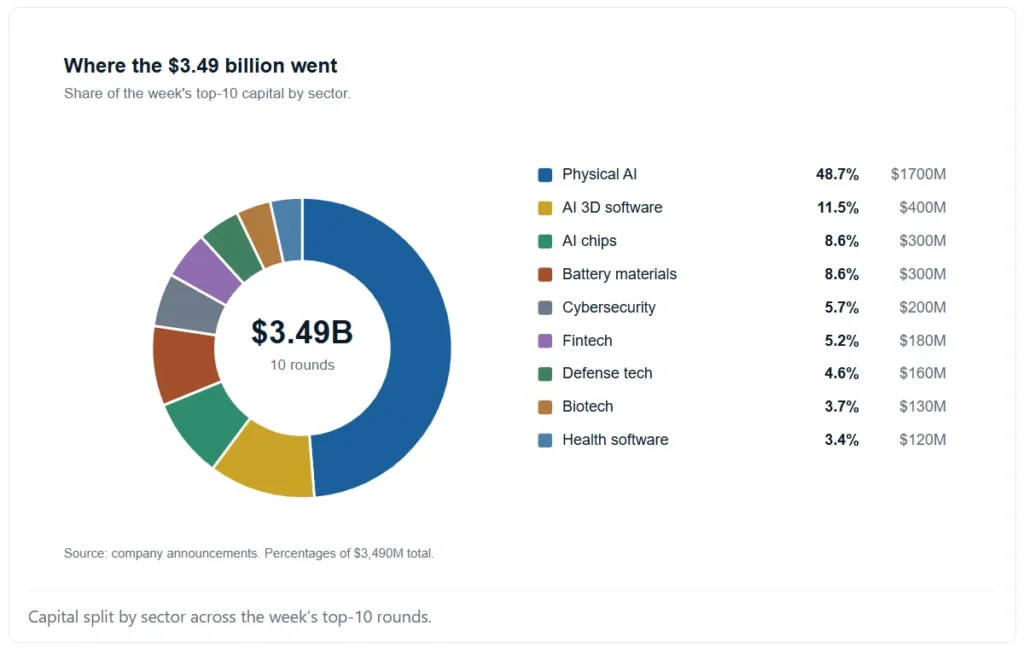
Hardware plays drew 65.9% of the money, despite a varied sector list.
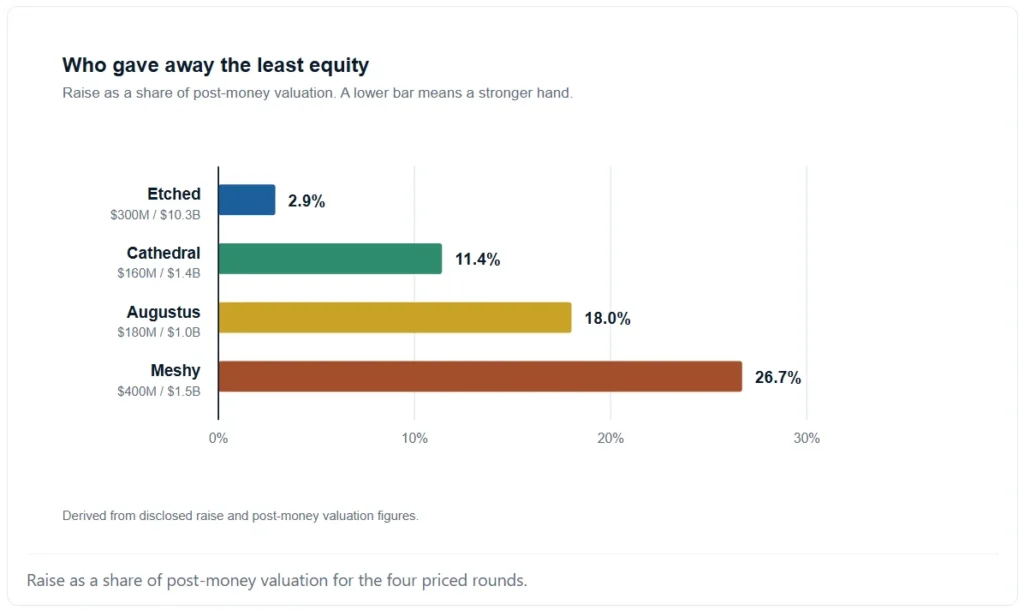
Etched sold just 2.9% of its equity, the lightest dilution of the week.
Three widely repeated figures needed correction, including Etched’s valuation.
Physical AI funding led the biggest week for U.S. startup deals this month. Ten rounds together drew about $3.49 billion. Moreover, one deal claimed nearly half of that sum.
Atoms, the industrial robotics company from Uber founder Travis Kalanick, raised $1.7 billion. Andreessen Horowitz led the equity round. Co-founder Ben Horowitz also joined the board. The company also folded its separate businesses into one equity structure.
Notably, Uber itself backed the round. Bain Capital, Fifth Wall and Alpha Square Group joined too. Meanwhile, five banks signed on as debt partners. They include Goldman Sachs, JP Morgan and Barclays. Kalanick has not disclosed the size of that debt facility.
Two firms shaped most of the week
Weekly roundups usually stress how varied these deals look. However, the capital tells a tighter story. Andreessen Horowitz and Sequoia Capital touched five of the ten rounds. Those five deals total $2.36 billion. Therefore, two firms sat inside roughly 68% of the week’s money.
a16z alone backed four names. It led Atoms, then joined Etched, Cathedral and Neo. Sequoia backed three. Both firms co-led Cathedral, the defense startup founded by former DOGE staff. Consequently, a week billed as varied looks concentrated at the very top.

Hardware drew two thirds of the cash
Sector labels also hide a simple split. Three deals fund physical things: robots, batteries and chips. Atoms, Sila and Etched together raised $2.3 billion. As a result, about 66% of the week’s capital went to Atoms rather than software.
Sila secured $300 million to expand its silicon anode plant in Moses Lake, Washington. Atreides Management and Sutter Hill Ventures led that round. The company frames the raise around supply chain risk. China processes more than 90% of the world’s anode material. Additionally, Sila targets 250 gigawatt hours of capacity within five years.
Etched sold under 3% of itself
Valuations reveal who held the stronger hand. Etched raised $300 million at a $10.3 billion valuation. That price implies the company sold just 2.9% of its equity. Sequoia led, while SK Hynix and Jane Street joined.
Compare that with the rest of the field. Meshy raised close to $400 million at $1.5 billion. Its founders therefore parted with roughly 27% of the company. Augustus gave up about 18% for $180 million. Cathedral surrendered near 11%.
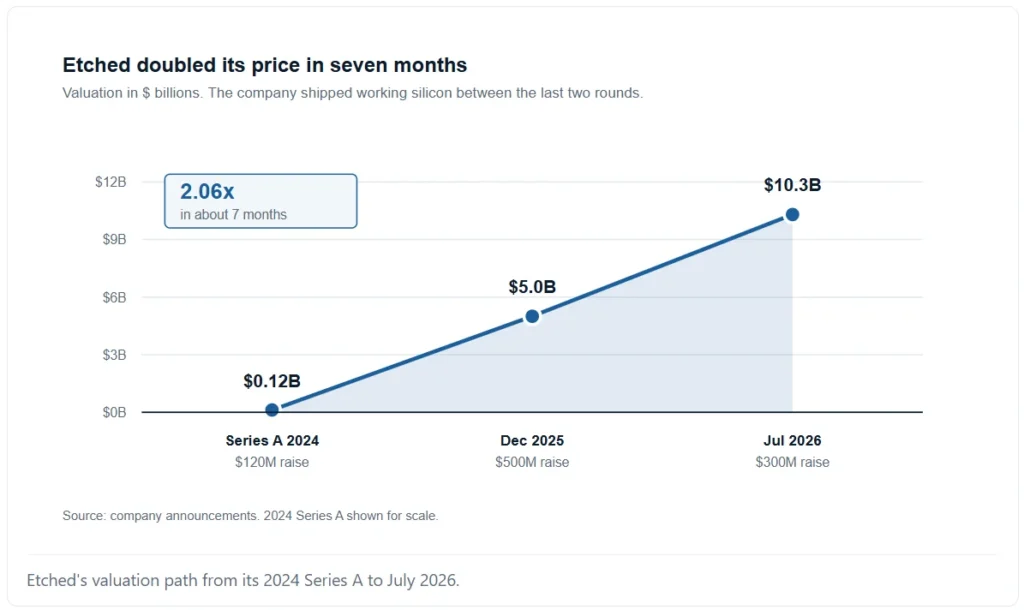
Etched doubled its valuation in about seven months. It stood at $5 billion last December. Since then, the company has shipped working silicon and booked $1 billion in orders. Investors clearly paid up for proof rather than promise.
Meshy leans on revenue, not hype
Meshy raised the week’s second-largest round. Specifically, the 3D model startup closed nearly $400 million at $1.5 billion. Notably, that marks its first public price tag.
Its numbers explain the appetite. Annual recurring revenue grew about 12 times over the past year. Furthermore, the platform now counts more than 12 million registered users. Together they have generated over 100 million models. Customers include game studios and consumer 3D printing brands.
Smaller deals filled the middle
Six rounds landed between $100 million and $180 million. For example, Augustus took $180 million to give banks direct dollar account access. Meanwhile, Tiger Global led that deal at a $1 billion valuation.
Crystalys Therapeutics closed $130 million for gout treatments. Similarly, Candid Health raised $120 million for healthcare billing software. Glow and Neo each landed $100 million in cybersecurity. Indeed, both left stealth this week.
Three figures worth correcting
Early accounts of this week carried errors. First, several reports pegged Etched at a $10 billion pre-money valuation. The company itself states $10.3 billion.
Second, Neo appeared as a $75 million round. Neo actually launched with $100 million in total funding. That splits into a $75 million Series A and an earlier $25 million seed. Andreessen Horowitz and Bessemer Venture Partners backed the company.
Third, Sila still appears under its old name, Sila Nanotechnologies. The company now trades simply as Sila.
What the pattern signals
Two readings emerge from these ten deals. Investors are paying record prices for hardware that already works. Etched shipped chips before doubling its price. Sila runs a live plant. Atoms spent eight years in stealth before this raise.
Yet the week also rewarded access over traction. Cathedral reached a $1.4 billion valuation with no public revenue. Its founders recently held senior government posts. Meanwhile, Neo and Glow launched straight out of stealth with $100 million each.
Because a16z and Sequoia anchored so much of the total, concentration risk deserves attention. A handful of partners now shape which categories look fundable. For founders outside those networks, the bar may sit higher than headline totals suggest.
Readers should treat valuations as point-in-time figures. Several rounds remain unpriced or undisclosed. Refresh these numbers before acting on them.




