

August 19, 2026 – Robotics, defence and aerospace startups raised more in six months than the whole sector collected across 2022 to 2024.
In Summary
Physical AI startups raised $47.4bn across 521 deals in the first half of 2026.
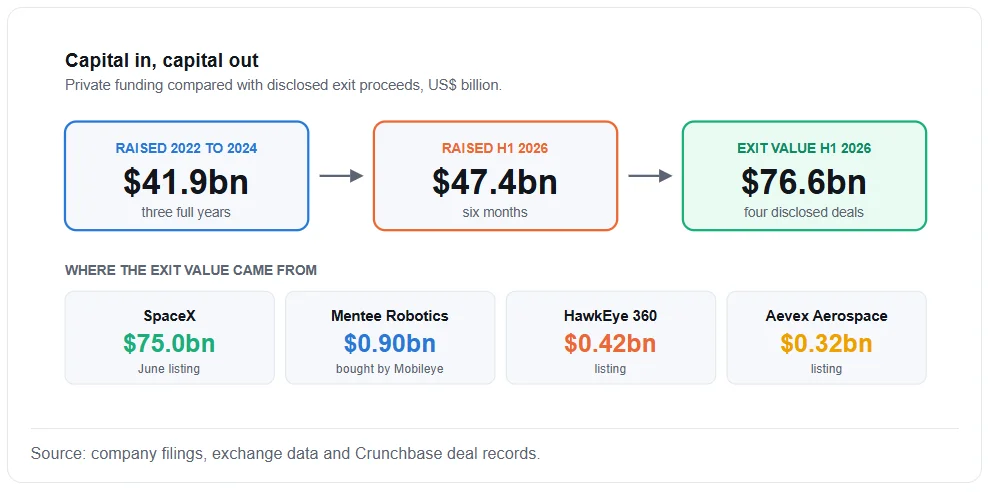
That single half beat the $41.9bn raised across 2022, 2023, and 2024 combined.
Waymo’s $16bn February round supplied about a third of the total.
Three of the four biggest rounds serve defence buyers, not consumers.
Exits reopened, led by the $75bn SpaceX listing in June.
Average deal size jumped to about $91m from $61m a year earlier.
A half year with no precedent
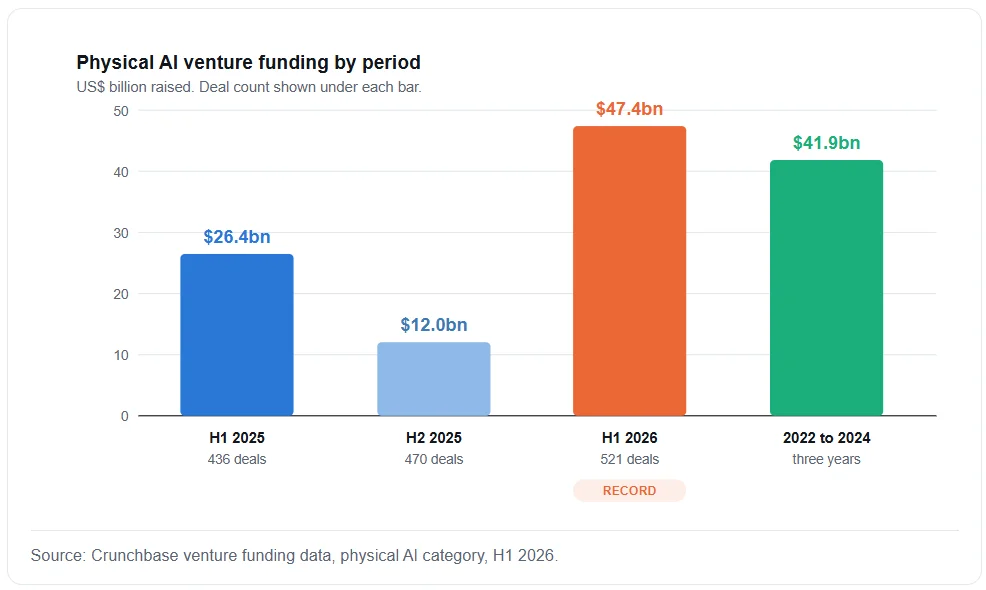
Physical AI startups pulled in $47.4bn across 521 deals during the first half of 2026. Those six months beat the $41.9bn the sector raised across 2022, 2023, and 2024 put together. Moreover, the tally dwarfed the $12bn logged in the second half of 2025. Deal counts barely moved, so cheque sizes did all the work.
Physical AI describes machines that sense the world and then act in it. Robotics, self-driving cars, drones, aerospace, sensors, and factory automation all sit inside the label. Joe Fath of Eclipse Capital calls it “intelligence embedded in systems that perceive, reason, and act in the real world.” In short, the software has left the screen.
Physical AI funding has clearly changed shape. Investors have moved their weight. Large language model builders still raise the single biggest cheques. Even so, the hardware layer now attracts the same crossover funds, sovereign pools, and growth investors.
Bigger cheques, not more of them
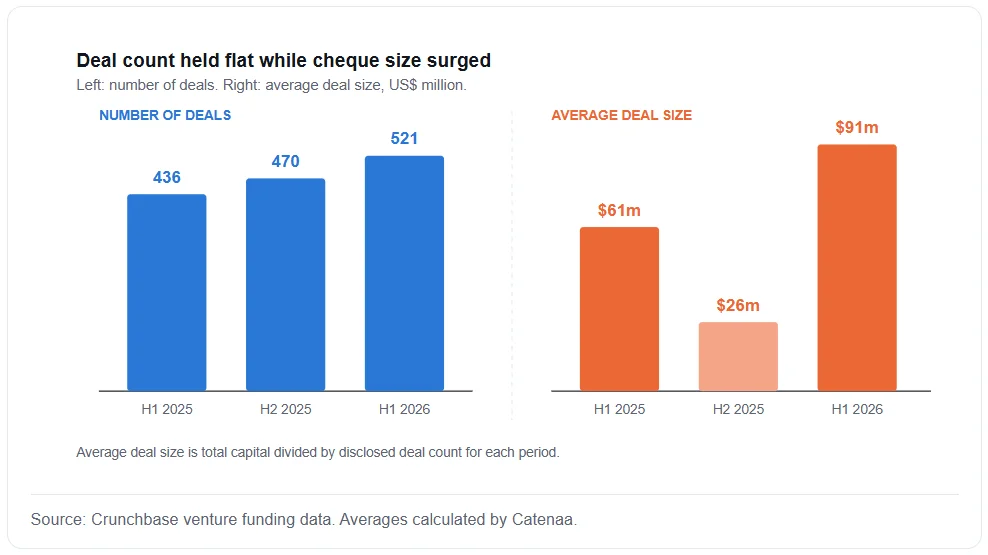
Growth against last year looks steep on any measure. The first half of 2025 brought in $26.4bn from 436 deals. This year’s figure sits 80% higher on just 19% more deals. Therefore, the average deal climbed to roughly $91m from about $61m.
The back half of 2025 now reads like an air pocket. Investors signed 470 cheques in that stretch, yet the value collapsed to $12bn. By contrast, the current half delivered close to four times that sum on only 11% more deals.
Four rounds set the tone
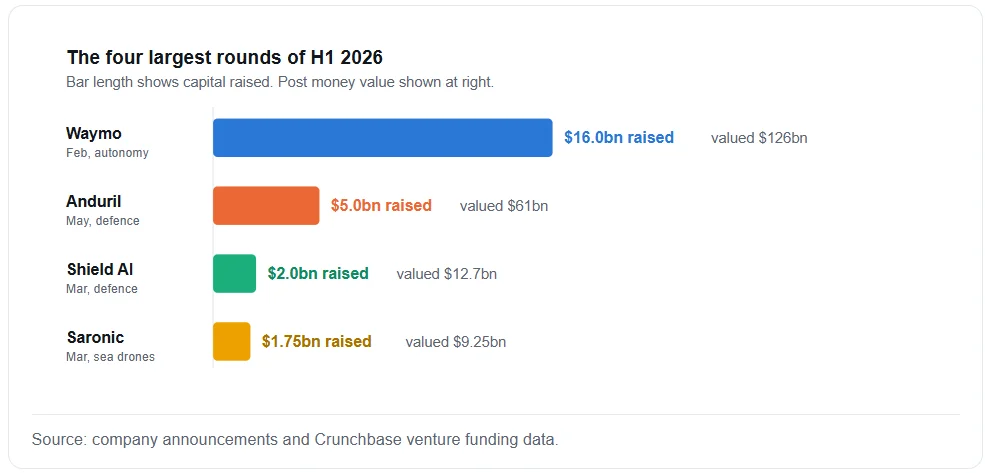
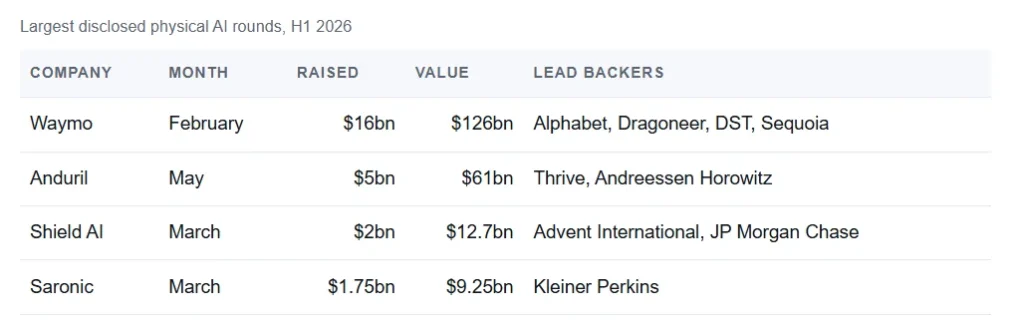
Waymo led everything by a wide margin. Alphabet’s robotaxi arm raised $16bn on 2 February at a $126bn post-money valuation. Dragoneer Investment Group, DST Global, and Sequoia Capital co-led the round alongside Alphabet. Co-chief executives Tekedra Mawakana and Dmitri Dolgov said the capital shows “the age of autonomous mobility at scale has arrived.”
That deal alone supplied roughly a third of the half’s total. Waymo plans ride hailing in more than 20 new cities this year, including Tokyo and London. Fleet expansion, not research, absorbs most of the money.
Defence sits at the centre
Anduril Industries raised $5bn in May. Its value doubled to $61bn from $30.5bn twelve months earlier. Shield AI arrived in March with a $2bn Series G at $12.7bn, co-led by Advent International and JP Morgan Chase. Meanwhile, Saronic banked $1.75bn at $9.25bn in a Kleiner Perkins-led deal.
Three of those four rounds therefore serve defence and security, buyers. Household robots barely featured in the top tier. Government buyers, not shoppers, now set the price in this field.
Exits finally reopened
Venture money needs a route out, and 2026 delivered one. SpaceX floated in June, raised $75bn and listed at about $1.7tn. HawkEye 360 raised $416m through its own offering. Aevex Aerospace added $320m. In addition, Mobileye bought Mentee Robotics for about $900m.
Exit value across the half therefore reached roughly $76.6bn. That sum exceeds every dollar the sector raised privately over the same period. Above all, it gives late-stage backers a credible mark for the next fundraising cycle.
Why building got cheaper
Costs explain a large slice of the surge. Ryan Ziegler of Edison Partners argues that “the costs to build these companies have come down, and AI infrastructure and multi-modal tech to do so are now available.” Shared vision models, cheaper sensors, and contract manufacturing all cut the bill.
Hardware teams once burned years on basic perception. Today they licensed it. So a young robotics team now reaches a working prototype in months.
Risks buried in the numbers
One flaw stands out at once. Strip out Waymo, and the half falls to $31.4bn. Remove the top four rounds, and the figure drops near $22.7bn. Most of the 521 deals stayed small.
Valuations also climbed faster than revenue. Anduril doubled its price within a year. Public investors will test those marks in time. Listed peers set a hard yardstick.
Supply chains add a second risk. Sensors, batteries, and advanced chips still face long lead times. Any tariff shift or export control therefore lands directly on unit costs.
Investors are buying atoms again
Software absorbed most venture money for a decade. Now the pendulum has swung. Machines that move, lift, fly or drive are back in favour.
Two forces drive the shift. War in several theatres has lifted defence spending sharply. At the same time, driverless fleets have started to carry paying riders at scale.
Buyers with deep pockets change the maths for founders. A defence ministry signs multi-year contracts. Meanwhile, a ride-hailing fleet earns cash per mile. Both look far steadier than an app subscription.
What to watch next
Anduril entered talks in July at a reported $100bn. Should that round close, defence technology would reset the ceiling again. Physical AI funding will hinge on three signals through year-end.
First, new robotaxi cities will show whether driverless fleets pay their way. Second, defence budgets in the United States and Europe will set order books. Finally, the listing window matters most because exits fund the next wave of cheques.




