

April 23, 2026 – Montreal-based NorthStar Earth & Space plans to merge with Viking Acquisition Corp. I. The deal targets a $300 million NYSE listing under ticker NSTR. But a troubled satellite history casts a long shadow.
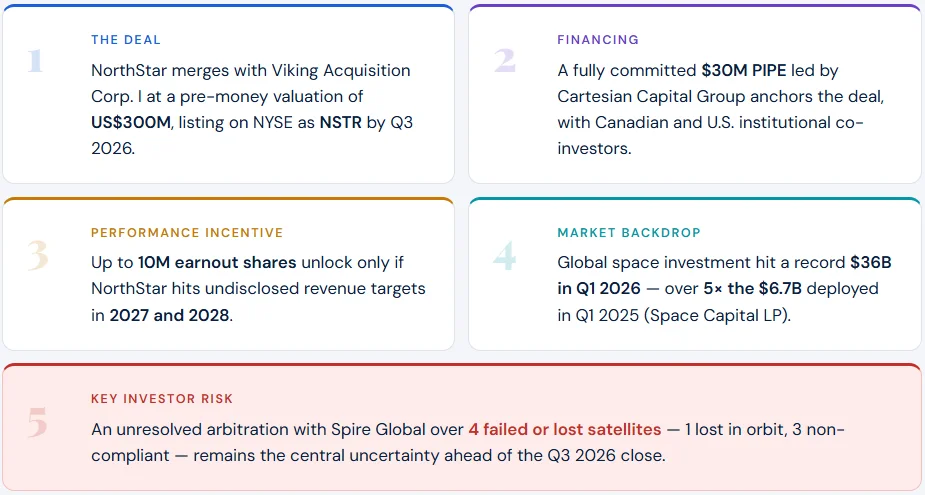
NorthStar Earth & Space Inc. is going public. The Montreal-based space security startup announced on April 17 a definitive merger agreement with Viking Acquisition Corp. I. The deal values NorthStar at a pre-money valuation of US$300 million. The combined company will trade on the New York Stock Exchange under the ticker symbol “NSTR.”
The announcement arrives at a remarkable moment. Investor appetite for space assets has surged dramatically in 2026. This SPAC deal positions NorthStar at the intersection of two red-hot themes: space security and orbital sustainability.
The Deal Structure at a Glance
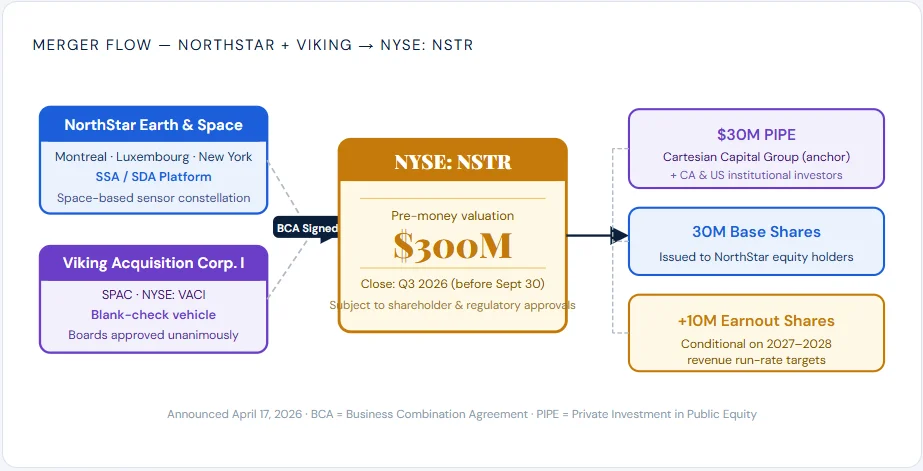
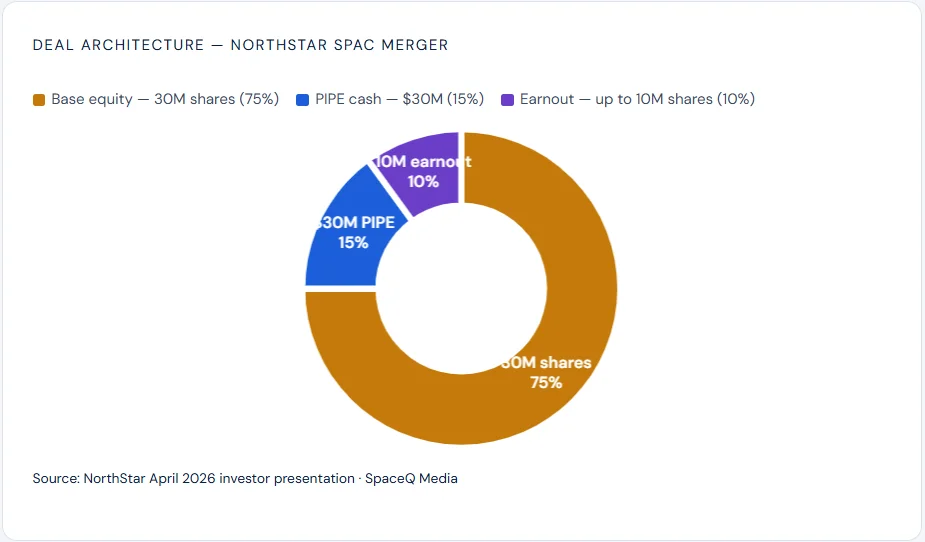
The transaction is straightforward on paper. According to SpaceNews, NorthStar’s equity holders receive 30 million shares at the $300 million pre-money valuation. A committed $30 million PIPE anchors the financing. New York private-equity firm Cartesian Capital Group leads the PIPE. Canadian and U.S. institutional investors also participate.
Gross proceeds are expected to be at least $30 million. Additional funds may come from Viking’s trust account. The combined company’s boards have each unanimously approved the deal. Closing is subject to shareholder and regulatory approvals.
There is also a performance-based earnout component. Up to 10 million additional shares are tied to revenue targets in 2027 and 2028. This structure incentivises NorthStar’s management to hit commercial milestones quickly after listing.
A Record Quarter for Space Investment
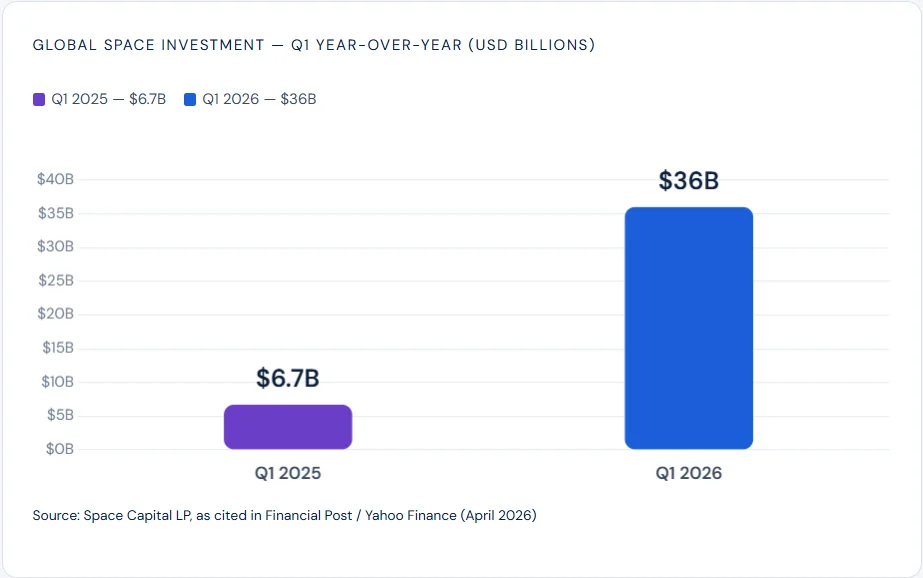
The timing of this deal is no accident. Space investment is exploding globally. According to venture-capital firm Space Capital LP, investors poured a record US$36 billion into space companies in Q1 2026. That compares to just US$6.7 billion in Q1 2025, a more than fivefold increase in one year.
Government defence spending is a key driver. Space surveillance and domain awareness are now national security priorities. NorthStar’s core product aligns directly with those priorities. A company spokesperson stated the firm’s mission “directly” aligns with Ottawa’s plan to protect critical assets in orbit.
What NorthStar Actually Does
NorthStar operates in the Space Situational Awareness (SSA) and Space Domain Awareness (SDA) market. The company uses a network of bespoke sensors to monitor orbital activity. Its platform integrates both ground-based and space-based data streams. This dual approach gives it an edge over purely ground-based competitors.
The company is headquartered in Montreal. It also has offices in Luxembourg and New York. NorthStar’s sensors are designed to track objects as small as five centimetres in low Earth orbit. In geostationary orbit, they can resolve objects down to 40 centimetres.
Proceeds from the SPAC merger will fund three things. First, payload capital expenditures, primarily sensors to mount on satellites. Second, spacecraft integration and deployment costs. Third, non-recurring engineering expenses for constellation build-out.
“NorthStar intends to play a vital role in safeguarding orbital environments and advancing sustainability in space.”
— Stewart Bain, Founder & CEO, NorthStar Earth & Space
The Spire Global Dispute: A Cloud Overhead
The deal does not come without complications. Via Satellite reported that NorthStar launched four satellites via Rocket Lab in January 2024. The payloads were built and integrated with Spire Global’s Space Services division. The outcome was damaging.
NorthStar claims one satellite was lost entirely in space. It alleges the other three failed to produce contract-compliant images. The company filed legal action against Spire for breach of contract, willful misconduct and fraudulent misrepresentation. Spire denies all claims in full. An arbitral tribunal held an evidentiary hearing in January 2026. The case remains unresolved.
The Bigger Picture: A $1.8 Trillion Space Economy
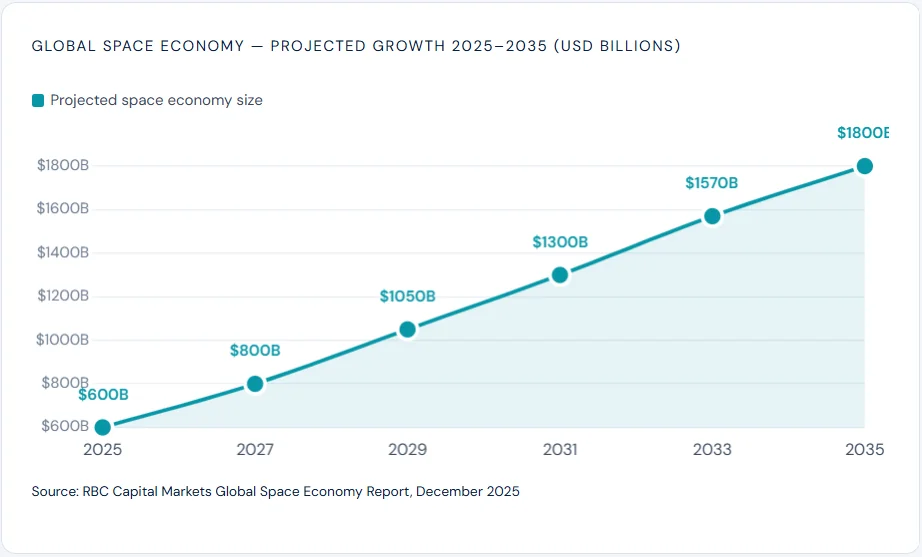
Beyond the litigation, the macro context is compelling. A December 2025 report by RBC projected the global space economy would triple in value. It could reach US$1.8 trillion within the next decade. Canadian opportunities alone could exceed $21 billion.
The SPAC route echoes a 2021 wave that took companies like Rocket Lab, Spire, BlackSky, and AST SpaceMobile public. Some of those trades have been volatile since listing. But the sector’s long-term growth thesis remains intact. An anticipated SpaceX IPO, potentially the largest ever at US$75 billion, could further energise investor interest in the sector.
What Happens Next
The deal must clear shareholder and regulatory hurdles first. Both NorthStar and Viking boards have signed off unanimously. Closing is expected before the end of September 2026. Once complete, NSTR will debut on the NYSE. Management has committed to executing NorthStar’s constellation growth strategy as a public company.
For Canadian space watchers, this is a landmark moment. It is rare for a Canadian-founded space startup to list on a major U.S. exchange. Whether NorthStar can translate its orbital ambitions into public-market performance remains the central question for investors.




