

July 02, 2026 – The $807 billion manager moves a high-yield corporate bond strategy onchain with Centrifuge, widening Wall Street’s tokenization race.
In Summary
New York Life Investment Management launched its first tokenized investment fund.
The product puts a U.S. high-yield corporate bond strategy onchain with Centrifuge.
Eligible investors subscribe and redeem shares using Circle’s USDC stablecoin.
The move expands tokenization beyond Treasuries into higher-yield credit markets.
New York Life Investment Management (NYLIM) has stepped firmly onto blockchain rails. The firm oversees roughly $807 billion in assets. Moreover, it now joins a widening group of Wall Street tokenization adopters. On Tuesday, the manager unveiled its first tokenized investment product, according to CoinDesk.
The new fund places a U.S. high-yield corporate bond strategy onchain. It carries the name NYLIM Anemoy U.S. High Yield Corporate Bond Segregated Portfolio. The manager built the product with tokenization platform Centrifuge. Meanwhile, eligible investors can subscribe and redeem shares using Circle’s USDC stablecoin. USDC ranks among the largest regulated stablecoins by market value.
New York Life still manages the underlying portfolio and investment strategy. Therefore, the blockchain layer mainly modernizes issuance, transfer and settlement. The core bond strategy itself stays unchanged.
Tokenization represents a compelling evolution in how investment solutions can be accessed, managed and distributed.
Those words came from Thomas Sy, who leads multi-asset solutions at the firm. His comment frames tokenization as an upgrade to distribution rather than a new strategy. As a large life insurer, New York Life rarely moves first on emerging technology. Consequently, this debut carries extra signaling weight.
A blue-chip name joins the onchain push
NYLIM is not the first major manager to embrace tokenized funds. Indeed, BlackRock, Franklin Templeton, Apollo and Janus Henderson already run onchain products. BlackRock’s tokenized Treasury fund alone has passed $2.5 billion in assets. These firms bet that blockchain can shorten settlement times. In addition, supporters say the technology improves efficiency and asset mobility.
The efficiency case rests on speed. Traditional bond settlement can take up to two business days. By contrast, onchain transfers can finalize in minutes. In addition, smart contracts can automate coupon payments and other routine tasks. These savings appeal to operations teams across the industry.
For Centrifuge, the deal adds another heavyweight client. The platform already tokenizes funds from Apollo and Janus Henderson. Furthermore, those assets increasingly plug into decentralized finance protocols such as Aave and Morpho. Centrifuge also serves as Coinbase’s preferred tokenization partner, following a strategic investment.
Why corporate bonds matter
Early tokenization efforts centered on U.S. Treasury funds. However, those products offer modest yields and minimal credit risk. High-yield corporate bonds sit further along the risk curve. Consequently, they promise stronger returns for onchain investors. The New York Life tokenized fund, therefore, targets a different investor appetite.
This launch marks a meaningful shift in approach. Asset managers are moving beyond safe government debt. Instead, they are testing private credit, equities and corporate bonds. In fact, six tokenized asset categories now each exceed $1 billion in value. As a result, the on-chain market is becoming increasingly diverse.
The yield gap explains much of the appeal. High-yield issuers carry lower credit ratings than investment-grade names. In return, they pay investors richer coupons. Tokenization could widen access to that income stream. Historically, smaller investors struggled to reach these markets directly.
The market behind the move
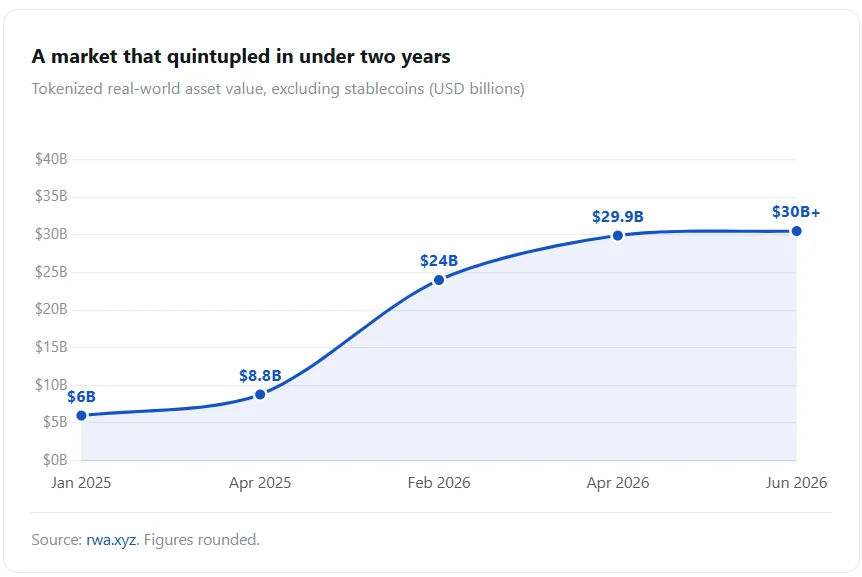
The tokenized real-world asset market has expanded rapidly. It now exceeds $30 billion, excluding stablecoins, according to rwa.xyz. Notably, that figure stood near $6 billion in early 2025. In other words, the market has roughly quintupled in under eighteen months.
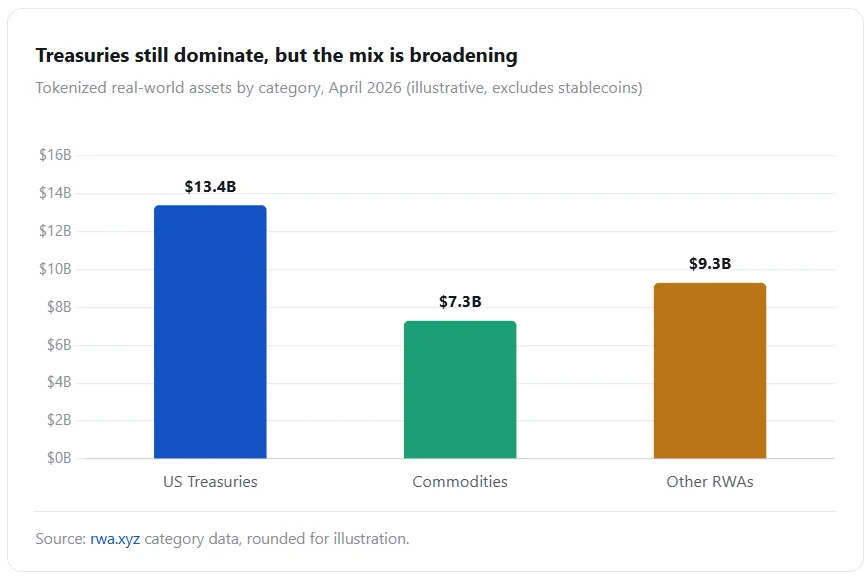
Treasuries still account for the largest single share. Yet newer categories keep climbing fast. For example, commodities and private credit each gained ground through 2026. Ethereum also hosts the bulk of tokenized fund activity. This broadening base gives the sector firmer footing.
Wall Street’s widening race
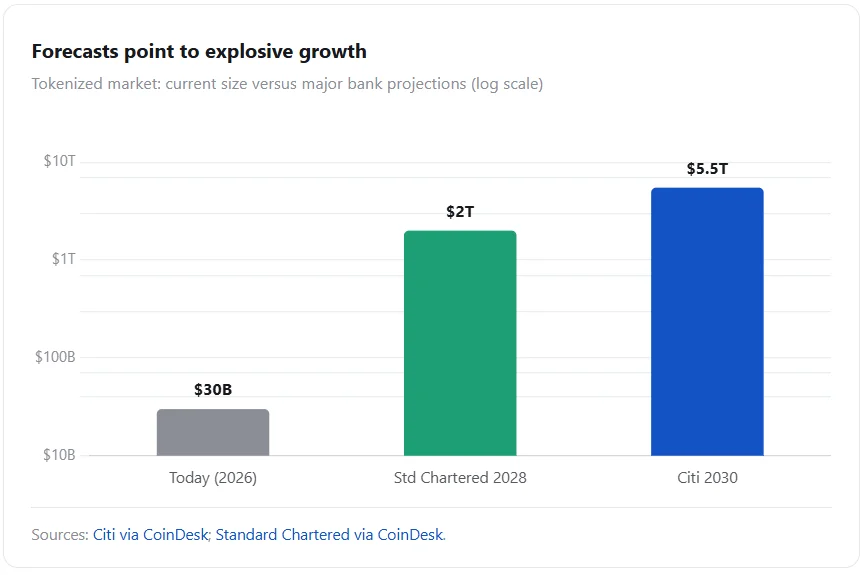
Big banks expect the trend to accelerate sharply. Citi projects tokenized assets could reach $5.5 trillion by 2030. Meanwhile, Standard Chartered estimates the market could hit $2 trillion by 2028. Both forecasts dwarf today’s totals.
These projections rest on several converging forces. First, major infrastructure providers are embedding tokenization into core systems. Second, regulated stablecoins now supply reliable on-chain settlement. Third, regulatory clarity is improving across key markets. Together, these factors lower long-standing barriers to adoption.
Recent U.S. legislation has reinforced that shift. The GENIUS Act created federal rules for stablecoins in 2025. That framework now underpins the cash leg of tokenized trades. As a result, institutional settlement rests on firmer legal ground.
What could still slow it down
Tokenization faces real obstacles despite the momentum. Liquidity remains the most stubborn concern. After all, placing an asset onchain does not create instant buyers. Many tokenized products still trade thinly and infrequently.
Custody concentration adds another risk. A small group of custodians holds most institutional tokens. Therefore, a single failure could ripple widely. Valuation also poses challenges for thinly traded holdings. Pricing illiquid assets accurately remains difficult. Cross-border regulatory gaps further raise compliance costs.
Even so, the overall direction looks clear. Blue-chip managers keep shifting traditional assets onto public blockchains. For New York Life, this debut marks a measured entry. Ultimately, its progress may encourage other large insurers to follow.