

April 16, 2026 – Singapore-based Meridian & Saturn Capital secured the mandate to trade onshore Chinese equities. A market-neutral quant strategy backs the bet.
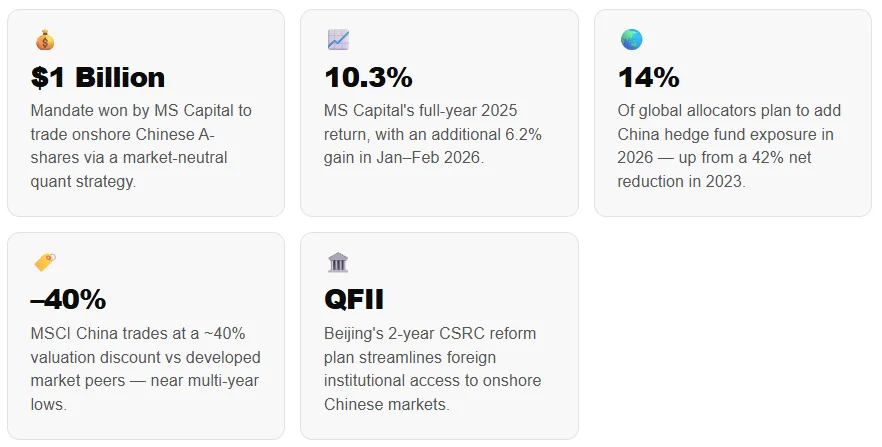
A Singapore-based quantitative hedge fund just landed a massive bet on China. Meridian & Saturn Capital (MS Capital) announced a $1 billion mandate to trade onshore Chinese equities. The news landed on April 15, 2026.
It is not just a big number. It is a signal. The mandate points to a deeper trend: institutional capital is rotating back into Chinese markets after years of caution.
Kate Zhang, founding partner and CEO of MS Capital, confirmed the deal in an interview with Bloomberg. The fund will deploy the capital via a market-neutral strategy targeting A-shares, stocks traded on mainland Chinese exchanges.
Why This Mandate Matters Now
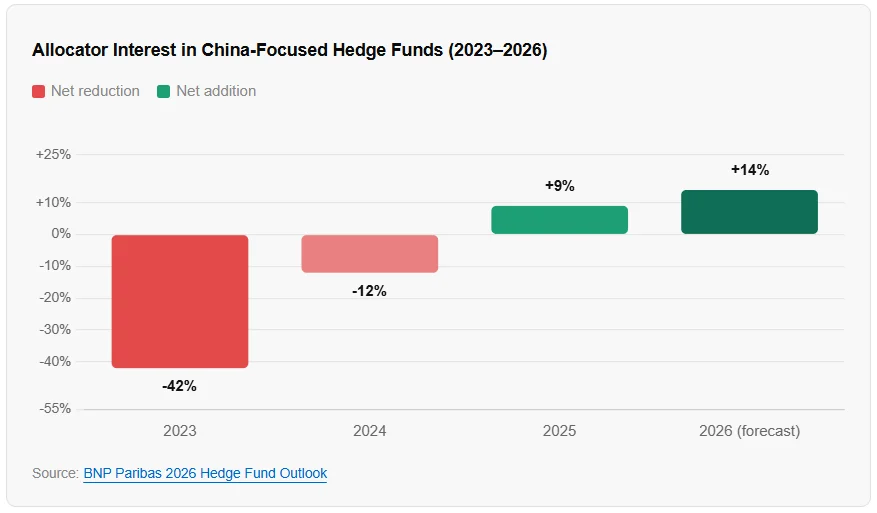
MS Capital is not the only fund eyeing China right now. But the size and timing of this mandate carry weight. BNP Paribas’ 2026 Hedge Fund Outlook shows just 9% of allocators invested in China-focused hedge funds in 2025. That number is now projected to grow: 14% plan to add China exposure in 2026, a significant jump from the 42% net outflow recorded in 2023.
Zhang noted that demand has turned global. At a Morgan Stanley conference in the Middle East in February, MS Capital gave five presentations; most major global fund managers gave one or two.
“Chinese investment is heating up again. Confidence in Chinese quantitative investment is growing stronger.”
— Kate Zhang, Founding Partner & CEO, Meridian & Saturn Capital
The Strategy: Market-Neutral in an A-Share Market
MS Capital’s approach is disciplined. A market-neutral strategy aims to profit regardless of the broad market direction. It takes long positions in stocks it expects to outperform. It simultaneously takes short positions in those it expects to underperform. The net market exposure stays close to zero.
This is a quant-driven approach. Algorithms, not human analysts, screen thousands of A-share stocks. The method thrives on volatility and pricing inefficiency, two things that remain abundant in China’s retail-heavy onshore markets.
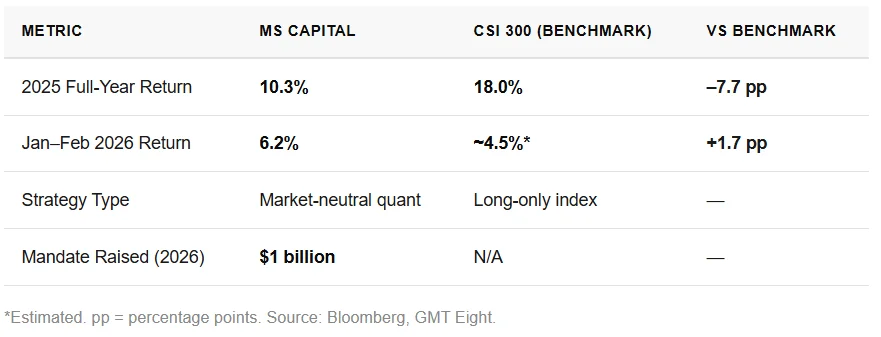
In volatile market conditions, like the Iran conflict that rattled global markets in early 2026, a neutral strategy can outperform directional equity funds. That 6.2% gain in January–February 2026 is exactly why allocators want this kind of exposure.
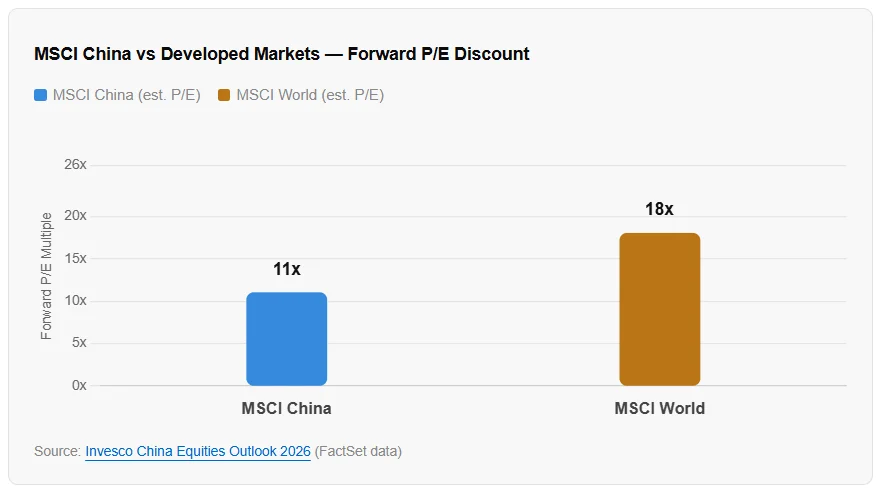
Valuation Gap: China Still Cheap vs Developed Markets
Numbers support the renewed interest. The MSCI China Index trades at roughly a 40% discount to developed-market peers, according to Invesco’s 2026 China Equity Outlook. That is despite a strong rebound in 2025.
Corporate earnings have also recovered. Invesco notes that earnings per share have likely bottomed. Return on equity is improving. That combination of cheap valuations and earnings recovery is a classic signal for long-term allocators.
AI, Quant Performance, and Mandate Timing
Timing matters here. DeepSeek’s high-profile launch in early 2025 reshaped global perceptions of China’s AI capabilities. It proved that Chinese technology firms can deliver competitive large language models at a fraction of the cost of US counterparts.
For quant funds, AI-enhanced models now drive alpha generation across Chinese A-shares. MS Capital benefits from this. Better models mean better signal extraction from noisy, volatile markets.
According to BNP Paribas, quant equity strategies returned an annualized 11.31% over five years through 2025. Quant multi-strategy returned 12.76% on a five-year annualized basis. These numbers attract institutional money.
Macro Backdrop: Policy Support Remains Key
China’s policy environment has shifted in favor of foreign capital. In October 2025, the China Securities Regulatory Commission (CSRC) launched a two-year plan to upgrade the QFII regime. The goal is to make it easier for sovereign wealth funds, pensions, and institutional investors to access onshore markets.
Separately, seven major Chinese authorities streamlined onshore reinvestment rules for foreign-invested entities in July 2025, per Norton Rose Fulbright. These changes reduce friction and signal long-term commitment to financial opening.
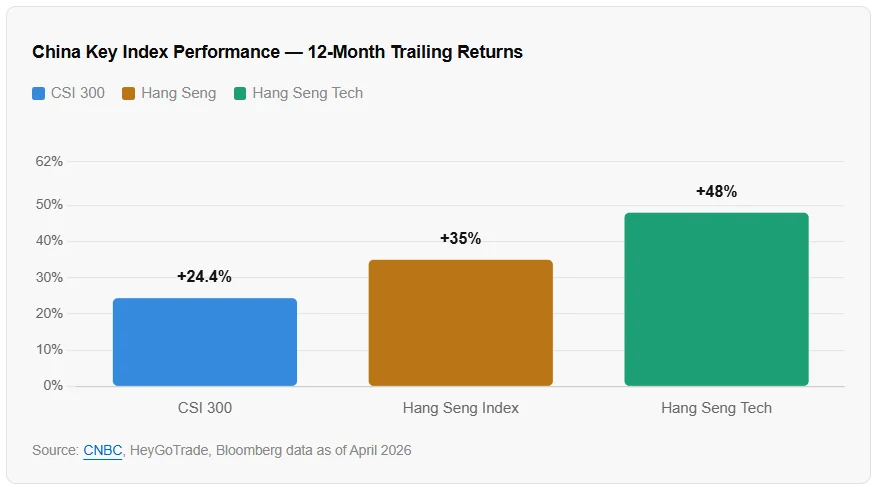
GDP growth supports the thesis, too. China’s Q1 2026 growth is forecast at 4.8% year-on-year, up from 4.5% in Q4 2025. The CSI 300 hit 4,678 points this week, its highest in over a month, with a 24.39% gain over the past 12 months.
What Risks Remain?
Not everything is straightforward. China’s March 2026 exports grew just 2.5% year-on-year. That compares to 21.8% growth in January–February. The Iran conflict is weighing on global energy costs and demand.
Geopolitical risk between the US and China remains a key concern. Capital controls, policy reversals, and regulatory unpredictability are risks that allocators price in. A market-neutral strategy like MS Capital’s is designed in part to hedge against exactly these tail risks.
Yet the momentum is clearly building. As Ashley Wilson, Global Head of Prime Services at BNP Paribas, noted, Asia-Pacific and China hedge fund managers have re-entered the global allocator spotlight in 2026.
“After back-to-back years of equity market strength and consistent alpha delivery, Asia-Pacific and China hedge fund managers have re-entered the global allocator spotlight in 2026.”
— Ashley Wilson, BNP Paribas Global Head of Prime Services
The Bottom Line
MS Capital’s $1 billion mandate is both a business milestone and a market signal. It reflects rising institutional confidence in China’s equity markets. It also shows that quant-driven, market-neutral strategies are the preferred vehicle for cautious re-entry.
For global allocators still on the sidelines, the message is clear. The window for cheap China exposure is open. But it may not stay that way for long.