


April 18, 2026 – The first spot Bitcoin ETF from a major U.S. bank crossed $100 million in one week. Here’s what the numbers really mean for the $56 billion market.
In Summary
MSBT launched on April 8, 2026, on NYSE Arca, the first spot Bitcoin ETF from a major U.S. bank.
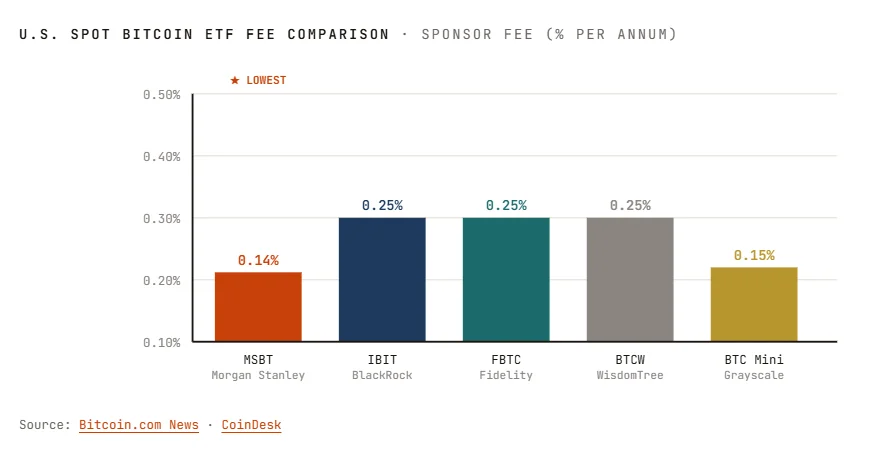
The fund’s 0.14% fee is the lowest in the U.S. Bitcoin ETF market, undercutting BlackRock’s IBIT by 11 basis points.
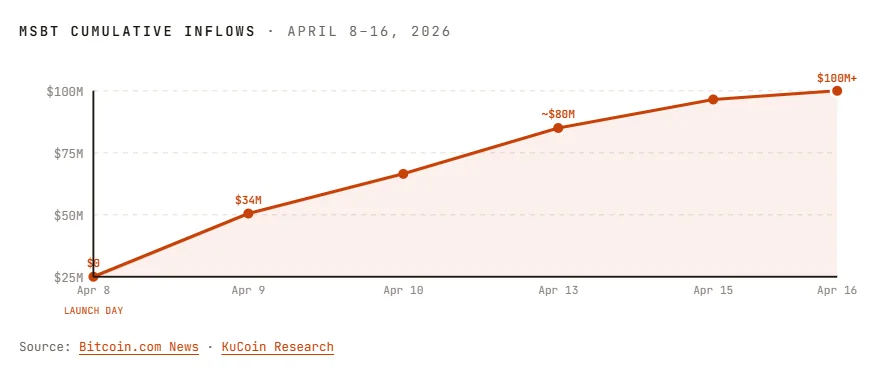
$34 million flowed in on day one. Total inflows topped $100 million within the first week.
16,000 Morgan Stanley advisors managing $6.2 trillion give MSBT an unrivaled distribution pipeline.
Goldman Sachs has filed for a covered-call Bitcoin ETF; the fee war is only accelerating.

Wall Street Crosses the Rubicon
On April 8, 2026, Morgan Stanley made a move no major U.S. bank had made before. It launched MSBT, the Morgan Stanley Bitcoin Trust on NYSE Arca. The fund is the first spot Bitcoin ETF ever issued by a major U.S. commercial bank. Morgan Stanley owns, manages, and distributes the product entirely under its own name.
Eight days later, the New York Stock Exchange celebrated publicly. The NYSE rang its closing bell on April 16. It described MSBT as “the first spot Bitcoin ETF issued by a major U.S. bank.” That was not marketing copy. It was market history.
“In December 2017, a Morgan Stanley analyst concluded Bitcoin’s true value could be zero. On April 8, 2026, the same institution launched its own Bitcoin ETF at the lowest fee in the market.”
— Nadcab Labs Analysis
The Fee That Changes the Conversation
MSBT carries a 0.14% annual sponsor fee, the lowest among U.S. spot Bitcoin ETFs. It undercuts BlackRock’s iShares Bitcoin Trust (IBIT) by 11 basis points. IBIT charges 0.25% and holds roughly $53 billion in assets. At the institutional scale, that gap matters enormously. On a $100 million allocation, the annual saving is $110,000.
Bloomberg senior ETF analyst Eric Balchunas ranked MSBT’s debut in the top 1% of all ETF launches in history. He projected $5 billion in first-year AUM. That target depends heavily on one engine: Morgan Stanley’s advisor network. The bank previously held over $729 million in third-party Bitcoin ETF stakes before building its own.
16,000 Advisors. $6.2 Trillion. A Closed Loop.
Morgan Stanley employs 16,000 financial advisors. Together, they oversee $6.2 trillion in client assets. Before MSBT launched, those advisors directed Bitcoin ETF allocations to competitors, mainly IBIT and Fidelity’s FBTC. Now the bank has its own product.
The bank recommends Bitcoin allocations of 0% to 4% of client portfolios. Even conservative adoption at that range could route billions into MSBT. Morgan Stanley’s head of digital assets, Amy Oldenburg, told Bloomberg that MSBT is already the firm’s most successful ETF launch to date.
The fund’s structure is institutional-grade. Coinbase Custody secures the Bitcoin. BNY Mellon handles cash management and administration. Authorized participants, Jane Street, Virtu Americas, and Macquarie Capital provide market-making depth.
A Market Under Fee Pressure
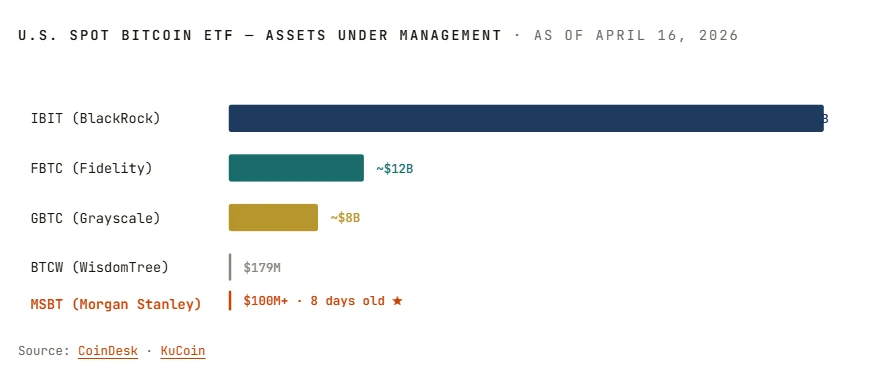
The U.S. Bitcoin ETF market is now a $56.5 billion category. IBIT dominates with $53 billion. Fidelity’s FBTC, VanEck’s HODL, and Grayscale’s products hold the rest. MSBT enters from behind, but with structural advantages that no competitor can copy.
Fee competition is intensifying. WisdomTree’s BTCW holds $179.3 million at 0.25%. MSBT undercuts it immediately. Goldman Sachs has filed for a Bitcoin Premium Income ETF using a covered-call strategy, with an expected launch as early as mid-2026. The product landscape is broadening fast.
In its first week, MSBT attracted $37.5 million in net inflows. Total AUM reached approximately $100 million by April 16. The fund holds around 960 BTC. Its market price trades at a 0.57% premium to NAV. Rolling 30-day net flows for the broader Bitcoin ETF market have exceeded 30,000 BTC, confirming sustained institutional demand.
What Comes Next
MSBT is one piece of a much larger strategy. Morgan Stanley has also filed for Ethereum and Solana ETFs. It launched direct spot crypto trading via E*Trade for BTC, ETH, and SOL. It is exploring an OCC trust charter for custody and staking services.
Whether MSBT can challenge IBIT’s liquidity lead remains the key question. AUM momentum, advisor adoption speed, and consistent inflows will define the answer. The primary risk is narrow: the 0.11% fee advantage may be too slim to overcome IBIT’s two-year liquidity lead and brand dominance. But Morgan Stanley’s distribution machine has no peer in the ETF industry. The era of bank-backed Bitcoin ETFs has officially begun.




