

May 06, 2026 – Meta taps Wall Street’s biggest banks to fund a 1-gigawatt Texas campus. The deal resets the ceiling for single-site AI infrastructure financing and raises new questions about Big Tech’s debt-fuelled buildout.
In Summary
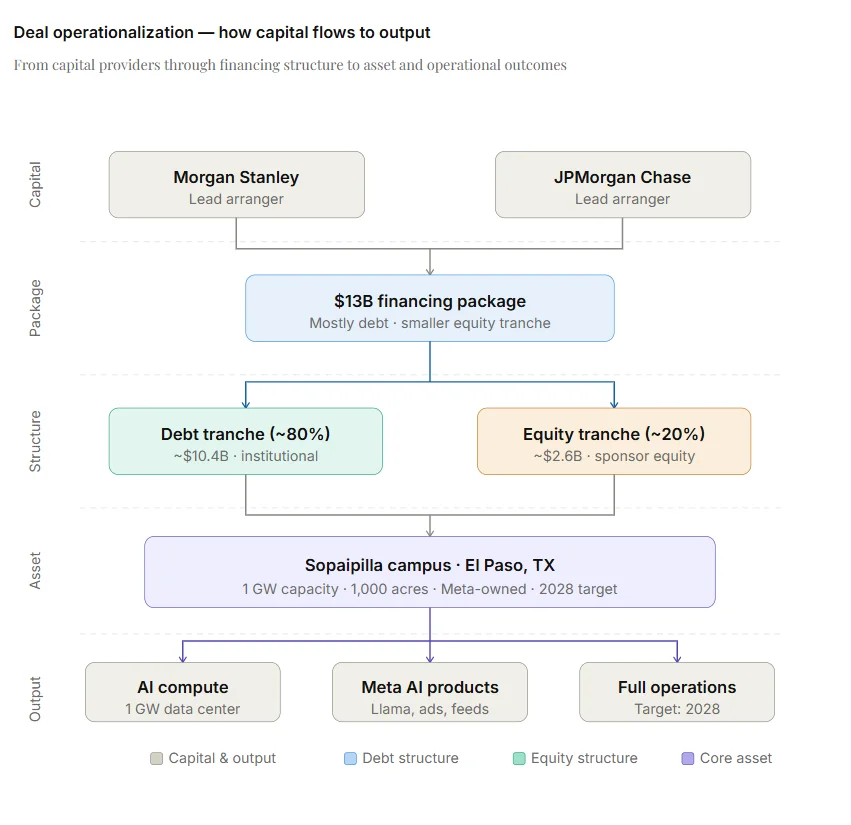
Meta is assembling a ~$13 billion financing package for an El Paso, TX AI data center
Morgan Stanley and JPMorgan Chase are leading the deal as co-arrangers
Financing is mostly debt; targets 1 GW capacity on a 1,000-acre campus
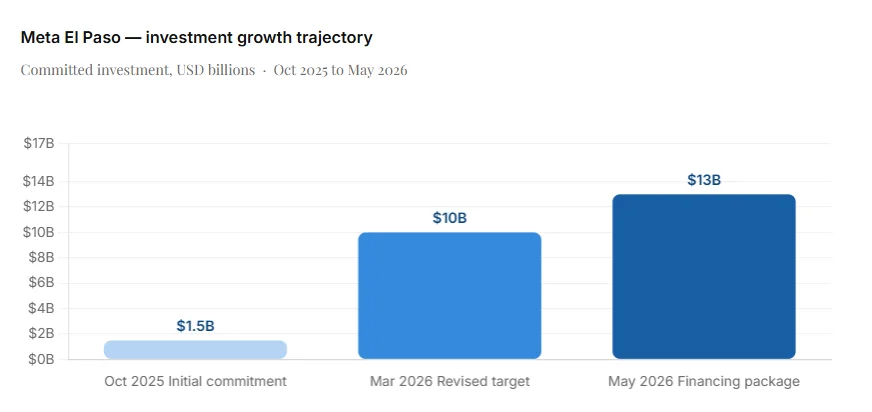
Meta’s El Paso commitment grew 8x in six months, from $1.5B to over $10B
Meta raised its 2026 capex guidance to $125-$145 billion in Q1 earnings
Meta Platforms is making its largest infrastructure bet yet in Texas. The social media giant is assembling a $13 billion financing package for a new AI data center in El Paso. Morgan Stanley and JPMorgan Chase are leading the deal. The announcement, first reported by Bloomberg, signals a new phase in Big Tech’s AI arms race.
Deal structure
Most of the financing will come in the form of debt. A smaller equity slice rounds out the package. This mirrors how institutional capital funds large infrastructure assets. If completed at the reported size, it will rank among the largest single-site digital infrastructure financings in history.
The project, known as “Sopaipilla,” sits on a 1,000-acre campus. It targets one gigawatt of power capacity. That is enough electricity for roughly 750,000 homes. The aim is to open the facility in 2028.
A stunning investment escalation
Meta first committed $1.5 billion to El Paso in October 2025. By March 2026, that figure surpassed $10 billion. That is a more than sixfold jump in five months. The new $13 billion financing package adds yet another layer. In six months, the project has grown by more than 8x in scale. Few infrastructure projects scale at such a pace.
This pace reflects Meta’s urgent need for compute. CFO Susan Li has been explicit. Meta will remain compute-constrained through much of 2026. Capital decisions are driven by that pressure, not long-term caution.
Why El Paso?
El Paso offers strong incentives. Local authorities approved property tax abatements worth up to $110 million. Texas operates a deregulated energy market. That gives Meta more flexibility in sourcing power at scale.
But the project faces real opposition. Environmental groups have raised air quality concerns. A one-gigawatt facility places significant demand on local power and water systems. Meta will need to navigate these challenges as construction advances.
El Paso vs. Hyperion: two financing models
The El Paso deal is structurally different from Meta’s Louisiana project. In Louisiana, Meta partnered with Blue Owl Capital in a $27 billion joint venture called Hyperion. Blue Owl holds 80%. Meta retains 20% through a special purpose vehicle.
El Paso is mostly straight debt. Meta will hold more direct ownership of the asset. That gives it greater long-term control and greater balance-sheet exposure.
Meta’s historic capex surge
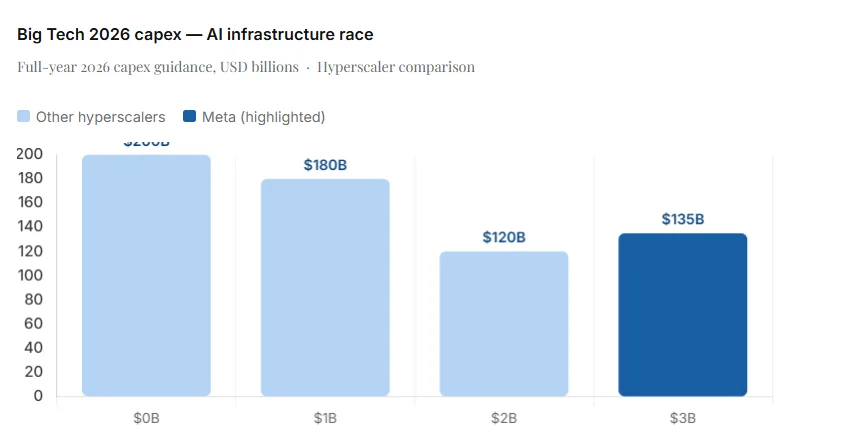
Meta raised its full-year 2026 capex guidance to $125-$145 billion after its Q1 earnings report. That is up from a prior range of $115-$135 billion. It is nearly double the $72.2 billion Meta spent in all of 2025. Mark Zuckerberg has pledged over $600 billion in U.S. investment by 2028. The majority targets AI data centers. The company has also committed to building tens of gigawatts of capacity this decade.
Big Tech as a whole is spending at unprecedented levels. The four largest hyperscalers plan to invest up to $725 billion in AI infrastructure in 2026. Amazon leads at $200 billion. Alphabet follows at $175-$185 billion. Microsoft targets $120 billion or more. Meta’s revised guidance places it fourth. But with a crucial difference: unlike its rivals, Meta operates no public cloud business. Every dollar goes to internal AI products.
Wall Street’s ROI anxiety
“It raises the question about what is the real ROI on all this capex being spent.” S&P Global Visible Alpha, on Meta’s Q1 2026 earnings call
Investors are not fully convinced. After Meta raised its capex guidance, shares fell more than 6% in after-hours trading. The concern is simple: spending is growing faster than visible revenue gains. Analysts want to see AI investment translate into measurable returns.
Zuckerberg addressed this on the earnings call. He cited improved ad targeting and AI-powered first-principles content understanding. “Every sign we’re seeing gives us confidence,” he said. But the ROI timeline remains unclear to markets for now.
Debt as the new normal for AI
The El Paso deal reflects a broader structural shift. Big Tech is increasingly turning to institutional debt markets to fund AI infrastructure. Meta is not alone. Structured financing against long-term asset leases is becoming standard practice across the industry.
The fact that Morgan Stanley and JPMorgan can arrange $13 billion against a single site says something important. Institutional lenders believe in AI infrastructure as a credit asset. If closed, this deal will set a new benchmark for single-site financings globally.
What comes next
Meta is building on many fronts simultaneously. The company has signed a $10 billion cloud deal with Google and a $14.2 billion agreement with CoreWeave. Talks with Oracle for an estimated $20 billion deal are reportedly ongoing.
El Paso is one tile in a vast mosaic. But at $13 billion, it is the tile that resets the record.




