

May 30, 2026 – A new House bill could block Mercedes-Benz from the entire US market. Chinese shareholders hold nearly 20% of the German automaker. The economic fallout for American workers could be enormous.
In Summary
The Motor Vehicle Modernization Act of 2026 may bar Mercedes-Benz from all US sales and manufacturing.
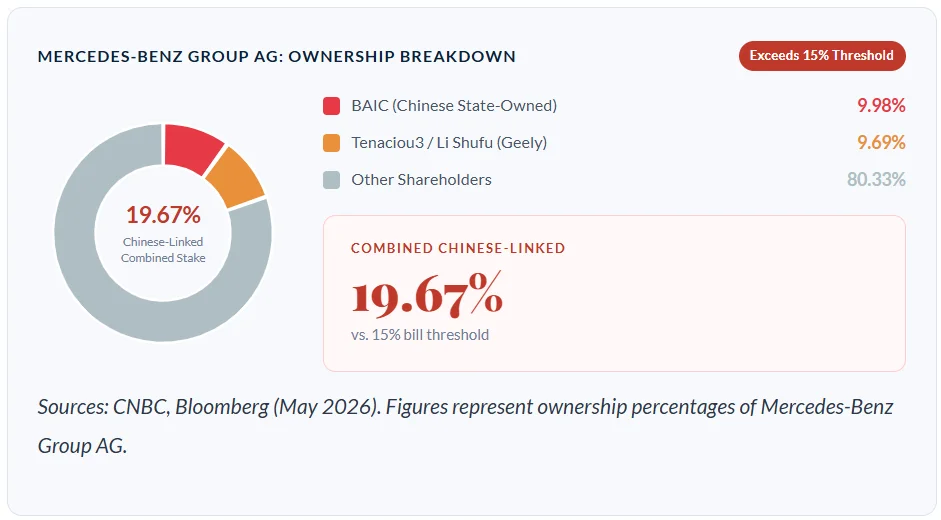
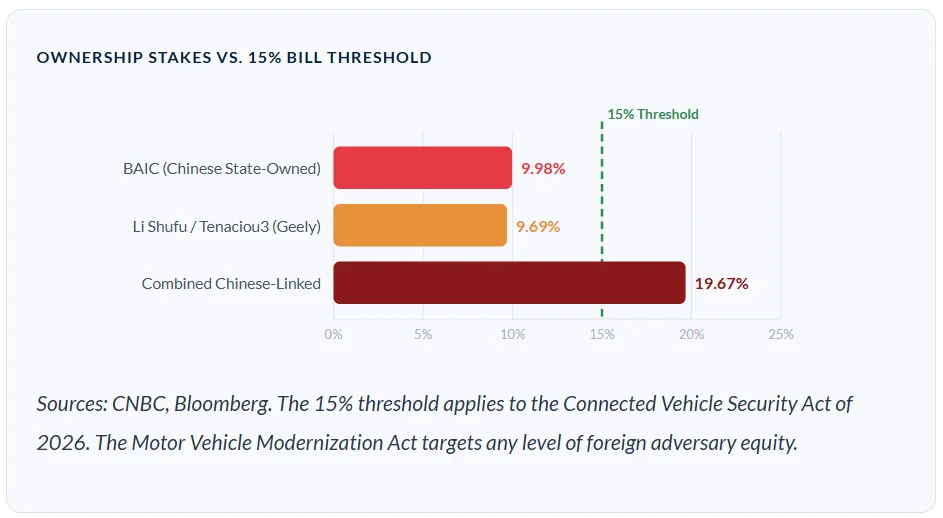
Chinese state-owned BAIC holds 9.98% of Mercedes-Benz Group AG. Li Shufu of Geely holds another 9.69%.
Their combined 19.67% stake triggers bans under the parallel Connected Vehicle Security Act of 2026.
Mercedes sold 374,100 vehicles in the US in 2024, making it the brand’s second-largest market.
The Tuscaloosa, Alabama plant supports over 57,000 jobs and carries an annual economic impact of $1.5 billion.
A new House bill now threatens to remove Mercedes-Benz from the US market entirely. The Motor Vehicle Modernization Act of 2026 targets automakers with Chinese government ownership. Under the legislation, Mercedes could face a five-year ban on US vehicle sales and manufacturing. This outcome was previously unreported, according to CNBC.
Why Mercedes Is at Risk
Mercedes-Benz Group AG has two significant Chinese-linked shareholders. BAIC, formerly the Beijing Automotive Industrial Corp., is a Chinese state-owned enterprise. According to CNBC, BAIC holds a 9.98% stake in Mercedes-Benz Group AG. In addition, Geely founder Li Shufu holds 9.69% through his Tenaciou3 Prospect Investment firm.
Together, these two entities control 19.67% of Mercedes-Benz Group AG shares. Critically, BAIC is not a private investor. It is a state-backed enterprise directly linked to Beijing. Mercedes-Benz Group AG is the parent company for the automaker, its brands, and its financial services division. No other major German automaker carries this level of Chinese government ownership exposure.
What the Bill Actually Says
House Energy and Commerce Committee Chairman Brett Guthrie (R-KY) sponsors the legislation. It would bar any automaker in which a foreign adversary government holds an equity interest. China, Russia, and North Korea are all classified as foreign adversaries under the bill. A covered company could not import, sell, manufacture, or deliver vehicles in the US for five years.
The bill currently remains a House-only initiative. No Senate companion bill exists yet. However, bipartisan support is growing for tighter restrictions on the auto sector. Democratic Sen. Elissa Slotkin and Republican Sen. Bernie Moreno have introduced a parallel Senate measure. Both senators represent traditional auto-producing strongholds: Michigan and Ohio, respectively.
Furthermore, the legislation builds on existing Commerce Department rules. Those rules ban connected vehicle software from adversary nations starting with the 2027 model year. Hardware restrictions from those nations follow in 2030. The Motor Vehicle Modernization Act goes further by directly targeting ownership structures.
Critical Finding
Two sources with knowledge of the bill told CNBC that Mercedes would face a ban in its current form. A former automotive policy advisor described the language as “unambiguous.” The manufacturing exemption in the bill is automatically voided if any foreign adversary holds equity.
The US Economic Stakes
The economic consequences of a ban would be severe and far-reaching. In 2024, Mercedes-Benz sold 324,500 passenger cars and 49,600 vans in the United States. The US is the brand’s second-largest global market, behind China.
Mercedes has invested over $7 billion in its Tuscaloosa, Alabama, plant alone. According to Autos Drive America, the facility produced approximately 260,000 vehicles in 2024. Two-thirds of that output was exported globally. This makes the plant one of the largest automotive exporters in the United States.
The Tuscaloosa plant directly and indirectly supports over 57,000 jobs in the region. Nationally, Mercedes operations sustain over 163,000 jobs across 385 dealerships and 24 corporate locations. Therefore, removing the brand from the market would ripple through Alabama’s entire supply chain.

Industry Reaction
Industry groups broadly support stricter national security rules in the auto sector. However, many warn that sweeping ownership restrictions may produce unintended consequences. John Bozzella, CEO of the Alliance for Automotive Innovation, wrote directly to lawmakers about the bill. He acknowledged “substantial progress” but stressed that “details matter.”
Autos Drive America also backed the legislation’s overall direction. Nevertheless, it cautioned lawmakers against disrupting established US manufacturers. Stephen Ezell of the Information Technology and Innovation Foundation told CNBC his key assessment. He said including Mercedes in the ban “would be an unintended consequence”, causing significant job losses.
Exemptions and Legal Ambiguity
The bill includes a narrow potential exemption for long-established manufacturers. Companies with at least 5 years of US passenger-vehicle production before January 1, 2026, may qualify. Mercedes has operated its Alabama plant since 1997, producing over 4.5 million vehicles to date. However, the exemption is immediately voided if a foreign adversary government holds any equity stake. This is the precise clause that directly implicates Mercedes.
Who Else Is at Risk?
Other automakers with ties to China also face potential restrictions under this legislation. Volvo, Lotus, Faraday Future, and Karma Automotive all have notable ties to Chinese ownership. However, the Commerce Department disconnected the vehicle ban. Volvo’s majority owner is Geely, but its South Carolina manufacturing presence helped secure the carve-out. The broader policy direction is tightening. Only the scope of the tightening remains uncertain.
What Happens Next
The bill remains far from becoming law in its current form. It must still pass the full House and then clear the Senate. Lawmakers may incorporate it into a broader transportation package, in which the language could shift significantly. German government officials and Mercedes executives are actively engaging US policymakers to protect the brand.
In May 2025, Mercedes pledged an additional $4 billion investment in its Alabama plant through 2030. The company is also shifting GLC SUV production from Germany to Tuscaloosa. These moves underscore how deeply invested Mercedes is in its American operations. Consequently, the stakes for both the brand and the US economy are rising simultaneously.
The Motor Vehicle Modernization Act of 2026 tests the limits of modern trade policy. A German luxury brand with a century of US history now faces uncertainty due to its shareholder base. Thus, policymakers must weigh national security goals against the real cost of disrupting US manufacturing. The decisions made in the coming months could reshape the American auto market for years.